Enterprise AI Security

Pluto Team
Mar 30, 2026・
7 min read
One of the key developments in Artificial Intelligence is that it is no longer confined to data science and application development teams. Across modern enterprises and in various individual departments, AI now generates code, automates workflows, and orchestrates business processes. While this velocity is unprecedented and beneficial for productivity, it has also increased risk exposure. Enterprise AI security has therefore emerged as a formal discipline designed to govern AI across the organization. This article articulates what enterprise AI security governance must look like in practice, where the gaps are emerging, and how organizations can build scalable control frameworks without stifling innovation.
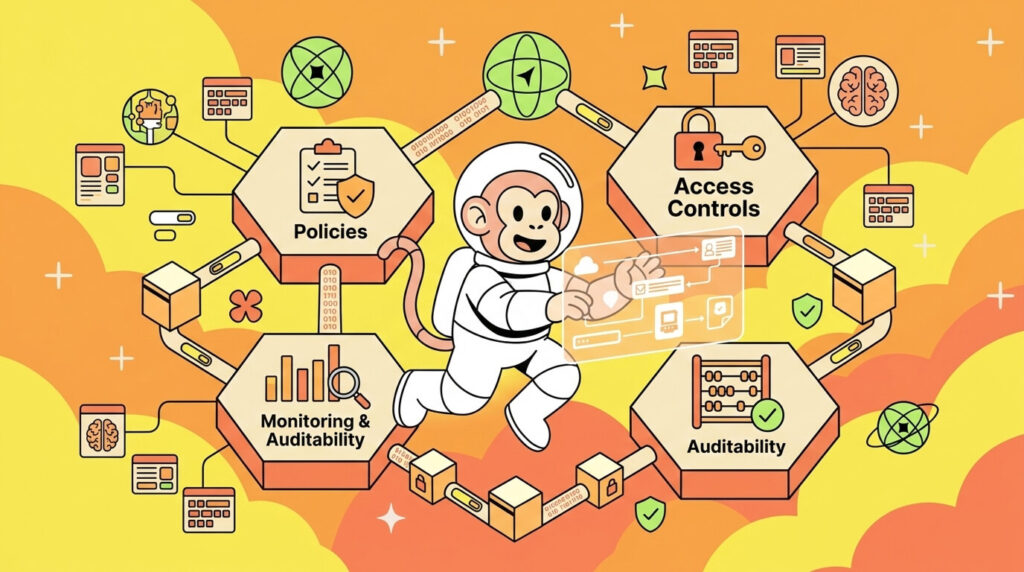
In operational terms, enterprise AI security can be viewed as consisting of four core domains, namely:
These are explained in more detail below:
AI-generated code: Security leaders should now accept that AI is part of the fabric of software development. AI agents can now write code autonomously while AI-assisted development tools generate large volumes of production code. Without governance:
AI agents with system-level permissions: AI agents typically operate with high levels of delegated authority in performing organizational activities. Unlike static applications, agents can initiate actions without explicit human triggers or intervention. This makes AI agent security a core pillar of enterprise risk management. Modern AI agents can now:
Embedded AI services: Embedded AI services within official business platforms can extend the existing enterprise AI security and governance approaches. This should go beyond traditional safety and bias controls. While ethical AI and bias mitigation remain critical, operational enterprise AI security governance practices should be designed to address the following elements:
Model and data lifecycle governance: Given the scale of risks associated with AI and related data, enterprise AI security governance requires structural controls, not just advisory policies. This helps ensure the existence of a robust AI security environment across an enterprise in terms of the following key elements:
Despite the current aggressive pace of AI adoption, most enterprises exhibit recurring governance gaps that security teams should be prepared to address. The first step is to identify the key gaps encountered in governing AI-driven development. Such gaps include:
Shadow AI applications: Most departments and individuals within enterprises frequently deploy internal AI applications or agents without centralized oversight. These systems can create governance gaps because there is no official inventory, preventing security teams from effectively enforcing security policies. The governance gaps arise as Shadow AI systems connect to sensitive databases, store embeddings of proprietary content, and share prompts across teams.
Unreviewed AI-generated code: AI-generated code may lack formal security reviews. This is because traditional security reviews focus solely on human-written logic. As AI-generated artefacts are rarely labeled and tracked, unreviewed AI-generated code can:
Prompt sprawl and sensitive context leakage: When AI prompts are reused across a variety of environments, they increase the risk of lateral propagation. This creates governance gaps as the prompts may include:
Inconsistent model update governance: External AI providers continuously update their models for performance and other reasons. Without change management and visibility, governance gaps may arise as output behavior shifts. As a result, the regulatory posture may be affected as security assumptions become invalid.
For security leaders and their teams, scaling enterprise AI security requires layered, systemic processes aligned with existing enterprise AI security governance frameworks. The best approach is to adapt the framework to AI-specific dynamics as follows.
Establish centralized AI asset visibility: Create an enterprise registry or inventory of AI assets across the entire organization. This is usually the first step, and such an inventory should cover the following items for effective governance:
Integrate AI Controls into the SDLC: Update all DevSecOps pipelines across the enterprise to include the following security aspects:
Formalize AI Agent identity and access controls: To enhance security across access and authentication processes and for effective AI agent security, security teams should ensure that they configure the following controls:
Implement AI behavior monitoring: Because AI systems are probabilistic in their operations, runtime monitoring becomes essential. Security teams should therefore continuously monitor AI behaviors such as:
Define governance guardrails: An enterprise’s AI security best practices should be designed to ensure that security does not become an innovation blocker across departments. Instead, the following should be implemented:
Most security teams often feel reactive in the face of AI velocity and are unable to cope with the pace of change and its related risks. Regaining control requires deliberate, strategic shifts, often spearheaded by CISOs, that encompass the following.
Move from tooling to policy architecture: Security teams should recognize that AI risk is typically not solved through point solutions. Instead, they should move toward developing the entire security architecture. This means they should:
Embed AI security champions in engineering: Traditional security gatekeeping slows innovation within the enterprise. Instead, the following should be implemented for a better posture:
Align AI governance with regulatory requirements: Enterprise AI security governance must anticipate evolving compliance requirements. This helps avoid a tendency to be reactive as regulatory frameworks emerge. Better alignment with regulatory requirements often leads to improved model transparency, stronger data lineage, and improved decision explainability
Implement continuous risk assessments: AI systems evolve rapidly; hence, continuous risk assessment is key. In terms of enterprise AI security best practices, governance cannot be static, and security leaders should:
What is enterprise AI security?
Enterprise AI security refers to the processes involved in the governance, protection, and monitoring of AI-built applications, AI-generated code, and AI agents. It also encompasses model integrations that are performed and reside within enterprise environments. Its main role is to ensure that AI systems operate securely, align with organizational security controls, and do not introduce operational risks.
Why are AI-built applications difficult to govern at scale?
AI-built applications are difficult to govern because they typically evolve rapidly before controls can be put in place. They also reuse prompts and models across teams and often operate autonomously. While traditional application governance assumes deterministic logic and clear ownership, AI introduces probabilistic behavior in its operations. This often leads to blurred accountability boundaries, causing governance challenges.
How do AI agents introduce new security challenges?
AI agents can autonomously access APIs within enterprise environments. They can therefore trigger workflows and retrieve sensitive data. Unlike conventional applications, AI agents can dynamically interpret inputs and take actions without requiring explicit human execution. This eventually expands the attack surface, increasing the risk of privilege misuse across the organization. This often demands stronger identity, logging, and runtime-monitoring controls.
What role does governance play in enterprise AI security?
Governance provides structured oversight across AI operations within an enterprise. It assists in defining security aspects such as acceptable AI usage patterns, authentication and identity controls, logging standards, and risk classification tiers. Without effective governance in place, AI deployments increasingly become fragmented and inconsistent. This tends to undermine the overall security posture and regulatory alignment across the enterprise.
How can organizations secure AI development without slowing innovation?
Organizations can secure AI development without slowing innovation progress in several ways, including embedding security controls directly into DevSecOps pipelines and providing approved AI architecture patterns. They can also implement resilient security controls, such as enforcing least privilege for agents and offering reusable secure prompt templates. Deploying guardrails, automation, and shared frameworks also enables innovation while maintaining consistent security standards.
Enterprise adoption of AI is accelerating within organizations faster than most governance frameworks can keep pace with. AI has reached a stage where it is no longer experimental. It is now writing complete code, executing workflows, and making enterprise decisions at scale. Security leaders should match the pace and evolve from reactive oversight to proactive architectural governance. By treating enterprise AI not as optional infrastructure but as foundational governance, and by implementing the best practices set out in this article, organizations can scale intelligence and innovation without a corresponding increase in risk.