The Real Value of Agentless Monitoring: Continuous Visibility Without Friction
Pluto Team
Jan 22, 2026・
6 min read
If you’ve worked in cloud security (SOC) and cloud infrastructure long enough, you’ve undoubtedly encountered the agent sprawl issue, also known as agent fatigue, where it can be very taxing to deploy agents across hundreds or thousands of workloads and to maintain, update, and troubleshoot downtime. This is where agentless security monitoring comes into play, and to be honest, it’s time we have this discussion.
Agent-based and agentless monitoring debated depth versus breadth in the days of static data centers. However, the agent-first architecture is now a liability because ephemeral workloads (containers, serverless, and transient virtual machines) now form the foundation of the organization.
The agentless approach has come a long way, and we are now seeing tech teams jumping on the bandwagon and adopting it as part of their security posture. By doing so, they are reaping significant benefits by gaining visibility and saving DevOps teams time and maintenance costs.
Why Agentless Monitoring Matters for Modern Cloud Environments
Here’s the thing about modern cloud infrastructure: it’s temporary, spread out everywhere, and honestly, kind of a mess. Containers pop up and disappear in seconds, and serverless functions execute and disappear. On the other hand, traditional agent-based monitoring just wasn’t built for this world. Agents require installation, configuration, and ongoing maintenance for every asset you want to monitor. In a static datacenter environment from 2010? Sure, that was manageable. In today’s multi-cloud, Kubernetes-heavy landscape? Good luck keeping up.
The Architectural Evolution of Cloud Visibility
We got to the point where we are today because of some shortcomings of the traditional model:
Scalability issues: Suppose you had 5,000 agents and had to troubleshoot an unknown issue; you would have to check each of the 5,000 instances for the bug. This is unrealistic.
The “un-agentable” stack: Because it is impossible to install an agent on managed services such as AWS S3, RDS, or Google Cloud Functions, you are generally left with invisible traditional security layers.
Resource Taxation: Every agent sips (or sometimes gulps) CPU and RAM. In a microservices architecture, this can bloat your cloud bill and also degrade application performance.
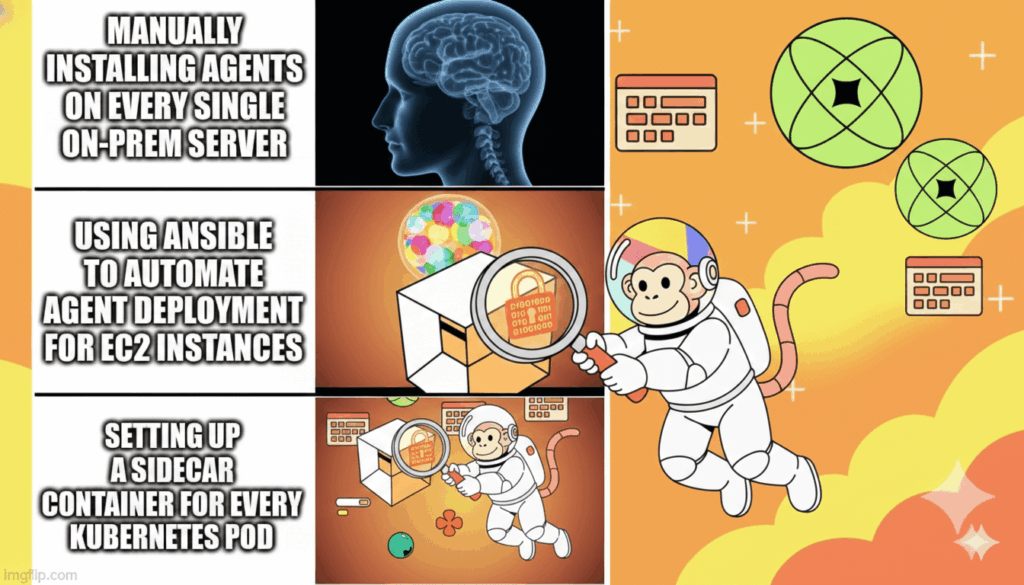
A Security Architect trying to manage 5,000 individual agents across three different cloud providers.
While the meme above is funny, the reality of traditional maintenance windows is a leading cause of burnout for engineers. To address these challenges, we consider adopting an agentless approach.
Key Benefits of the Agentless Model
Nowadays, agentless monitoring agentless monitoring tools communicate via their cloud provider APIs, eliminating the need for per-host instrumentation, which has numerous advantages. Here are some of the practical benefits that we have witnessed teams gain from this change:
No overhead in performance: Agents consume significant CPU, RAM, and storage resources. However, even a 2–3% cost may not be acceptable in performance-sensitive settings, such as trading or analytics platforms. Since nothing is actually running on your systems, the agentless approach eliminates this worry. Monitoring is performed via API calls.
Rapid coverage and deployment: With agentless monitoring solutions, we’ve seen companies achieve full visibility into their environments without relying on traditional techniques such as deployment scripts or even Ansible playbooks.
Reduced attack surface: With every installed agent, you risk introducing vulnerabilities into your environment. The agentless model reduces your attack surface by removing such risk from your production environment.
That moment a CISO realizes they can get 100% visibility without asking the DevOps team for a maintenance window.
Simplified management and maintenance: Consider agent lifecycle management. It’s wild —updates, patches, deprecations, incompatibilities with new OS versions, etc. Updates under the agentless approach occur on the monitoring platform, which your vendor often runs.
Improved coverage for serverless and ephemeral workloads: 30-second containers don’t give a damn about your agent installation procedure. Lambda functions run and then disappear. Because the agentless approach reads from the cloud control plane, which already logs all this activit, it automatically captures these transient resources.
Common Use Cases for the Agentless Approach
Now, where does the agentless model really shine? Here are some situations where we have observed it having the greatest effect:
Currently, the most evident use case is arguably Cloud Security Posture Management (CSPM). When it comes to regularly evaluating your cloud setups against security benchmarks, such as CIS, NIST, your internal regulations, etc., the agentless paradigm excels. By searching cloud APIs, it may identify publicly accessible S3 buckets, overly permissive security groups, or IAM roles with excessive privileges — all without the need for agents.
Compliance and audit readiness: When auditors show up, they want proof. Continuous compliance reporting, which displays the condition of your environment at any given time, can be provided by agentless platforms. Do you need to demonstrate that you have no unencrypted databases over the previous quarter? The information is already available. Really awesome!
Visibility over multiple clouds: Managing various agents for each platform can be a nightmare if, like everyone else, you run workloads across AWS, Azure, and GCP. Agentless models usually provide visibility by supporting multiple cloud providers via their respective APIs.
Asset discovery and inventory management: Identifying your assets is the first step toward protecting them. The agentless method offers real-time, automated asset discovery. That covert IT issue where developers are creating resources that you are unaware of? Resolved. Everything related to your cloud accounts will be visible to you.
Synthetic monitoring: Without the need for agents, agentless synthetic monitoring can be conducted from external sites to monitor application availability and performance. This is very helpful for tracking user experiences from various geographical regions.
How to Implement Agentless Monitoring in Your Organization
Now that we understand the concept, how do we implement it in the environment to avoid unnecessary chaos and conflict with compliance teams while recognizing that agentless deployment can happen quite quickly? We would not want compliance issues. Here are some pointers:
Begin with a pilot project: Start coverage within your environment with a narrowly defined scope rather than targeting the entire environment at once. Doing this allows you to understand the data you’ll collect, adjust your alerting criteria, and demonstrate value before launch.
Set up your monitoring objectives: You need to know what you want to achieve, because the agentless monitoring software you will need will depend on your goals. Conformity? Threat identification? Asset management? You will have to decide.
Take care when handling permissions: This method requires permissions to access your cloud environments via the API. Give the monitoring platform only the read rights it needs, adhering to the principle of least privilege. The majority of vendors will give you Terraform modules or CloudFormation templates that properly configure this.
Integrate with your current stack: You shouldn’t use your monitoring platform as a stand-alone solution. Connect it to your ticketing system, SIEM, and Slack channels (where your security team actually works).
Create useful alerts: Many solutions fail at this point. Untuned alerting rules that come out of the box will drown you out. Spend some time adjusting notifications according to your risk tolerance and surroundings. For example, a production database with default credentials is essential, while a publicly accessible development S3 bucket is a lower priority.
Establish a consistent review cadence: This approach will highlight problems you may not have been aware of. To assess outcomes, update policy, and monitor progress, set up regular evaluations, such as weekly initially, then monthly, etc.
Create a scaling plan: If you’re currently monitoring fifty resources, that’s great, but remember that tech environments are meant to be scaled. As your environment grows, you need a platform that not only scales upward but also handles bandwidth and provides proper visibility.
FAQ
How quickly can organizations deploy agentless monitoring across their cloud environments?
Usually, deployment happens quickly– often in a matter of hours. Most monitoring tools can start scanning and inventorying resources right away as you’ve verified your cloud accounts and been given the required API access. The number of cloud accounts and the complexity of your environment will determine the actual duration. Still, there is no lengthy deployment process, unlike agent-based systems that require per-host installation. In a day or two, most businesses achieve complete visibility across their cloud footprint.
In what ways does agentless monitoring reduce performance impact compared to agent-based solutions?
Since the agentless approach does not run on your workload, the guarantee of no overhead is ensured. This is made possible because, unlike the traditional approach, data is not gathered using resources but via API requests and queries. You can imagine how much relief this provides for performance-critical and real-time processing systems. Teams, therefore, spend time on important tasks rather than worrying about application performance.
What types of data and cloud services are typically covered by agentless monitoring platforms?
Agentless platforms span a wide range of cloud services through API interfaces. Examples include compute instances (e.g., VMs and containers), databases (e.g., RDS and Cosmos DB), storage (e.g., S3 and Blob Storage), networking configuration (e.g., VPCs, security groups, load balancers, etc.), IAM policies, serverless services, Kubernetes clusters, and more. The data collected includes resource configurations, network architecture, access controls, compliance posture, and pretty much anything your cloud provider makes public via APIs.
How does agentless monitoring integrate with existing security tools and alert systems?
When creating modern monitoring solutions, integrations are crucial. These will usually come with connectors that nicely integrate with SIEM solutions, security orchestration platforms, and ticketing systems. We have seen support for webhook notifications made possible, REST APIs, and even protocols like syslog.
Can agentless monitoring effectively scale to cover multi-cloud and hybrid infrastructures?
Of course. In fact, one of the main advantages of this paradigm is its scalability. Scaling to thousands of resources across several cloud providers is relatively simple because monitoring is handled via API calls rather than per-host installations. Most platforms support AWS, Azure, GCP, Oracle Cloud, and even Alibaba Cloud natively through unified dashboards. However, hybrid settings can call for a hybrid strategy, with potential agents or network sensors for on-premises assets and agentless for cloud services.
In contemporary business settings, browser extensions have emerged as one of the most overlooked attack vectors. Under the glossy symbols and five-star ratings, there is…
Inside Claude Cowork: How Anthropic’s Autonomous Agent Actually Works
We reverse-engineered the security architecture of Claude’s autonomous desktop agent. Here’s what we found. Computer use agents represent a new class of AI capability: systems…
Another Day, Another Supply Chain Compromise: Here’s What We Know About the Axios Incident
A maintainer account takeover, a cross-platform RAT, and a payload designed to vanish – inside the axios npm compromise and why network-level detection matters more…