
Credential rotation is one of those security habits that feels tedious until the day it saves you. In modern enterprises, secrets such as API keys, database passwords, and SMTP credentials often persist in applications, pipelines, and clusters for months, or even years. That creates a long, quiet window for attackers if anything leaks. This article breaks down what credential rotation is, why it matters, and how to automate it safely at scale.
What Is Credential Rotation?
Credential rotation means changing your passwords regularly, either on a predictable schedule or in response to specific events. Credential rotation primarily focuses on the time window during which others can use secret information.
Credentials worth rotating include:
- Cloud access keys and API keys.
- Database usernames and passwords.
- SMTP credentials used for outbound email.
- Kubernetes secrets and service account-related keys or tokens.
- Third-party SaaS tokens and webhooks that embed secrets.
Rotation is not only about changing the secret. It also includes updating the systems that use it, revoking the old value, and verifying that everything still works.
Why Credential Rotation Matters for Enterprise Security
Secrets leak in boring ways. A debug log is shipped to the wrong place. A developer pastes a token into a ticket. A build system exposes environment variables. Rotation helps because even if a secret leaks, it expires sooner as a useful asset.
Rotation also reduces blast radius during incident response. If you already have a rotation pipeline, the team can rotate quickly and consistently rather than scrambling across multiple systems.
One nuance: guidance on human password rotation has evolved. Modern guidance discourages forced password changes on a fixed schedule unless a compromise is suspected, as such changes can backfire and result in weaker passwords. That does not eliminate the need to rotate non-human credentials, such as keys, tokens, and service secrets.
How Automated Credential Rotation Works
Automated rotation replaces a mostly manual, error-prone checklist with a repeatable, testable workflow.
A common pattern looks like this:
- Generate a new secret value in a secrets manager or vault.
- Update the target system to accept the new value; for example, by creating a new cloud access key.
- Update dependent apps via secure delivery, such as sidecar injection or dynamic runtime retrieval.
- Validate using health checks and real requests, not just a “deployment succeeded” signal.
- Revoke the old value after a safe overlap period.
In AWS, a documented method for rotating IAM access keys at scale uses AWS Organizations and AWS Secrets Manager.
In Kubernetes environments, automated credential rotation solutions often combine a secrets manager, a controller, and a workload delivery method to enable pods to consume updated secrets without manual redeployments.
A practical example is Amazon SES SMTP. SMTP credentials are derived from IAM access keys, and rotating them means rotating the underlying access keys and generating a new SMTP password for the SES SMTP interface.
Common Challenges in Credential Rotation Implementation
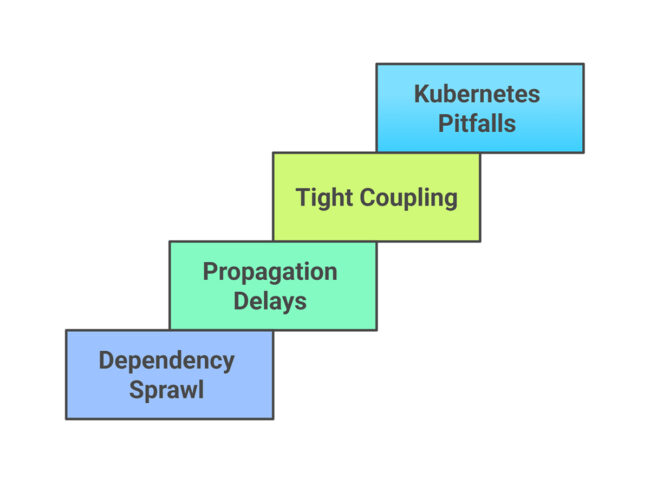
Rotation sounds easy until it touches production.
1. Dependency sprawl
One credential may be used by many services. If even one consumer is missed, you get an outage.
2. Propagation delays
Some systems cache credentials. If you revoke too quickly, you break traffic that still uses the old value.
3. Tight coupling to deployment
If your apps only read secrets at startup, you may need restarts or rolling deploys to pick up new values.
4. Kubernetes-specific pitfalls
Secrets are accessible to anyone with high privileges in the cluster, and some token or key rotation actions can affect availability depending on the control plane setup and the method used.
Best Practices for Rotating Credentials at Scale
1. Prefer short-lived credentials where possible
Temporary tokens reduce reliance on long-lived static secrets. Rotate what remains.
Classify and tier credentials
- Tier 1: Internet-exposed and high-privilege credentials; rotate most often
- Tier 2: Internal service to service credentials
- Tier 3: Low-impact credentials with limited scope
2. Use overlap with automated validation
Keep the old and new validations brief. Validate with real calls, then revoke.
3. Centralize secrets, decentralize access
Store secrets in a central system but grant each workload only what it needs. Avoid copying secrets across repos and pipelines.
4. Make SES SMTP rotation a first-class runbook
SES SMTP credentials are region-specific, and the SMTP password is different from the AWS secret access key. Automate the steps and treat the rotation like any other production change.
FAQs
1. What is the difference between manual and automated credential rotation?
In manual rotation, people are responsible for creating new secrets, updating applications, and canceling old values. It often fails at scale because some steps are missed. Automated rotation uses a defined workflow to generate, distribute, validate, and revoke credentials, often integrating with a secrets manager and including deployment checks.
2. How often should credentials be rotated in enterprise environments?
There is no single number that fits every secret. Rotate based on risk, privilege, exposure, and operational impact. High-privilege keys and internet-facing service credentials should be rotated more frequently than low-risk internal tokens. Also, rotate immediately after a suspected compromise or when staff access changes.
3. Can credential rotation cause service downtime?
Yes, if consumers do not adopt the new value or if the old value is revoked too soon. Avoid downtime with a short overlap window, automated validation, and a rollback plan. In Kubernetes, consider how secrets are mounted and refreshed, and whether your app can reload without a restart.
4. What types of credentials should be rotated most frequently?
Prioritize credentials that grant broad access or are difficult to monitor, such as cloud access keys, third-party API tokens with write permissions, database admin passwords, and SMTP credentials for outbound email. Also, prioritize credentials used by CI pipelines, since these environments often interact with many systems.
5. How does credential rotation support compliance requirements?
Rotation supports auditability and reduces the risk window for compromised secrets, aligning with common security control expectations across frameworks. Automated rotation provides logs, consistent execution, and evidence that old credentials are revoked, making it easier to prove that access is controlled, reviewed, and maintained over time.