We have some great news from this corner of the AI security universe.
Latio has released its 2026 AI Security Market Report, and Pluto is proud to be recognized as an Endpoint AI Security Leader.
Latio counts roughly 400 AI security startups today, with overlapping labels and very different technical approaches often presented as answers to the same problem.
The useful question for a security leader isn’t which logo sits in which box. It’s what you’re trying to secure, where you need control, and which approach actually fits how AI is being used inside your organization. Here’s how we’d read it.
- Start with the problem, not the category. Two teams asking for AI security may be trying to see and secure very different things.
- Understand what each control point can actually see and do. Different approaches bring different context, coverage, and enforcement tradeoffs.
- And yes, we’re celebrating. Latio recognized Pluto as an Endpoint AI Security Leader, highlighting its breadth, runtime capabilities, supply chain coverage, research, and support for AI app builders.
Okay, why should I read another AI security report?
Latio’s 2026 AI Security Market Report earns the read because it goes beyond the logos and looks at outcomes, and the tradeoffs buyers actually need to understand.
A lot of products are saying “AI security” while enforcing at different points and solving different parts of the problem, and the report gives security teams a way to get underneath the category language and ask better questions.
READ THE FULL LATIO REPORT
First question: what are you actually trying to secure?
Two security teams saying “we need AI security” may be describing completely different jobs. One is worried about an internal agent connected to production systems. Another is trying to understand workforce use of Claude Code. Another is looking at MCP servers and skills. And another has employees spinning up applications in tools like Lovable.
Before comparing vendors, define the surface you actually care about: who’s using AI, what those tools and agents can access, and who owns the risk created by what people build with them. That question is where our own idea of the AI workspace comes from: the tool itself is only one part of the surface security has to understand.
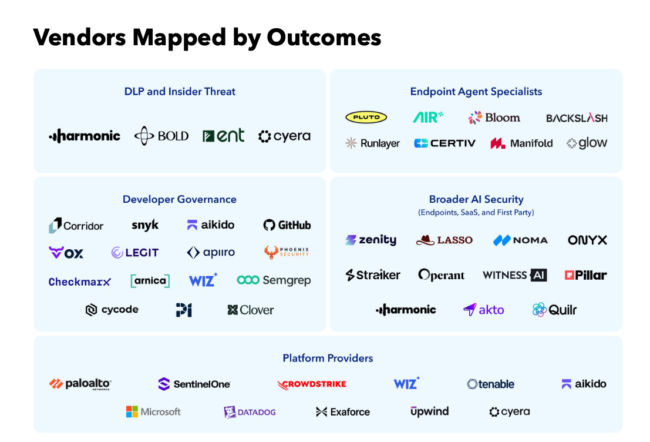
Source: Latio 2026 AI Security Market Report.
Second question: where should the control actually live?
Network. Endpoint. Hooks. Gateways. There’s no shortage of places to insert a security control. The more useful question is what that vantage point actually lets the product see and enforce.
Latio makes this point directly: different integration points carry different combinations of visibility, context, and coverage, and the report cautions there’s no single best one for AI security. So don’t ask which architecture sounds newest. Ask what it can see at the right time, what stays outside its field of view, and whether it can enforce without breaking the work.
Third question: are you buying today’s checklist or choosing a direction?
Feature matrices feel reassuring. AI has a habit of making them old fast. Latio’s report makes a related point well: finding the right partner depends more on whether its focus aligns with yours than on the exact feature list it supports today. That’s not buying a roadmap on faith. It’s asking what problem the company believes it’s solving, where it’s investing, and whether its architecture has somewhere to go as your program expands.
READ THE FULL LATIO REPORT
And yes, what did Latio say about Pluto?
We promised we’d come back to the good news. Latio recognized Pluto as an Endpoint AI Security Leader, a designation for vendors that demonstrated some of the most in-depth controls for AI on the endpoint that Latio evaluated, including permissions mapping and runtime controls for MCPs, skills, and intent-based tracking.
“Pluto has built a comprehensive AI security platform atop a strong foundation of endpoint security. Their enforcement and enablement capabilities across the endpoint extend from AI to broader software supply chain security, and their support for app builder tools like Lovable and Claude Code were among the strongest we saw, securing a growing blind-spot for security teams.”
— Latio, 2026 AI Security Market Report
That recognition matters to us because it reflects something we’ve been building Pluto around from the beginning: security teams shouldn’t have to choose between blocking innovation and embracing it blindly.
Pluto’s AI Workspace Security platform spans the tools people use, the supply chain around them, and the applications, agents, and automations they create. Our goal is clear: help security teams say yes to innovation without giving up visibility, context, or control.
Don’t take our word for it
The report goes deeper into the architectures, capability maps, and buyer’s guide than we’ve covered here. If AI security is anywhere on your 2026 agenda, put this one on the reading list.
READ THE FULL LATIO REPORT
Curious how Pluto approaches AI Workspace Security? See Pluto in action.