MCP Through an Attacker’s Eyes: The New Path Into Enterprise Environments
A working exploit for MCPfluence appeared on a cybercrime forum just 20 days after responsible disclosure. Pluto Research traces the attack path, examines similar exploitation patterns across MCP servers, and explains why third-party AI components are becoming a meaningful route into enterprise environments.
Twenty days after the patch for MCPwnfluence was released, a working exploit for the vulnerability appeared on a Russian-language cybercrime forum.
TL;DR
KELA brought to our attention a working MCPwnfluence exploit circulating on XSS.PRO, a Russian-language cybercrime forum.
MCPwnfluence chains two vulnerabilities in the popular mcp-atlassian server, allowing attacker-controlled content to be written to sensitive locations and leading to remote code execution.
The criminal PoC appeared 20 days after the patched version was released and only six days after the CVEs appeared on the NVD.
Similar activity involving nginx-ui and Flowise shows that attackers are actively targeting MCP servers and other third-party AI components as paths into enterprise environments.
As AI becomes embedded in everyday work, third-party AI components are becoming a significant attack vector, giving attackers new paths into enterprise environments.
This case is the latest chapter in Operation: MCP, our research into the security boundaries created when organizations connect AI agents to tools, data, and infrastructure. It centers on mcp-atlassian, one of the most popular MCP servers and the subject of our original MCPwnfluence research.
When we published that research, we had not observed active exploitation. KELA recently brought the criminal forum activity to our attention and collaborated with us as we reviewed the evidence. We thank their research team for the collaboration. Their full analysis examines the weaponization timeline in greater detail.
A quick recap: What is MCPwnfluence?
mcp-atlassian is a popular third-party MCP server that lets AI assistants work with Jira and Confluence. Through it, an agent can search pages, manage issues, upload attachments, download files, and perform other actions.
Our original research uncovered two vulnerabilities:
CVE-2026-27826 allowed an attacker to redirect the MCP server’s requests to a server they controlled.
CVE-2026-27825 allowed downloaded content to be written to an arbitrary location on the machine running the MCP server.
In affected network-accessible deployments, the MCP server also accepted requests without authentication. Chaining these conditions allowed an attacker to control both the content being downloaded and where it would be written.
That turned an AI integration into a path to remote code execution.
The full technical analysis, affected versions, and remediation instructions are available in our original MCPwnfluence disclosure.
From Patch to Cybercrime Forum in 20 Days
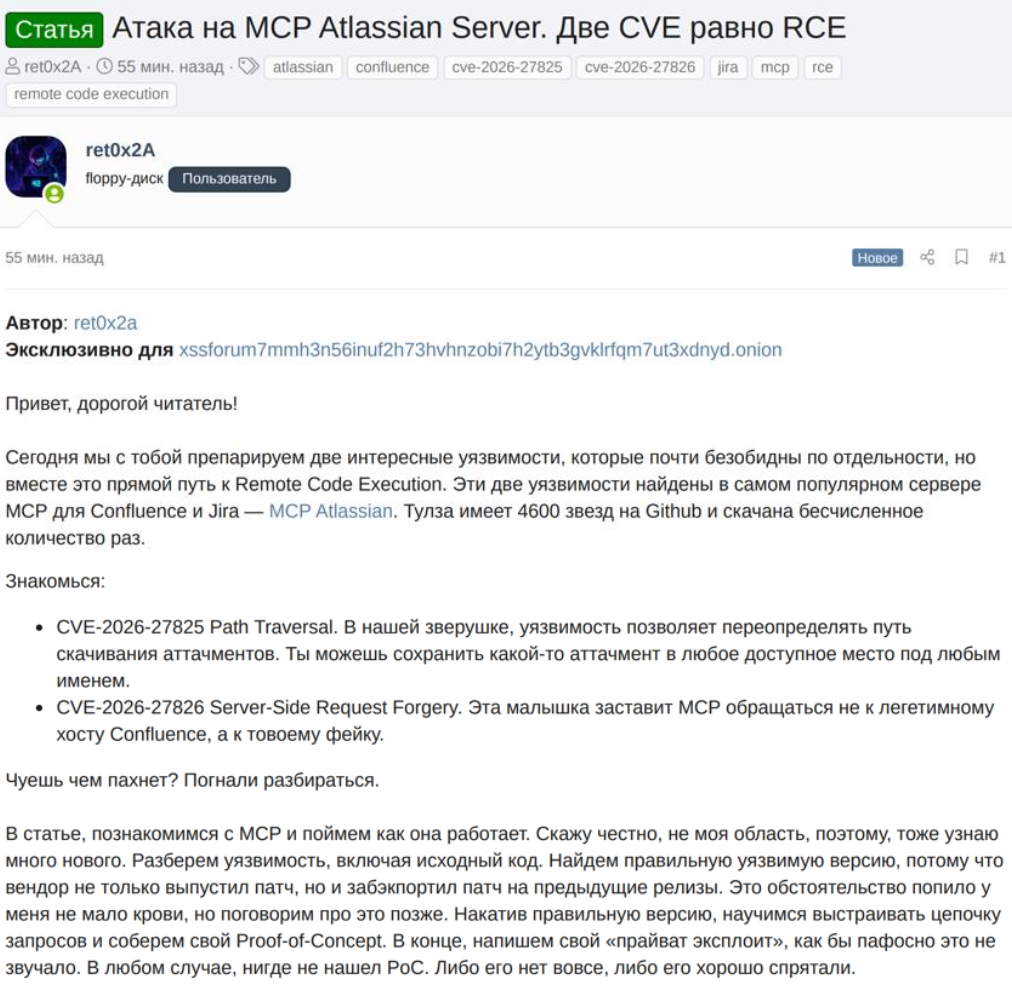
The forum post did more than discuss the vulnerabilities. It described a complete malicious request chain demonstrating how they could be combined from beginning to end.
The MCPwnfluence exploitation writeup identified on XSS.PRO by KELA researchers.
The flow shared on the forum was straightforward:
1Initialize an MCP session
The attacker connects to the MCP server over HTTP and obtains a valid MCP session ID.
2Redirect the Confluence connection
The attacker supplies a spoofed X-Atlassian-Confluence-Url header pointing to an HTTP server they control. In the demonstrated PoC, the value was:
X-Atlassian-Confluence-Url: http://127.0.0.1:9001
Instead of retrieving an attachment from a legitimate Confluence server, the MCP server retrieves attacker-controlled content.
3Write the payload to a sensitive location
The attacker invokes the confluence_download_attachment tool and supplies an unrestricted destination:
The vulnerable server writes the downloaded content to /etc/cron.d/cron_file without checking whether the path is safe.
The key is the combination: the attacker controls both the source of the content and its destination on the filesystem.
4Wait for execution
Once the malicious cron file is written, the attacker waits for the scheduled job to run and connect back to their listener.
What began as an AI tool call ends as code execution on the host.
A pattern, not an isolated case
MCPwnfluence is not the only example of attackers moving quickly to exploit weaknesses in the MCP ecosystem.
We saw the same pattern with CVE-2026-33032 in nginx-ui, another vulnerability discovered during our MCP research.
nginx-ui had added MCP support to let agents manage nginx configurations. However, its MCP message endpoint was missing authentication. Anyone who could reach it could invoke powerful tools to read configurations, modify them, and reload nginx.
In this case, the MCP integration did not merely expose an AI feature. It exposed control over the web server and everything behind it.
Evidence of active exploitation emerged shortly after the security advisory was published. Recorded Future identified the vulnerability as actively exploited in March 2026, and it was later added to VulnCheck’s Known Exploited Vulnerabilities catalog.
A similar story unfolded with Flowise, a widely used platform for building AI agents and workflows.
Security researcher Kim SooHyun discovered CVE-2025-59528, a CVSS 10.0 vulnerability in Flowise’s CustomMCP component. Flowise accepted MCP server configuration from a user and passed it into JavaScript’s Function() constructor. In simple terms, the platform treated configuration data as code.
That allowed an attacker to run commands on the Flowise host. VulnCheck later detected exploitation attempts through its Canary network, more than six months after a patch had become available.
The three cases are different, but the attacker logic is the same:
Find an AI component with access to something valuable.
Look for weak authentication or unsafe input handling.
Use the integration’s existing permissions to reach the host or surrounding infrastructure.
Target deployments that organizations may not even know are still running.
Attackers do not need to defeat the model when the integration around it provides a simpler path.
What attackers see when they look at MCP
Organizations see MCP servers as useful connectors. Attackers see software that often combines several valuable properties in one place:
Access to internal applications and data
Credentials for enterprise and cloud services
The ability to read or write local files
A trusted position on employee devices or internal networks
Limited security review and incomplete asset inventory
That makes MCP servers an attractive bridge from agent tooling to host-level compromise.
The underlying bugs are not always new. MCPwnfluence combined missing authentication, server-side request forgery, and an unrestricted file write. nginx-ui missed an authentication check on a powerful endpoint. Flowise evaluated configuration as executable code.
These are familiar security failures. What is new is where they now live and how much access the affected component already has.
As AI becomes embedded in everyday work, third-party AI components are becoming part of the path attackers use to enter enterprise environments.
From Operation: MCP research to real-world weaponization
This is the pattern we have been documenting through Operation: MCP: adoption is moving faster than most organizations’ ability to discover, review, and govern it.
Our research has examined the code organizations install, the services they expose, the identities agents inherit, and the external instructions those agents trust. The exploitation and weaponization of vulnerabilities across mcp-atlassian, nginx-ui, and Flowise show why those boundaries matter.
The same analysis logic that allowed us to discover MCPwnfluence is now integrated into MCP Inspector. It gives organizations a practical way to examine third-party MCP components and identify dangerous behavior before trusting them with access to sensitive systems.
From disclosure to criminal exploit
Responsible disclosure gave defenders a meaningful head start.
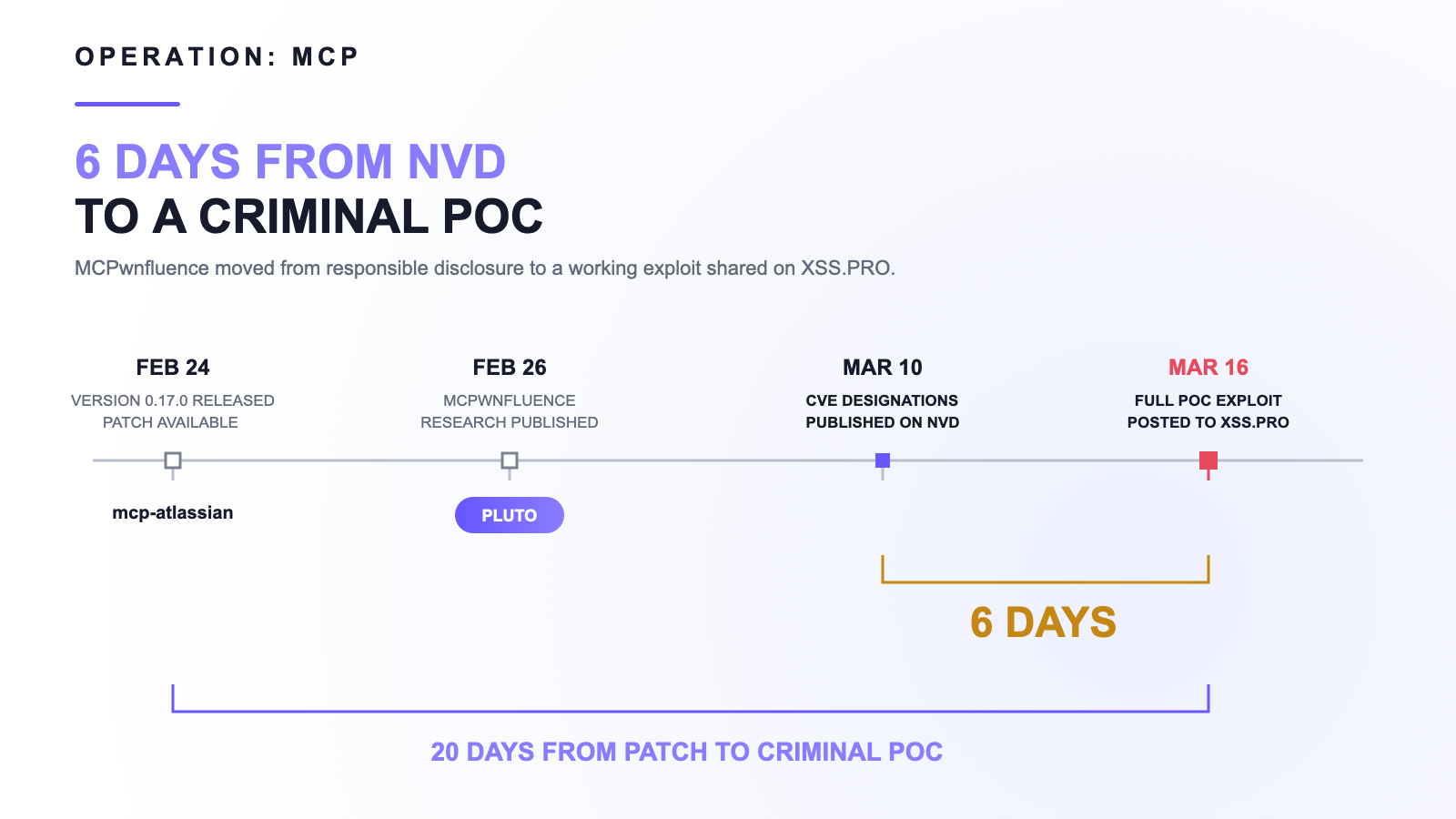
The maintainer released the patched mcp-atlassian version 0.17.0 on February 24. We published our research on February 26. The CVEs appeared on the NVD on March 10. The criminal PoC appeared on March 16.
MCPwnfluence moved from patch release to a criminal proof-of-concept in 20 days, and from NVD publication to criminal weaponization in six.
Organizations that followed the project or our disclosure had 20 days from the patch release to the appearance of the criminal exploit. Vulnerability management programs that waited for the NVD listing had only six.
But a patch only helps when teams know the affected software is running.
Organizations using mcp-atlassian should upgrade immediately to version 0.17.0 or later. They should also identify every MCP server in their environment, review its network exposure, restrict its filesystem and network permissions, and stop treating locally installed AI integrations as harmless plugins.
To an organization, an MCP server may look like a connector. To an attacker, it may be the shortest path in.
Pluto’s platform starts with discovery: every connector, skill, plugin, and MCP server already running across an organization’s AI stack, sanctioned or not. From there, risk assessment surfaces exactly the kind of gap covered in this piece, and enforcement closes it before an attacker finds it first. MCP servers are one surface in that stack. The same blind spot shows up in browser extensions, coding agents, and the plugins builders install without asking anyone first.
If your team is using MCP servers, self-hosted or otherwise, and wants someone to verify everything’s under control, book time with us and we’ll show you what we’d find in yours.
Malicious Servers, Clean Scans: The Dangerous Illusion of a Clean MCP Scan
Pluto Research tested five public MCP security scanners against malicious servers. Several returned clean or zero-finding results, exposing the gap between what a scan checks…
Introducing MCP Inspector: Know an MCP Server’s Risks Before You Install It
Meet MCP Inspector, a free tool from Pluto Research that checks MCP servers for security risks before you install them. Built from the findings behind…
Enterprise AI Guardrails: How to Build Policy Enforcement That Actually Works
The rapid adoption of Generative AI, which has evolved from experimentation to enterprise-wide use, has revealed a critical reality: most organizations have AI policies, but…