
A marketing manager signs up for a design tool with a work email. A developer connects a free note-taking app to the company’s Google Drive. Neither tells IT, and neither means any harm. Multiply that across a few hundred people, and you get shadow SaaS: a layer of cloud apps that hold company data and that the security team cannot see.
What Is Shadow SaaS?
Shadow SaaS is any cloud application used for work without IT or security approval or oversight. It is the most common form of shadow IT today. Older shadow IT meant a server under someone’s desk. Now it takes a credit card or a “Sign in with Google” button, and the app is live in minutes. The tools are often useful. The problem is that nobody checks where the data goes or who can access it.
How Shadow SaaS Enters an Organization
Most shadow SaaS walks in through doors that look harmless. A free trial with a work email address. A team lead who pays for a tool with a corporate card and files it as an expense. An OAuth prompt that lets a new app read someone’s mailbox or files. Browser extensions and AI tools are now some of the biggest sources.
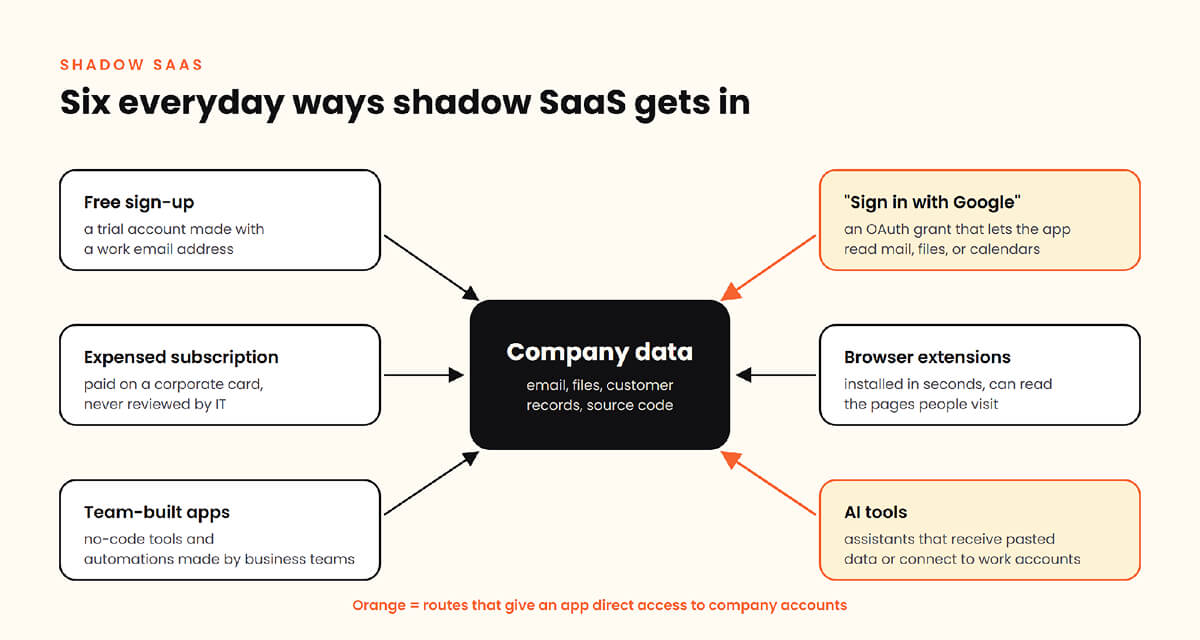
Business teams also build their own apps on no-code platforms, a trend Pluto covers in its post on citizen development and security teams.
Business Risks Created by Shadow SaaS
The first cost is money. When every team buys its own tools, a company can end up paying for three project trackers and four file-sharing apps. That kind of SaaS sprawl wastes budget and makes renewals hard to manage. Compliance suffers too. If an app stores customer or health data without a proper contract, the company may inadvertently violate rules like GDPR or HIPAA. And when the person who set up the account leaves, the data often stays behind in an account nobody controls.
Shadow SaaS Risks
On the security side, every unknown app is a potential leak point for company data. Many of these apps never pass a vendor security review, so nobody knows how they store data or how well they are protected. OAuth grants are a quiet risk: an app given access to email or Drive keeps that access until someone revokes it, even if the user stopped using it months ago. Accounts with weak passwords and no single sign-on are easy targets. Offboarding also breaks down because IT cannot remove access to apps it doesn’t know exist.
How to Detect and Manage Shadow SaaS
Finding shadow SaaS means aggregating signals from several sources. Single sign-on and OAuth logs show which apps people connect to work accounts. Expense reports reveal paid tools. Browser and endpoint data catch extensions and apps that skip both.
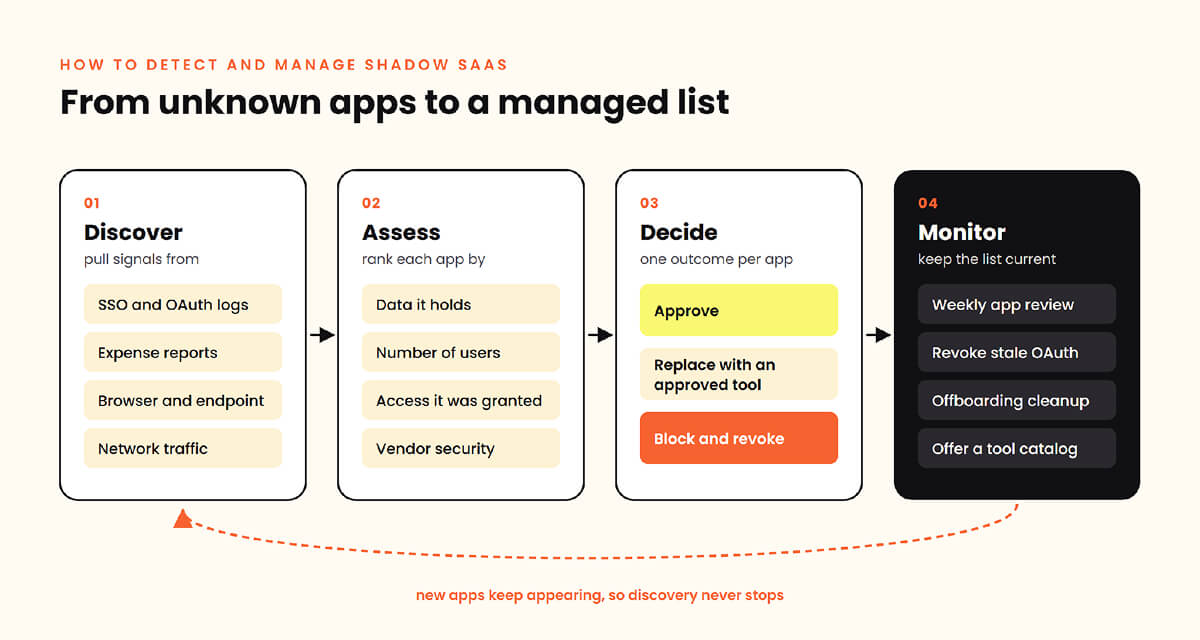
Once you have a list, rank apps by risk: what data they hold, how many people use them, and what access they have. Then approve, replace, or block each one, which also cuts down SaaS sprawl. Make the approved route easy with a catalog of tools people can request, so employees aren’t tempted to go around it. Pluto Security helps teams find the apps, extensions, and AI tools in use across their environment.
Final Thoughts
Shadow SaaS signals that people want better tools, not that they are careless. You cannot block your way out of it. Find the apps, understand what they can reach, and give employees a fast, approved path to the tools they need.
FAQ
Is shadow SaaS always a security threat?
No. Many shadow SaaS apps are harmless, and some solve real problems approved tools don’t. The risk depends on what data the app holds and what access it has. A free timer app is low risk. A file converter with access to your shared drive is not. Assess each app instead of banning them all.
Do browser extensions count as shadow SaaS?
Usually, yes. Many extensions connect to a cloud service in the background and can read the pages you visit, including web apps that contain company data. They install in seconds and rarely undergo any review. That makes them one of the hardest parts of shadow IT to track, and one of the riskiest.
How much of a company’s SaaS is typically unsanctioned?
Numbers vary by survey, but the trend is clear. Gartner predicted that by 2027, 75% of employees will acquire, modify, or create technology outside IT’s visibility, up from 41% in 2022. Most companies that run a discovery exercise find far more apps than expected, often several times the size of their approved list.
Should employees be penalized for using shadow SaaS?
Generally, no. Most people use these tools to get work done faster, not to cause harm. Punishment pushes usage further out of sight. A better approach is to explain the risks, make approved tools easy to request, and respond quickly when someone asks for something new. Reserve discipline for deliberate policy violations.
Are AI tools a form of shadow SaaS?
Yes, and they are now one of the fastest-growing kinds. Employees paste code, contracts, and customer data into AI assistants and connect AI apps to their work accounts. When this happens without approval, it is often called shadow AI, a problem Pluto explores in how AI-built apps evade security visibility.