Software Supply Chain Attack: How the AI Agent Ecosystem Became a New Battleground
Apr 20, 2026・
7 min read
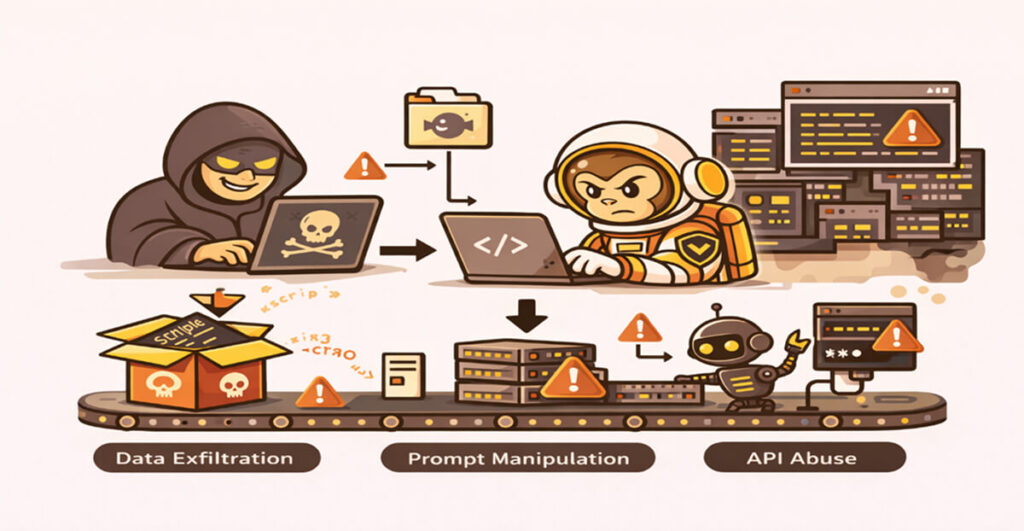
The software ecosystem has undergone a fundamental shift with the emergence of AI agents. Applications are no longer built from isolated codebases. They are now also developed from interconnected dependencies, automation tools, open-source components, and AI agents. These systems interact autonomously with repositories, APIs, and development workflows, creating a new class of risk: software supply chain attacks. This article explores how this AI agent ecosystem has become a battleground as modern attackers seek to compromise a single loophole to gain access to numerous other downstream systems.
AI agents are increasingly used to automate a wide variety of development tasks. Because these systems operate with significant autonomy, a single successful open-source software supply-chain attack can propagate rapidly across organizations. This creates several new software supply chain attack vectors, including the following:
All these characteristics make AI ecosystems highly attractive targets for attackers seeking scalable compromise opportunities. In essence, AI agents can act as automation amplifiers. For example, an attacker can influence what the agent retrieves or executes, thereby gaining leverage across entire development pipelines.
Supply chain security has improved significantly in recent years, with many organizations deploying effective solutions. Traditional supply chain defenses such as dependency scanners, SBOMs, and artifact signing were designed for static software components. They currently lack native capabilities to perform AI-related functions, such as inspecting the behavior of an MCP server, validating the intent of LangChain tools, and detecting poisoned vector database entries. This means that currently, attackers targeting AI pipelines are operating in largely unmonitored territories. This underscores the need for continuous improvement in software supply chain attack prevention strategies. Some common techniques used by attackers to operate include:
Security practitioners have often considered open-source software the backbone of modern development. While it offers immense benefits in innovation and collaboration, it also introduces unique security risks. For example, most open-source projects are maintained by small teams or individual developers, creating opportunities for attackers to exploit weaknesses in governance, code review processes, and dependency management.
When AI agents interact autonomously with open-source repositories, these risks can be amplified. The following scenario shows how such an attack can occur:
The above shows that without robust verification mechanisms, the entire pipeline becomes susceptible to compromise. Such dynamics have led to an increase in open-source software supply chain attacks targeting widely used ecosystems such as Python, JavaScript, and container registries.
Modern security teams face a persistent challenge when implementing supply chain defenses: balancing strict enforcement with operational efficiency. This requires implementing software supply chain attack prevention measures that balance over-blocking and under-detection, in line with each organization’s risk appetite.
For example, aggressive security policies can block legitimate dependencies, which in turn slow development workflows and frustrate engineering teams. Conversely, overly permissive policies may allow malicious components to pass undetected. This creates the over-blocking vs. under-detecting dilemma as explained below.
Achieving the right balance is key to optimal, secure operations. This requires intelligent supply chain threat detection capabilities that can distinguish between legitimate updates and suspicious behavior.
As AI systems become increasingly integrated into development workflows across many organizations, supply chain security is evolving as well. As a result, software supply chain attacks have become one of the most scalable attack strategies available to adversaries. The following trends are likely to shape the next phase of defensive strategies for security teams:
What makes AI agent ecosystems more vulnerable to software supply chain attacks?
AI agents are often more vulnerable as they operate autonomously and interact with a wide variety of external repositories, APIs, and dependencies. Because they automatically retrieve and integrate several lines of code or packages, the respective compromised sources can introduce malicious components. This often happens without immediate human review, which, in turn, increases their exposure to supply chain compromise.
How do attackers bypass supply chain security scanning in AI platforms?
In AI platforms, attackers often use a combination of sophisticated techniques to bypass supply chain security scanning. This includes dependency confusion, typosquatting, delayed payload activation, and compromised maintainer accounts. These techniques allow malicious packages to appear legitimate during initial scans, while, in fact, they are executing harmful behavior. This typically happens only after installation or during runtime.
What is the difference between a software supply chain attack and a traditional cyberattack?
The main difference is the target of attack. While traditional cyberattacks typically target a specific organization directly, a software supply chain attack compromises widely used software components and development tools. This enables attackers to indirectly infiltrate many organizations simultaneously through a network of trusted dependencies. This makes a supply chain attack more damaging than a traditional cyberattack.
How does supply chain threat detection work in open-source environments?
In open-source environments, supply chain threat detection typically involves analyzing factors such as dependency behavior, maintainer activity, update patterns, and ecosystem relationships. By monitoring changes across repositories and packages, security systems can identify suspicious behavior across the environment. This behavior may indicate threats such as malicious code injection and repository compromise.
What steps can organizations take to reduce software supply chain risk?
Organizations should implement a range of security measures to reduce supply chain risks, either in isolation or in combination. These steps often include dependency monitoring, maintaining software bills of materials, enforcing artifact signing, restricting CI/CD access, and deploying automated threat detection tools. Combined security governance and automation often help reduce exposure to malicious dependencies and compromised software development tools.
The prevalence of AI supply chain risks is increasing rapidly as organizations increasingly adopt AI. It is therefore imperative that security leaders in the AI age have comprehensive strategies in place to protect against software supply chain attacks. With the rapid emergence of AI agent ecosystems starting from the point where autonomous systems fetch packages to where they generate code, and orchestrate tasks, the software supply chain has become an even more attractive attack surface requiring stronger security controls.