What Is Vibe Coding? Meaning, Origins, and Use Cases
Jun 29, 2026・
7 min read

Software development is undergoing a significant transformation driven by large language models (LLMs), autonomous agents, and natural language interfaces. One notable paradigm in this shift is vibe coding, an emerging AI-assisted development approach where intent is expressed in natural language rather than through manual syntax-heavy programming. This guide provides a detailed overview of vibe coding, its origins, and its use cases. The objective is to help users understand vibe coding and design effective and appropriate security controls for its safe adoption in enterprise environments.

The term ‘vibe coding’ gained widespread prominence in 2025 after being popularized by AI researcher and engineer Andrej Karpathy. The concept is an AI-powered software development approach in which users describe desired outcomes in natural language, and AI systems interpret those intentions to generate working code structures, components, or complete applications. In its simplest form, users express what they want the system to accomplish in plain speech, and the AI transforms that intent into executable code.
At its core, the approach shifts development from syntax-centric programming to intent-centric orchestration. Rather than focusing on how to implement a solution, developers and, increasingly, ordinary users can focus on what the system should achieve. The approach, therefore, relies heavily on AI reasoning systems, contextual understanding, and iterative refinement loops in which outputs are continuously improved through conversational feedback.
Enterprises should view vibe coding as a productivity layer rather than a replacement for engineering. It accelerates prototyping, reduces boilerplate, and enables faster experimentation cycles. However, from a security perspective, the approach still requires effective governance and human validation.
The major difference between traditional coding and vibe coding is that traditional coding requires developers to explicitly define every logic path, data structure, and system interaction using programming languages such as Python and JavaScript. This often demands strong knowledge of syntax, architectural planning, and debugging expertise.
Vibe coding, by contrast, abstracts much of this complexity; instead of writing detailed implementation logic, developers only provide high-level intent descriptions such as:
The system will then interpret these requirements and generate functional scaffolding to improve productivity. Other key differences include:
| Aspect | Traditional Coding | Vibe Coding |
|---|---|---|
| Primary input | Code written manually using programming languages | Natural language descriptions of desired outcomes |
| Abstraction level | Low-level implementation details and syntax | High-level intent and business requirements |
| Development approach | Developers define logic, structure, and workflows directly | AI generates code and workflows based on user prompts |
| Iteration speed | Manual development and testing cycles | Rapid prototyping through conversational refinement |
| Technical expertise required | Strong programming and debugging skills | Basic technical understanding can be sufficient for simpler projects |
| Workflow structure | Write, compile, test, debug, and deploy | Prompt, generate, review, refine, and deploy |
| Productivity focus | Precision and granular control | Speed, experimentation, and accelerated development |
| Role of AI | Optional assistance tools | Central participant in the development process |
| Best use cases | Complex systems, custom architectures, performance-critical applications | Prototypes, internal tools, MVPs, and workflow automation |
| Human oversight | Required throughout development | Required for validation, security, governance, and production readiness |
| Security accountability | Security designed and implemented directly by developers | Security must be validated through governance, testing, and human review |
In real-world development and business workflows, vibe coding typically operates as a continuous feedback loop between human intent and machine interpretation. In many enterprises, multiple AI-assisted development tools are typically integrated throughout the software development lifecycle. A typical vibe coding workflow includes the following key aspects:
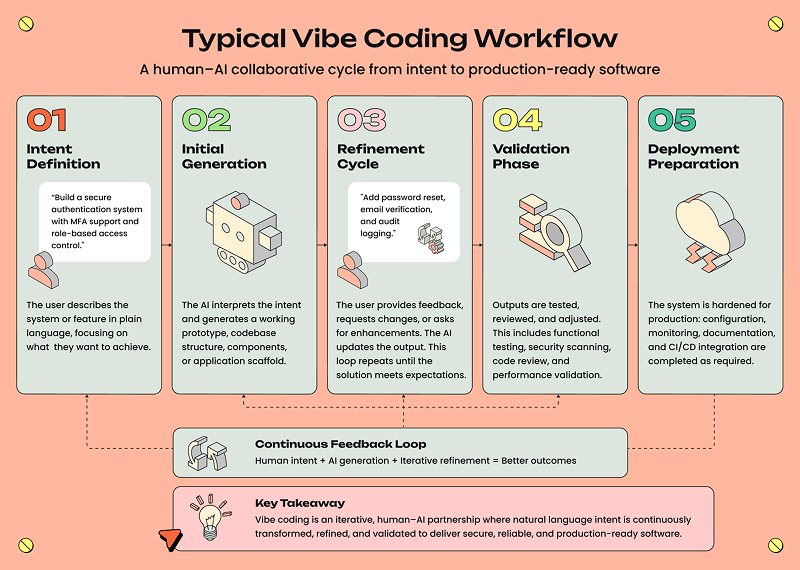
For example, a developer might request an internal tool to track security incidents as part of their normal duties. Through vibe coding, the AI generates the user interfaces (UI), backend endpoints, and database schema, while the developer iteratively refines access controls, logging mechanisms, and integration points. This process is often seamless and embedded into CI/CD pipelines, where AI-generated code is still subject to automated testing, compliance scanning, and peer review before deployment.
Vibe coding is increasingly adopted by developers and users with no prior coding skills, who leverage it to develop market-specific applications. The approach is being adopted across companies of varying sizes and verticals, as well as by different personas within the organizations. Tools like Replit, Cursor, Microsoft GitHub Copilot, OpenAI Codex, Anthropic Claude Code, and others, are increasingly enabling users to experiment with AI-assisted coding. Engineers are now spending less time on boilerplate code and more time shaping system behavior, which has enhanced overall productivity.
In most enterprises, the ecosystem that best supports vibe coding comprises integrated development environments (IDEs), AI copilots, and autonomous agents. Such ecosystems are typically designed to interpret natural language instructions and convert them into executable systems. Hence, modern vibe coding tools typically include:
The above tools serve as an orchestration layer, enabling users to effectively manage dependencies, propose architectural patterns, and even refactor legacy codebases using conversational prompts.
A growing subset of these platforms is classified as vibe coding AI systems. These are fully integrated environments in which AI not only assists development but also actively participates in architectural decision-making, code generation, and optimization. In enterprise environments, these tools are often integrated with governance layers such as:
The governance layer ensures that, while development speed increases due to rapid adoption of vibe coding, organizational security risk remains under control.
Vibe coding is not limited to professional software engineers. It spans multiple user groups with different objectives across an enterprise, including the following:
Despite its advantages, vibe coding has clear limitations that prevent it from fully replacing traditional engineering practices. These include the following:
No advanced programming knowledge is strictly required to get started with vibe coding. However, having some basic understanding of software concepts significantly improves results. Users who understand the basic functions of APIs, databases, and system flows can guide AI outputs more effectively. Without this, the results may still work, but often require more iteration and clarification cycles.
Yes, with proper security controls, vibe coding can be safe for use in business settings. What is crucial is that it be paired with proper governance, testing, and review processes. Enterprises should ensure that no AI-generated code is deployed directly without validation. Security scanning, compliance checks, and human oversight are essential to ensure vibe coding is enterprise-grade, reliable, and safe.
Vibe coding differs from ChatGPT in that it is a broader workflow. ChatGPT is just a chat interaction, while vibe coding often includes a series of continuous development loops, integrated tooling, environment awareness, and deployment pipelines. Coding with ChatGPT is done through conversational assistance. This contrasts sharply with the end-to-end development paradigm associated with vibe coding.
Vibe coding marks a significant shift in software development. It is already enabling individuals to translate business intent into functional software through natural-language interactions with AI systems. While the approach can dramatically improve productivity, it also introduces governance, security, compliance, and maintainability challenges. Enterprises adopting vibe coding should therefore view it as an augmentation capability rather than a replacement for professional engineering practices. Effective implementation of vibe coding requires appropriate governance, security validation, and human review to ensure compliance with software quality, security, and compliance requirements.