Agent Skills Supply Chain Risks
Apr 27, 2026・
7 min read
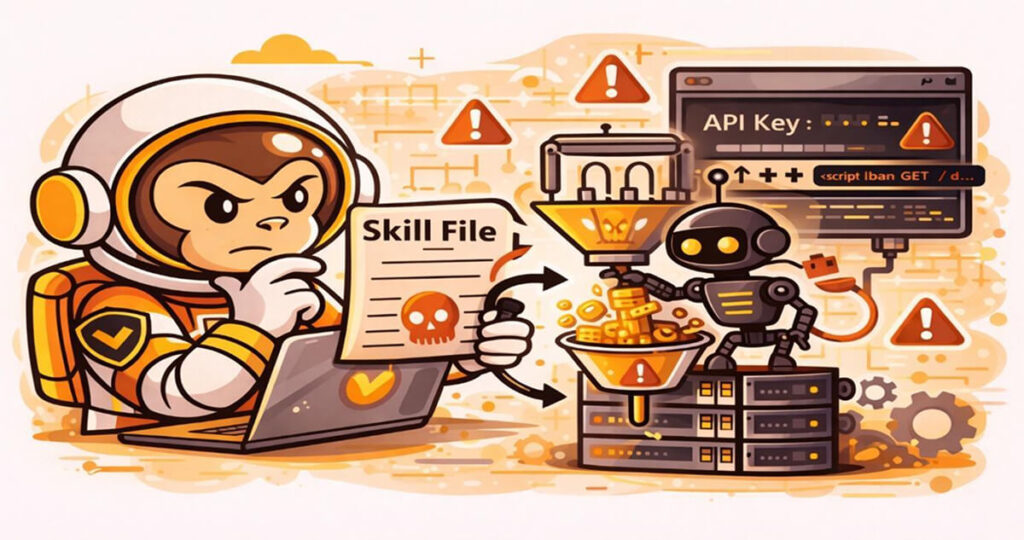
AI agents are rapidly evolving from simple automation tools into complex systems capable of performing a wide range of functions. These capabilities include executing tasks, interacting with external services, and integrating with other third-party capabilities. Many of these capabilities are delivered through agent skills, which are modular instruction packages that extend the functionality of AI agents. While this modular architecture accelerates innovation, it also introduces a new class of supply chain risks. This article examines the supply chain risks associated with agent skills and the controls security teams should implement to mitigate them.
Agent skills are organized folders of instructions, scripts, and resources that agents can discover and load dynamically to perform specific tasks more effectively. Technically, a skill consists of a skill.md file with YAML frontmatter. It defines metadata such as compatibility, permissions, and allowed tools, and provides markdown-encoded instructions that the agent reads and executes when the skill is activated. The frontmatter explicitly declares which tool categories the skill can invoke, such as read, exec, or write. They typically include all instruction files, configuration settings, prompt templates, and references to external resources within the agentic AI environment. These files instruct an AI agent how to perform a set of specialized tasks, such as:
Skills can be downloaded and enabled dynamically, thereby introducing a new layer of AI agent security risks. Unlike the traditional software packages, skill files often operate at the behavioral level. As a result, they can influence how an AI agent interprets instructions, interacts with external systems, and processes sensitive information. If a malicious actor modifies or distributes a compromised skill file, the consequences for an organization can include:
For security leaders, the risks posed by skills make them analogous to unverified code dependencies. Therefore, organizations should address the risks associated with skills to prevent them from introducing significant supply chain vulnerabilities into AI-driven development environments.
The following are some of the widely reported real-world attack scenarios involving agent skills.
In many emerging AI ecosystems, especially in tech startup environments, agent skills are distributed through public marketplaces. They operate similarly to open-source package repositories, where platforms often rely on popularity metrics such as download counts or user ratings to signal trust. However, such indicators are not always reliable measures of security. Attackers can manipulate the claimed download metrics through automated installations and coordinated bot activity. They can also engage in deceptive marketing strategies that encourage the widespread adoption of skills that may contain hidden, malicious logic.
This phenomenon introduces subtle AI agent security challenges, including a false perception of trust. In such cases, perceived trust is often based on social signals rather than technical verification. Security leaders and their teams should therefore treat skill marketplace metrics with extreme caution. They should not rely solely on popularity indicators; they should also independently verify each skill. The verification process should examine skill content, permissions, and behavior, and be carried out before enabling skills in production environments.
To ensure proper assessment of agentic AI security, security teams must understand the internal structure of each skill. Most skill packages contain several key components that influence agent behavior, including the following:
Organizations deploying AI agents should implement a set of structured security evaluation processes before enabling third-party skills in their operations. The following are some of the best practices that can be implemented to mitigate supply chain risks associated with external skills:
As AI agents become increasingly capable and autonomous, attackers are also targeting the ecosystems that support them. The continued rise of skill marketplaces and modular AI architectures means that agentic AI security must evolve alongside these innovations. Several defensive strategies can be implemented to assist in securing agent ecosystems, including the following:
Ultimately, the bottom line is that security teams should always treat agent skills as potential supply chain components rather than simple configuration files. This is key as the exact security discipline originally applied to software dependencies will now be extended to AI agent ecosystems.
What makes agent skill files a supply chain risk?
Agent skill files function as modular instruction packages that influence how AI agents behave and interact with systems. If a malicious actor distributes a compromised skill, it can manipulate agent actions, access sensitive data, or execute unauthorized workflows, introducing significant supply chain risks within AI ecosystems.
Can a malicious skill file compromise an AI agent silently?
Yes. Because skill files often modify an agent’s internal instructions or configuration parameters, a malicious skill can alter behavior without obvious indicators. The agent may continue functioning normally while performing unauthorized actions such as data exfiltration or executing hidden instructions.
How do attackers manipulate download counts in skill marketplaces?
Attackers can manipulate download counts in the skill marketplace by artificially inflating them through automated installations as their primary method. They can also use coordinated bot networks and deceptive promotional tactics for the same purpose. These techniques create the appearance of popularity or trustworthiness, which encourages other users to install the compromised skills, thereby increasing the risk.
What files should security teams review before enabling a skill?
Before enabling a skill, security teams should review a variety of file types, including instruction prompts, configuration files, embedded scripts, and API integration settings. Reviews should also extend to referenced external resources associated with these file types. These file types define how AI agents behave and may contain hidden instructions that can change system operations and expose sensitive data.
How should organizations treat third-party AI skills from a security perspective?
Organizations should always treat third-party AI skills as untrusted supply chain components that can elevate the threat levels. Therefore, before enabling them, security leaders and their teams should perform thorough code and instruction reviews and verify external dependencies. They should also apply the principle of least privilege to all access controls, while monitoring runtime behavior to detect suspicious activity in real time.
Agent skills are emerging and introducing new risks that extend agentic AI security challenges beyond traditional software vulnerabilities. The integrity of the skill files themselves, and the trustworthiness of skill marketplaces, are therefore set to become critical elements of modern AI security architecture. Therefore, security teams should view agent skills as potential vectors for compromise within AI ecosystems and guide their respective organizations in addressing the resultant risks.