
AI is now showing up in support tools, internal search, analytics, software delivery, sales workflows, and third-party SaaS features. It is no longer limited to a single model team or a controlled lab environment.
That creates a practical security problem. Teams cannot manage what they cannot see. AISPM gives security and engineering teams a way to understand where AI is being used, what it can access, and which risks require immediate attention.
What is AI Security Posture Management (AISPM)?
AI Security Posture Management, or AISPM, is the process of discovering, assessing, and continuously monitoring AI systems across an organization. This includes internal models, hosted model APIs, AI agents, embedded SaaS AI features, prompt workflows, training data, plugins, connectors, and the identities associated with them.
A useful AISPM program answers basic questions that often get missed, such as: Which teams are using AI? What data is being sent into prompts? Are model API keys stored safely? Can an AI agent read customer records or trigger actions in production systems?
The goal is not to stop every AI use case. That usually fails, pushing people toward shadow tools. The goal is to reduce AI security risks before they become data exposure, privilege sprawl, compliance gaps, or automation behavior that nobody owns.
AISPM vs. SSPM and CSPM: Understanding the Difference
SSPM focuses on SaaS applications. CSPM focuses on cloud infrastructure. AISPM focuses on AI assets, AI workflows, model access, prompts, agents, and the data moving through those systems. They overlap, but they do not answer the same questions.
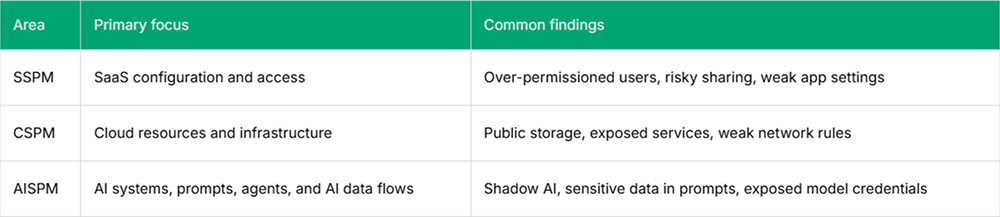
A real issue often spans all three. A support team may enable an AI assistant inside a SaaS ticketing tool. SSPM can review the SaaS configuration. CSPM may cover the data warehouse behind it. AISPM asks what customer data reaches the assistant, what prompts are logged, whether external tools are connected, and whether the assistant’s permissions match the task.
What Continuous AI Posture Assessment Looks Like in Practice
Continuous assessment starts with discovery. Security teams need to identify both approved and unapproved AI services. Browser extensions, personal AI accounts used for work, unmanaged API keys, OAuth-connected trial tools, and small scripts calling model APIs all count.
Once discovery is in place, the work becomes more concrete:
- Maintain an inventory of AI assets, owners, environments, and business purposes.
- Classify data flowing into prompts, embeddings, training sets, and logs.
- Review identities, tokens, service accounts, and delegated permissions.
- Detect risky configuration drift in AI-enabled SaaS and internal tools.
- Alert on unusual behavior, such as new external connectors or abnormal prompt volume.
AI workspace security tools add another layer to autonomous posture management. If employees use AI assistants, SaaS copilots, or browser-based AI tools with customer notes, source snippets, or internal documents, a tool like Pluto Security can help teams see that activity, understand the risk, and apply guardrails without blocking normal work.
Who Needs AISPM and Why It’s Becoming Non-Negotiable
AISPM becomes important once AI touches sensitive data, regulated workflows, production systems, or customer-facing decisions. That includes finance, healthcare, software vendors, retailers, public-sector teams, and any company using AI in business-critical SaaS systems.
Smaller teams still need a lighter version. They may not need a dedicated platform immediately, but they do need inventory, policy, access review, and logging. Waiting until dozens of AI integrations exist makes cleanup harder, especially when compliance teams start asking for evidence.
Conclusion
AISPM is a practical response to a practical problem. AI usage is spreading faster than manual review can keep up with.
Teams that handle it well will treat AISPM as they would any other security engineering. Find the assets. Understand the access. Watch for drift. Fix what matters first.
FAQs
1. How does AISPM handle third-party AI integrations and shadow AI tools?
Start with the boring signals: OAuth grants, SSO logs, browser extensions, expense records, API traffic, and SaaS audit events. When a new AI tool appears, AISPM should assign an owner, review the data it touches, and review permissions. Shadow AI usually needs cleanup first, not instant blocking.
2. Can AISPM be deployed in organizations that are early in their AI adoption?
Yes. Early teams are often in a better position because there is less mess to unwind. A small AISPM rollout can begin with an inventory, approved tools, simple logging, and a policy people can actually follow. That gives teams a cleaner AI posture before agents and sensitive workflows arrive.
3. How does AISPM support compliance with emerging AI regulations?
AISPM helps by keeping records close to the real systems rather than buried in old tickets. It can show which AI assets exist, what data they use, who approved access, and what has changed over time. That makes compliance reviews less dependent on memory, screenshots, or a spreadsheet built the night before an audit.