

Security teams cannot install software everywhere. Some workloads are short-lived. Some systems are owned by different teams. Some are too sensitive or old to change without a long approval process.
That is where agentless security helps. It gives teams visibility without placing an agent inside every server, container, or endpoint.
What Makes a Security Platform Agentless?
An agentless security platform connects to existing infrastructure through approved access paths. In cloud environments, this typically means cloud provider APIs, snapshots, metadata services, identity data, configuration records, and event logs. The platform does not run inside the workload. It reads from the outside.
A common flow looks like this. The security tool is granted read-only access to cloud accounts. It discovers assets such as virtual machines, storage buckets, databases, container registries, Kubernetes clusters, identities, and network paths. It then collects enough context to assess risk without changing how the workload runs.
This is why agentless cloud security is useful in large environments. A team can onboard a new cloud account and start detecting misconfigurations, exposed assets, vulnerable packages, secrets, and risky permissions without waiting for every application owner to install something. Agentless systems often rely on APIs and non-invasive methods rather than software deployed directly on each workload.
The tradeoff is worth understanding. Agentless scanning is strong for broad visibility and posture assessment. It is not the same as having a process-level sensor watching every system call in real time.
How the Data Is Collected
Most platforms start with inventory, asking what exists. From there, the analysis becomes more useful. A public virtual machine is not automatically a critical issue. A public virtual machine with an exploitable package, an attached role with broad permissions, and access to sensitive storage is different.
Agentless security usually combines several signals:
- Cloud asset inventory
- Configuration and policy data
- Network exposure
- Identity and permission relationships
- Vulnerability data from disk images, snapshots, or package metadata
- Secrets found in files, images, or configuration
- Runtime-adjacent signals from cloud logs and events
This correlation reduces some of the noise. A plain vulnerability list can overwhelm engineering teams. A finding tied to exposure, permissions, and data access is easier to prioritize.
Agentless vs. Agent-Based Security: Key Differences for Enterprise Teams
The agentless vs agent-based security discussion is not a winner-takes-all debate. Most enterprise teams need both, but for different jobs.
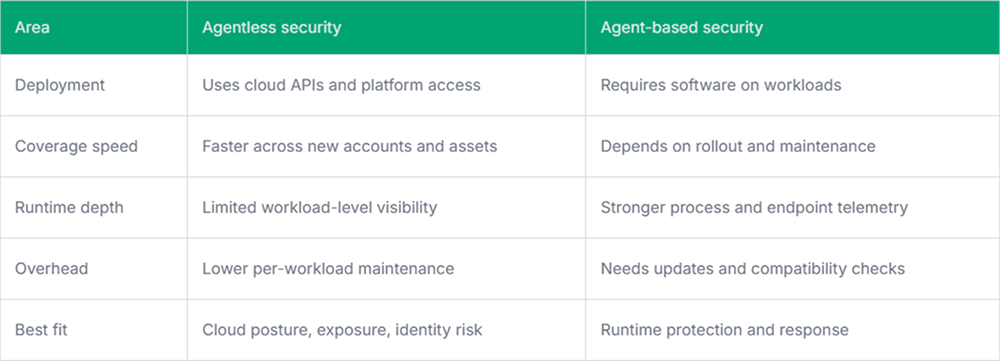
Agent-based tools remain important for workloads that require deeper monitoring or active blocking. They can observe process behavior, collect detailed forensic data, and respond closer to the system.
Agentless security is stronger when the main problem is coverage. Large cloud environments grow quickly. Test accounts appear. Containers are pushed and forgotten. Serverless workloads may not support a traditional agent model at all. A practical setup often uses agentless scanning as the broad visibility layer, then adds agents where deeper runtime control is needed.
Where It Helps Most
Agentless security is useful during cloud migrations, audits, and acquisitions. Security teams can quickly identify exposed assets, public storage, risky permissions, and vulnerable workloads without launching a lengthy installation project.
The same visibility problem now shows up around AI tools. Using a tool like Pluto Security can help here by giving teams real-time visibility into AI-driven workflows, helping them understand risk across tools and integrations, and adding guardrails before unsafe automation or sensitive data exposure spreads.
There are limits. If an attacker is already running commands inside a workload, an outside scan may miss important details. If permissions are too narrow, the platform may not see everything. These are normal engineering constraints.
Final Thoughts
Agentless security is a practical deployment model. It favors broad visibility, faster coverage, and lower operational friction. For modern enterprise teams, that is often the right starting point. Use it to understand the environment, reduce blind spots, and decide where deeper controls are actually needed.