
An AI support agent receives a routine request to review a customer issue. Before responding, it retrieves an internal document containing outdated instructions and a hidden directive instructing the model to ignore its original task. The user’s message appears harmless, yet the agent’s working context has already changed.
That is the problem with context window manipulation. Modern AI systems may combine system instructions, chat history, retrieved documents, tool outputs, memory, and user input within the same limited context.
What Is Context Window Manipulation?
Context window manipulation refers to attempts to insert, alter, or overwhelm information within an LLM’s active context so that it interprets instructions or makes decisions differently. It can involve malicious retrieved text, excessive irrelevant content, repeated demonstrations, or information designed to compete with trusted instructions.
A context window is the amount of information a model can process in a single interaction. As Redis explains in its guide to context window management, that space may include prompts, conversation history, retrieved data, and generated content. A larger window provides more room but also gives applications more material to validate and control.
How Attackers Insert or Alter Information Inside an AI Model’s Context
Attackers do not always need direct access to the prompt box. An agent may build its own context by reading webpages, tickets, PDFs, source code, knowledge bases, emails, or tool responses. If a source contains adversarial instructions, the model may process them alongside legitimate task information.
Common context window attack patterns include:
- Context stuffing: Irrelevant or adversarial text crowds the working context, making important instructions harder to use reliably.
- Poisoned retrieval: A manipulated document enters a RAG pipeline and is retrieved during a legitimate task.
- Many-shot manipulation: Repeated examples steer behavior over a long context. Anthropic has demonstrated this pattern in its research on many-shot jailbreaking.
- Truncation pressure: Excessive input may trigger application-level truncation or summarization, which can remove useful or security-relevant context while preserving adversarial content.
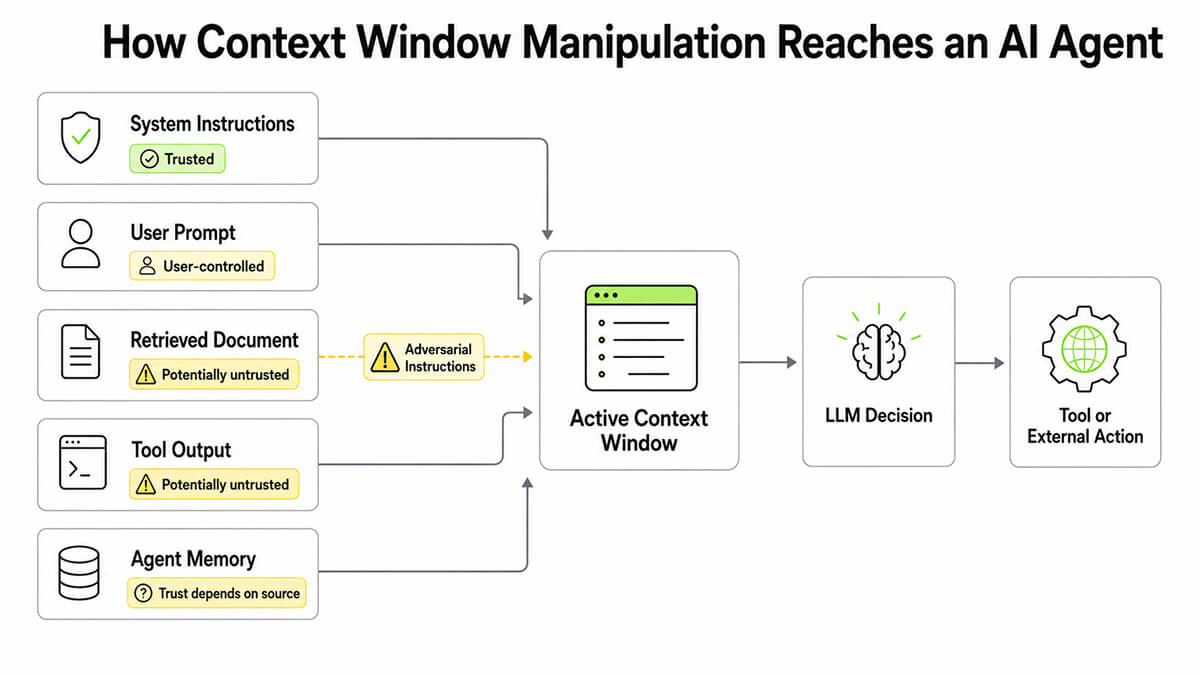
These attacks do not require the model to completely forget its system prompt. The risk is that untrusted information alters which instructions or evidence influence the next response or action.
Why Context Window Manipulation Is a Growing Risk in Agentic AI Workflows
The impact becomes more serious when an LLM can act. A chatbot manipulated by malicious context may return an incorrect answer. An agent connected to APIs, files, SaaS applications, browsers, or developer tools can turn the same manipulation into an external action.
Consider a procurement agent that reads supplier emails and can update purchase records. A malicious instruction hidden in an attachment could enter its context and redirect the workflow. If tool permissions are broad and no independent authorization check exists, LLM context manipulation becomes an access-control problem, not merely a model-quality issue.
Pluto’s guidance on AI agent security treats prompt injection, tool misuse, identity, access, and monitoring as interconnected issues. A safer design assumes some context may be hostile and limits what an agent can do when the model makes an incorrect decision.
The Difference Between Context Window Manipulation and Prompt Injection
The terms overlap, but they address different aspects of the problem. OWASP defines prompt injection as input that alters an LLM’s behavior or output in unintended ways. It can be direct, via a user prompt, or indirect, via external content.
In this broader usage, context window manipulation refers to how information within the active context may be shaped, crowded, poisoned, or reordered. Prompt injection is one way an attacker can influence that context, while other cases may involve excessive content, retrieval behavior, repeated examples, or weaknesses in context management.
How to Protect Context Windows in Enterprise AI Deployments
Good context window security starts before content reaches the model. Teams need to know where the context comes from, which sources are trusted, and what authority the model has after processing it.
A practical control set includes validating retrieved content, restricting retrieval by user identity, minimizing unnecessary context, and, where possible, separating instructions from untrusted data. Sensitive tool calls should undergo authorization checks outside the LLM rather than relying on prompt wording alone.
Logging also matters. Teams should retain sufficient evidence to reconstruct which sources were retrieved, which tools were invoked, which policies were evaluated, and what action was taken. Platforms such as Pluto Security can provide visibility and policy enforcement for AI workflows, helping teams identify risky data movement and agent behavior without treating the model as the sole security boundary.
Final Thoughts
Context windows provide AI systems with the information needed to complete complex tasks. That same flexibility creates a trust problem when user input, documents, memory, and tool results are combined. Protection depends on controlling what enters the context, limiting what agents can access or execute, and retaining enough evidence to investigate suspicious behavior.
FAQ
Can manipulation happen through documents an agent retrieves itself?
Yes. Retrieved documents may include instructions the agent did not request.
How does context window size affect exposure to attacks?
Larger windows can admit more untrusted content, but size alone does not determine the risk.
Are context window manipulation attacks detectable afterward?
Sometimes, the retrieved context, model activity, and actions are logged.