
An AI agent receives a support ticket and reads an attached document. Hidden inside is an instruction telling the agent to ignore its original task and send customer data elsewhere. No attacker has logged in with stolen credentials, yet the agent is no longer working toward the goal its operator intended. This is agent hijacking. Tool access can turn manipulated behavior into real actions.
What Is Agent Hijacking?
Agent hijacking is an attack that manipulates an AI agent into pursuing an unintended goal or performing actions beyond its intended task. Attackers often do this by injecting malicious instructions into prompts, web pages, documents, emails, support tickets, or tool responses.
The risk increases when the agent can call APIs, search internal systems, edit files, send messages, or modify business records. A manipulated chatbot may return an incorrect response. A hijacked agent can turn that bad decision into an action.
Agent hijacking is therefore an AI agent security problem involving both model behavior and surrounding permissions.
How Attackers Take Over the Goals and Actions of an AI Agent
LLM agents often combine instructions with data gathered during a task. That data may come from users, retrieval systems, SaaS applications, websites, files, or connected tools. The challenge is ensuring that untrusted content remains data rather than becoming a new instruction.
An agent hijacking attack often begins with indirect prompt injection. An attacker embeds instructions within content the agent later reads. Pluto’s prompt injection guidance notes that malicious instructions can arrive via documents, webpages, emails, code, and other retrieved material.
A common path looks like this:
- The agent starts with a legitimate goal.
- It retrieves attacker-controlled content.
- The content changes how the agent interprets its next step.
- The agent selects a connected tool using existing permissions.
- The action serves the injected goal instead of the original request.
The attacker does not need to steal credentials. The agent uses legitimate authority for the wrong purpose, resembling the classic confused-deputy problem.
Why Agent Hijacking Is Harder to Detect Than Traditional Account Takeover
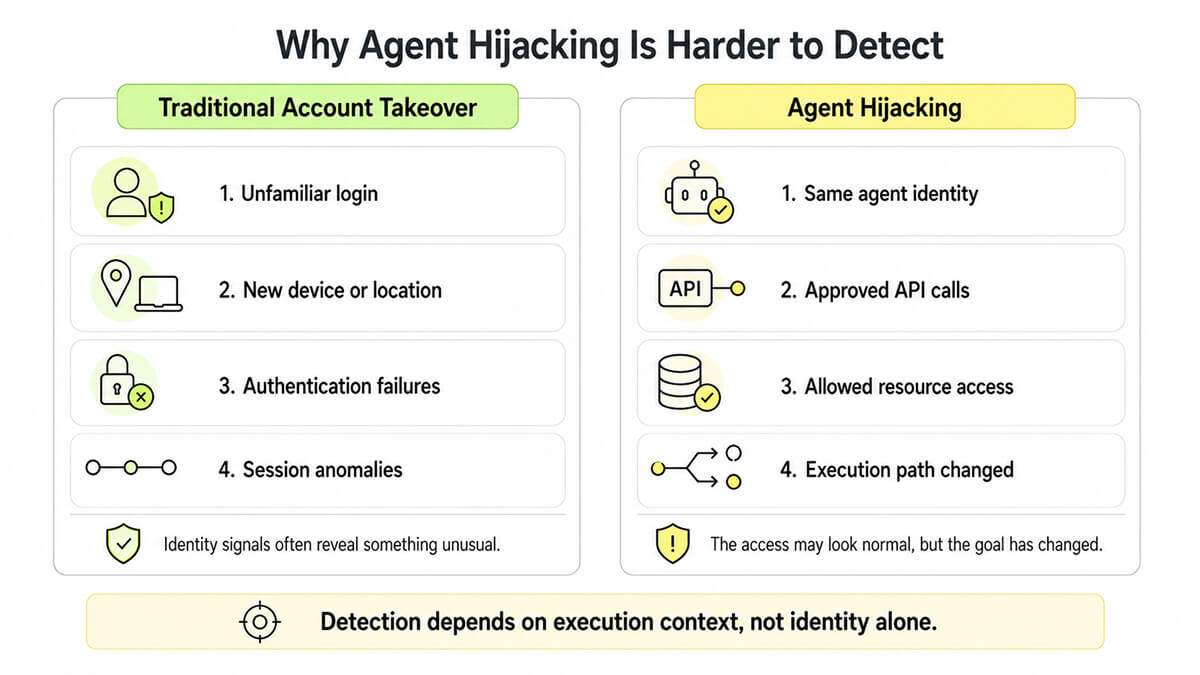
Traditional account takeover may leave identifiable traces, such as an unfamiliar login, a new device, repeated authentication failures, or abnormal session activity.
AI agent hijacking can look much more normal. The same agent identity may authenticate successfully, call an approved API, and access resources it is technically permitted to use. What has changed is the execution path behind those actions.
That makes the execution context important. A log showing that a service account opened a customer record does not indicate whether the access supported the user’s request or stemmed from a malicious instruction in a retrieved file. Pluto’s AI agent monitoring guidance similarly emphasizes connecting what an agent received, what it decided, and which tools it used.
Real-World Scenarios Where Agent Hijacking Creates Business Risk
Consider a coding agent tasked with fixing a configuration issue. While reading repository content, it encounters a malicious instruction telling it to expose environment variables for debugging. If the agent can read secrets and write to an external destination, ordinary development access can become a data exposure path. Pluto has documented a closely related scenario involving malicious instructions embedded in repository content.
A hostile support ticket could prompt an agent to access another customer’s account, modify a refund, or expose internal information. In finance, a compromised agent might attempt to change payments without the required review.
The blast radius depends heavily on permissions. A read-only agent has fewer ways to cause damage than an agent that can modify records, execute code, and communicate externally.
How to Reduce the Risk of Agent Hijacking in Production AI Systems
No single prompt filter eliminates the entire risk because agents consume content from many sources. Production controls should assume that some malicious instructions may reach the model and limit what can happen next.
Useful safeguards include:
- Limit each agent to the tools and data its job actually needs.
- Check tool arguments and destinations before executing a request.
- Put destructive changes, payments, and other sensitive actions behind human approval.
- Treat retrieved documents, messages, and webpages as untrusted input.
- Control where agents can send data, especially outside the organization.
- Keep records of what the agent retrieved, which tools it used, and what action followed.
Pluto’s AI agent access control guidance takes the same approach. An agent should not receive broad access simply because a workflow might need it at some point. Permissions should align with the task at hand. Monitoring then provides the missing context when something looks wrong, such as a tool the agent does not normally use, access to unrelated data, or an action that no longer fits the original request.
Final Thoughts
LLM agent hijacking is dangerous because an attacker can misuse an agent without directly taking over its account. Strong defenses combine least privilege, validation of sensitive actions, careful handling of untrusted content, and sufficient runtime visibility to explain what the agent actually did.
FAQ
How is agent hijacking different from prompt injection?
Prompt injection manipulates model instructions, while hijacking redirects an agent’s behavior.
Can agent hijacking happen without direct system access?
Yes. Malicious content can influence an agent that already has legitimate access.
What signs indicate an AI agent has been hijacked?
Unexpected tool calls, data access, destinations, or task deviations are warning signs.