
Prompt injection is a serious concern for AI security. It occurs when crafted instructions in a prompt, document, webpage, email, or other input alter the model’s behavior. For chatbots, this can lead to incorrect or unsafe responses. In enterprise systems, AI prompt injection is more dangerous when the model can interact with files, SaaS products, code repos, tickets, or other internal data. A prompt injection attack can appear as benign-looking text. The real problem is when an AI system treats this text as trusted instructions rather than untrusted content.
How Prompt Injection Attacks Work
Prompt injection works by blurring the boundary between system instructions, user requests, and external content. A company may give an AI assistant a system prompt such as “do not reveal confidential information.” An attacker may then enter a prompt that attempts to override that rule, change the assistant’s role, or force it to ignore previous instructions. That is a direct prompt injection attack-the attacker speaks to the model directly.
The more serious cases arise when AI tools are integrated into real workflows. An AI assistant may summarize emails, scan documents, review code, query a database, or trigger actions through tools. If an attacker embeds hidden instructions in the content the model reads, the model may follow them without the user noticing.
Common outcomes include:
- Leaking sensitive business data
- Revealing hidden system prompts
- Producing manipulated or false answers
- Calling tools with unsafe parameters
- Sharing data with the wrong user or system
This is why prompt injection protection cannot rely solely on improved prompt wording. The system also needs controls for data access, tool permissions, logging, and policy enforcement.
Why Indirect Prompt Injection Is a Growing Risk
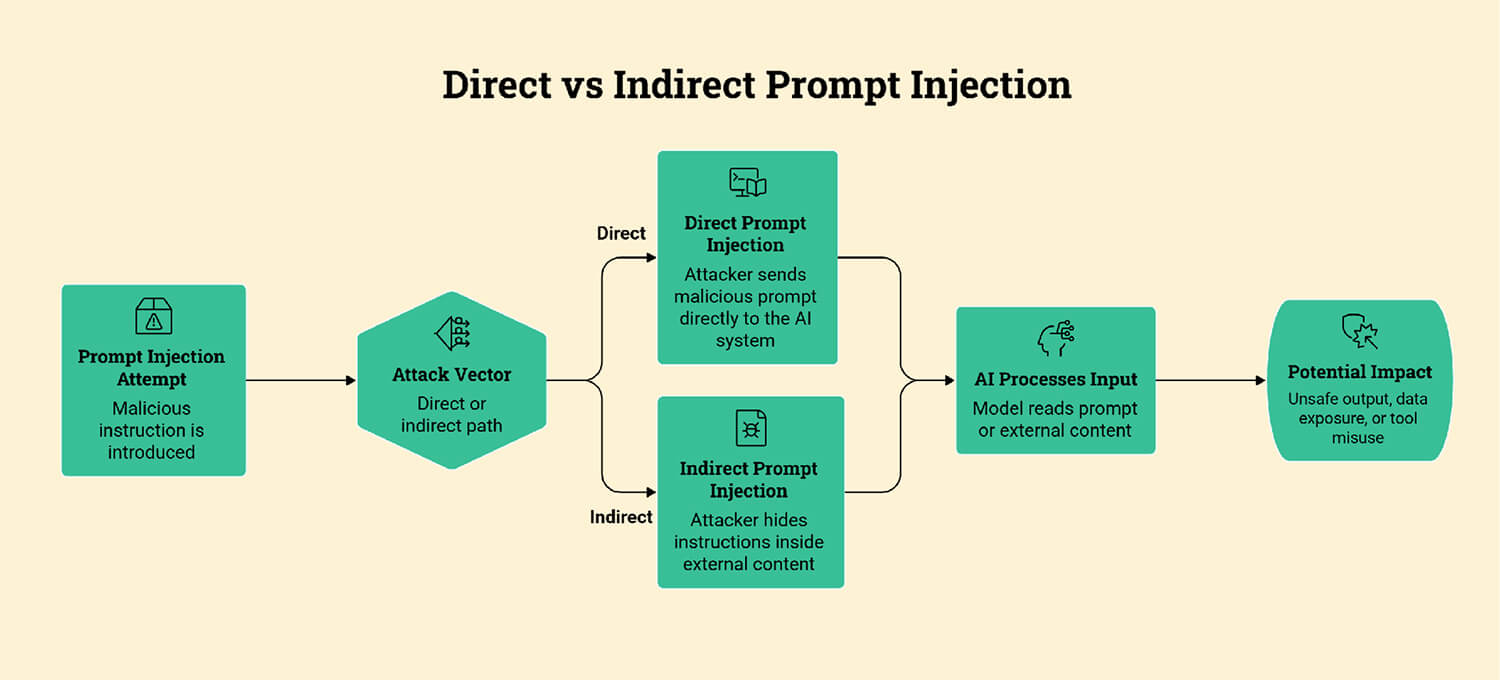
Indirect prompt injection is growing because AI systems now read more than chat messages. They read webpages, support tickets, PDFs, Slack threads, code comments, spreadsheets, and internal knowledge base articles.
A hidden instruction inside one of those sources can prompt the model to ignore its task, attempt to expose private data, or misuse a connected tool. The employee may never see the malicious instruction. They only ask the AI assistant to summarize a document or review a file.
This matters for companies using AI across departments. A support team may use AI to summarize customer tickets. A developer may use an AI coding assistant to inspect a repository. A finance team may ask an AI tool to analyze spreadsheets. In each case, the AI system processes content that could contain attacker-controlled instructions.
For platforms such as Pluto Security, this is where visibility and policy enforcement become important. Security teams need to see which AI tools employees use, what data enters those tools, and whether AI agents are trying to take risky actions.
Which AI Systems Are Most Vulnerable to Prompt Injection?
The most vulnerable systems are not always the most advanced models. They are usually the systems with too much trust and too little control.
AI systems become higher risk when they can:
- Read untrusted external content
- Access internal documents or customer data
- Use plugins, APIs, browsers, or coding tools
- Retrieve information from large knowledge bases
- Act without human review
- Share outputs across users or systems
A basic chatbot with no connected tools still faces prompt injection risk, though the damage is limited. An AI agent with access to files, email, code, and business applications has a much larger attack surface.
RAG systems also require careful review. Retrieval can improve answers, but it does not fully prevent prompt injection. If the retrieved document contains malicious instructions, the model may treat them as useful context.
How Organizations Can Reduce Prompt Injection Risk
Prompt injection cannot be fully eliminated with a single control. The better approach is layered protection.
Security teams must control the access that AI systems are granted, segregate the instructions for trusted and untrusted systems, and limit the tools available to different user roles. AI agents must be designed to ensure that their output is screened before reaching the end user and logged to provide a trace of the prompts, sources, tools, outputs, and the policy decisions made.
For enterprise use, prompt injection protection should include visibility, least-privilege access, data loss prevention, approval gates for risky actions, and regular red-team testing. The goal is not to stop employees from using AI. Rather, it is to make AI use safer, more observable, and easier to control.
Final Thoughts
Prompt injection is not just a chatbot issue. It becomes a real enterprise risk when AI systems can access sensitive data, retrieve internal context, or act through connected tools. Organizations should treat every prompt, document, and external source as untrusted input until proper controls, monitoring, and policy enforcement are in place.
FAQ
Can prompt injection attacks be fully prevented?
No. Prompt injection cannot be fully prevented because models still process instructions, user input, and external content in the same workflow. Organizations can reduce the risk by limiting access, restricting tool use, scanning inputs and outputs, and requiring approval for sensitive actions.
What is the difference between direct and indirect prompt injection?
Direct prompt injection is the more straightforward of the two concepts. In direct prompt injection, an attacker inputs an instruction to the AI system, and in doing so, tries to get the system to break its own rules. Indirect prompt injection is harder to spot, and the attacker inputs an instruction to the AI system in a comment, code, ticket, email, document, or webpage that the AI reads as part of its normal work.
How can organizations test AI systems for prompt injection vulnerabilities?
Testing should go beyond simple chatbot prompts. Teams need to test the points where the AI reads content, retrieves documents, calls tools, or acts through agents. A good test checks whether the system leaks data, follows hidden instructions, ignores policy, or performs an unsafe action that should have required review.