
AI jailbreaking is one of the most visible LLM security issues because it reveals a simple truth: safety controls can be challenged through language. A model may be trained to refuse harmful requests, follow protected system instructions, or respect enterprise policy. But an attacker may still try to push it beyond those limits. For companies using AI in real workflows, this is not only a model problem. It is an AI security risk that can affect data, tools, agents, and business systems.
What Is AI Jailbreaking?
AI jailbreaking is the act of manipulating a large language model to ignore or bypass its safety rules. The attacker is not always “hacking” the model in the traditional software sense. Often, they use carefully crafted prompts, role-play, repeated examples, or indirect instructions to make the model behave in ways it should not.
In a consumer chatbot, this may result in unsafe or restricted responses. In an enterprise AI system, the risk can be even greater. The model may have access to internal documents, connected apps, customer data, code repositories, or business workflows. That can turn a simple jailbreak attempt into an LLM vulnerability.
How Attackers Bypass AI Safety Controls
Attackers use different methods to bypass AI safety controls. Some are direct, while others are hidden within a normal-looking context.
A basic jailbreak may ask the model to role-play, ignore prior rules, or respond as a fictional system with no restrictions. More advanced attempts can be harder to detect. They may split instructions across several messages, use indirect wording, encode parts of the request, or hide the real goal within a long conversation.
Many-shot jailbreaking is a good example of how this can work. Instead of relying on a single clever prompt, the attacker fills the context window with numerous examples of unsafe behavior. The model recognizes a recurring pattern and may begin to follow it, even when the final request should be refused.
In agentic systems, the risk becomes sharper. An AI agent may read a document, decide what to do next, call a tool, and produce an output. If a malicious instruction is buried inside a file or web page, the model may treat it as part of the task. That is where jailbreaking overlaps with prompt injection, and tool misuse begins to overlap as well.
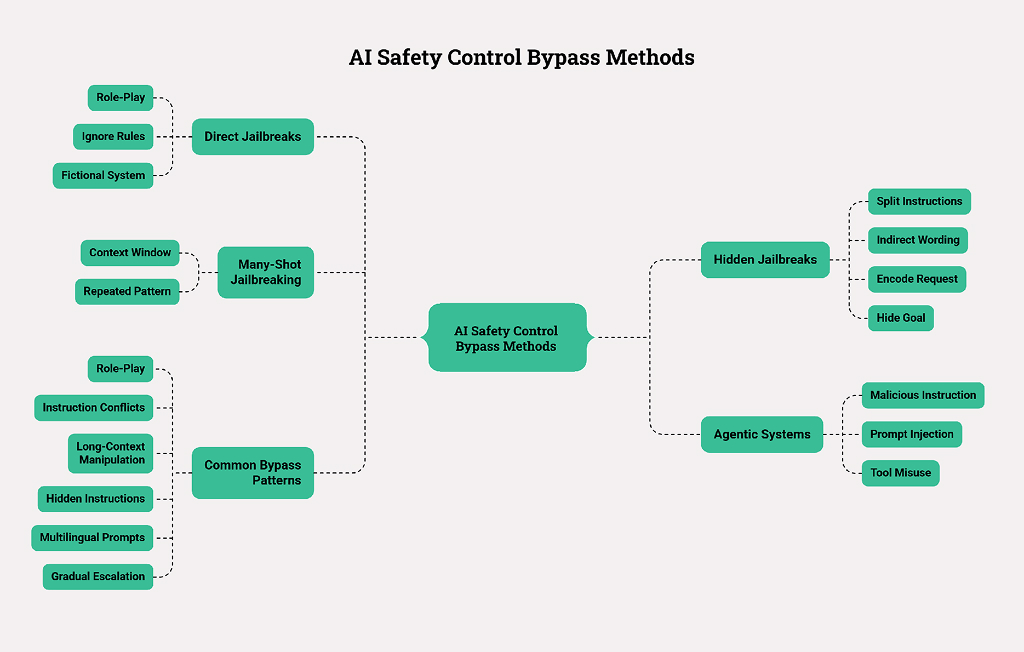
Common bypass patterns include:
- role-play or persona switching
- instruction conflicts between user prompts and system rules
- long-context manipulation
- hidden instructions in documents or code comments
- multilingual or encoded prompts
- gradual escalation across multiple turns
None of these should be treated as strange edge cases. They are normal adversarial behaviors in systems that accept open-ended language.
Why AI Jailbreaking Is an Enterprise Security Risk
For individual users, AI jailbreaking may look like a model giving an unsafe answer. For enterprises, the risk is tied to access:
- What can the model see?
- What can it trigger if connected tools allow it?
- What data can it send back?
If an internal assistant answers only public policy questions, the damage is limited. But many enterprise LLMs are not isolated. They may have access to HR documents, source code, support tickets, customer data, or production observability tools. A successful jailbreak can expose sensitive context or push the system toward actions that were never intended.
This is why the security risk of AI increases when models are connected to tools. A jailbroken model that only writes text is one problem. A jailbroken agent with broad tool permissions that can search internal drives, draft emails, update tickets, or execute commands is another.
Security teams should also care because jailbreak attempts are noisy signals. They indicate where users, insiders, or external attackers are testing the boundaries of an AI system. If those attempts are not logged, reviewed, and integrated into response workflows, the organization may not know which systems are being targeted.
Platforms such as Pluto Security are relevant to this discussion because enterprise teams need visibility into AI usage, risky prompts, tool access, and policy violations. Blocking every AI tool is rarely practical. But allowing AI adoption without monitoring creates blind spots.
What Makes an LLM Vulnerable to Jailbreaking?
An LLM application becomes more vulnerable when it has weak enforcement of the instruction hierarchy, poor separation between trusted and untrusted content, or excessive access to sensitive tools and data. Long context windows can also increase the attack surface because attackers have more space to shape the model’s behavior.
Risk also increases when companies rely solely on the system prompt as a security control. A hidden prompt can guide behavior, but it should not be treated as a firewall. Stronger protection comes from least-privilege access, input and output inspection, red-team testing, policy enforcement, and clear ownership across security, engineering, and AI teams.
Final Thoughts
AI jailbreaking is not just a chatbot trick. It is a practical security concern for any organization using LLMs in real-world workflows. The model can be manipulated through language, context, and examples. Enterprise defense should focus on visibility, permissions, testing, and control points outside the model.
FAQ
How quickly do new AI jailbreaking techniques emerge?
New AI jailbreaking techniques emerge quickly because attackers continually test model behavior, context handling, and safety filters. Each new model capability can create a new bypass path. Security teams should treat jailbreak testing as a continuous process, not a one-time review before launch.
Who is responsible for preventing AI jailbreaking in the enterprise?
Responsibility should be shared among security, engineering, AI platform teams, and business owners. Model providers improve baseline safety, but enterprises must control how models connect to data, tools, users, and workflows. The most effective approach combines secure design, monitoring, access controls, and incident response.
How can security teams explain AI jailbreaking risk to leadership?
Security teams can explain AI jailbreaking as a method attackers use to make AI systems ignore business rules. The risk is not only bad output. It also includes the possibility that an AI tool may expose data, misuse access, generate unsafe code, or take actions outside approved policy.