
Endpoint security used to mean antivirus, signatures, and blocking known malware. That model no longer fits how endpoints are used today.
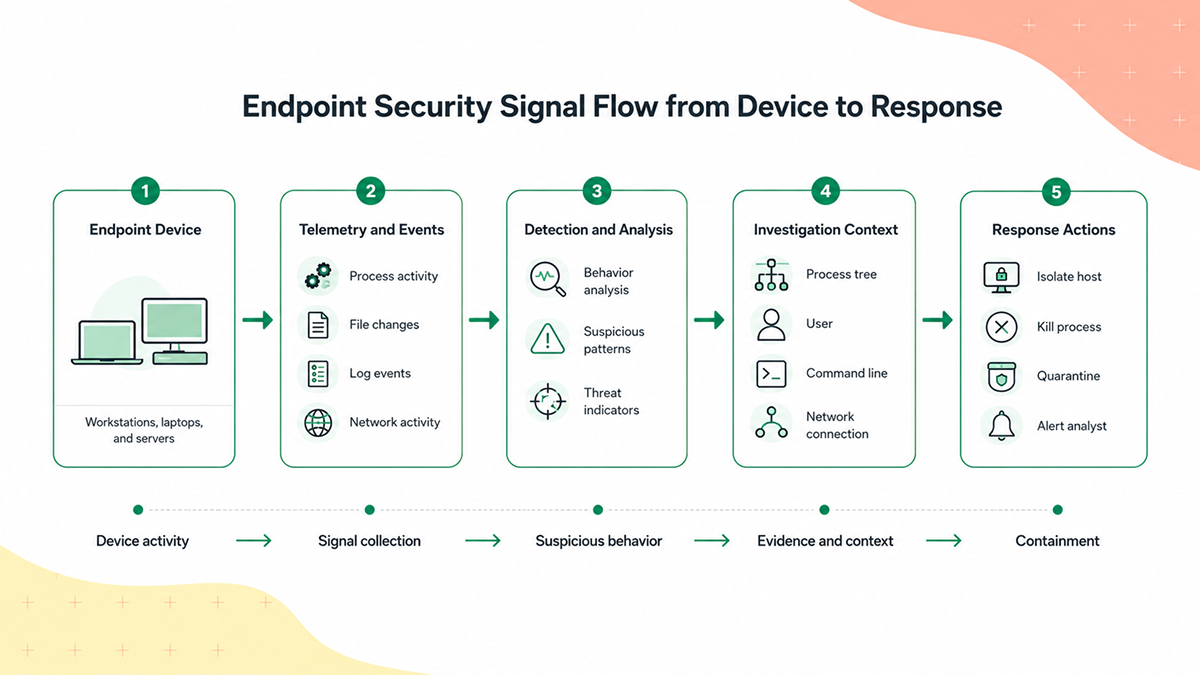
Next-generation endpoint security responds to that environment by monitoring endpoint behavior, collecting activity data, detecting suspicious patterns, and helping security teams respond before an issue spreads.
What Is Next-Generation Endpoint Security?
Next-generation endpoint security protects laptops, servers, workstations, and other endpoint devices by relying on more than static file signatures. It examines behavior, execution patterns, process relationships, user activity, and network activity.
The practical difference is visibility. A traditional tool may report that a file was blocked. A next-generation endpoint protection stack should help answer questions such as what launched it, which user was involved, which child processes ran, whether PowerShell or another scripting tool was used, and whether the endpoint contacted an unusual domain afterward.
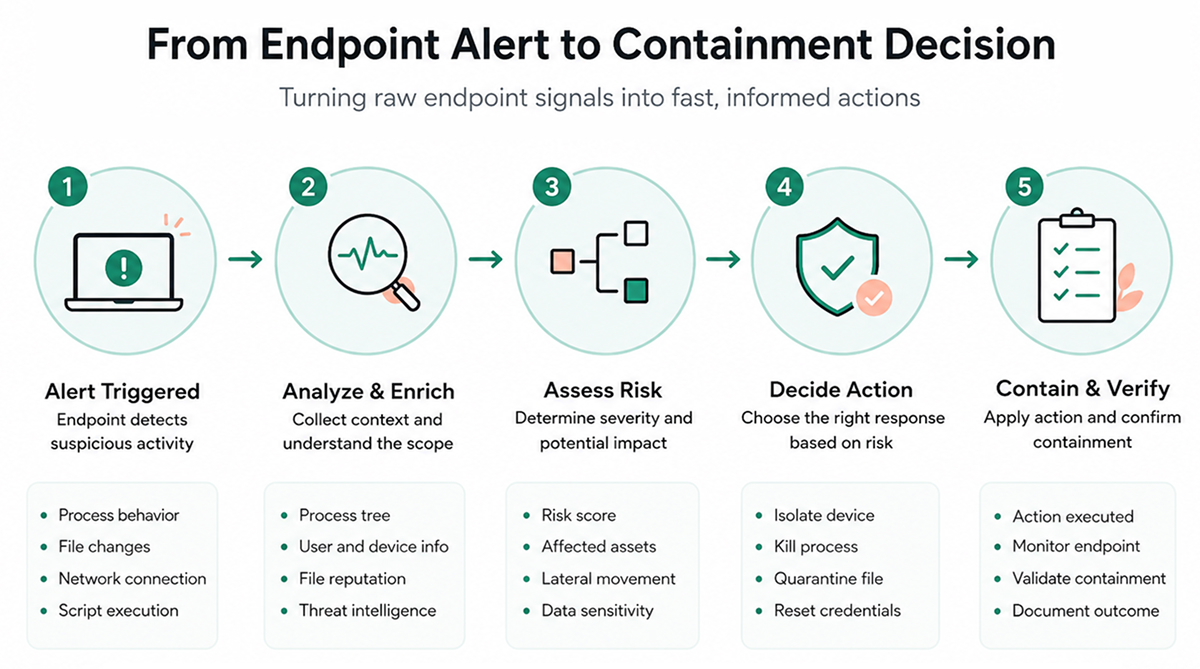
Security teams need more than “malware detected.” They need sufficient evidence to decide whether to isolate the host, kill a process, rotate credentials, remove persistence, or search for related behavior across the fleet.
Core Components of a Next-Gen Endpoint Stack
Next-gen endpoint protection usually combines several layers. The endpoint also needs to produce useful evidence when something gets through.
- Detection model: Uses signatures, behavior, reputation, machine learning, and known indicators to detect suspicious files, scripts, and processes.
- Endpoint telemetry: Collects process trees, command-line activity, file and registry changes, network connections, and user context.
- Response controls: Support actions such as host isolation, process termination, quarantine, rollback, and policy enforcement.
- Threat intelligence: Connects observed activity to known infrastructure, attack patterns, malware families, and campaigns.
- Central policy management: Maintains consistency in rules, exceptions, response actions, and endpoint coverage across the organization.
Engineering environments make this clear. Developers run package managers, local containers, debuggers, shell scripts, build tools, unsigned internal utilities, and test services. A strict policy may disrupt normal work. A weak policy may allow risky behavior to pass quietly.
Effective next-generation endpoint protection requires sufficient context to distinguish expected developer activity from suspicious execution. This means policies should reflect real-world workflows rather than treat every uncommon process as an attack.
Next-Gen vs. Traditional Endpoint Security
Traditional endpoint security was built around simpler device patterns and known bad files. That does not make it useless. Antivirus, allowlists, local firewalls, patching, and device hardening still matter.
The limitation is that modern attacks often avoid obvious malware files. Attackers may use trusted tools already on the machine. They may run scripts, abuse credentials, modify startup behavior, or move through remote management channels.
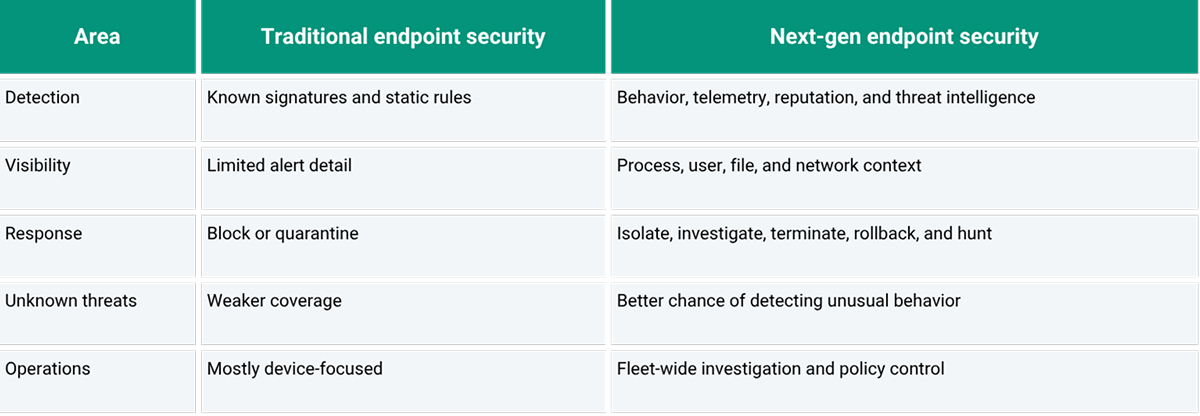
The biggest difference becomes apparent after the first alert. In an older setup, an analyst may need to manually collect logs from several systems. With next-gen EDR, endpoint data should already be searchable. The analyst can ask whether the same process, command, file hash, or network connection appeared on other devices.
That search capability is one reason endpoint telemetry matters. A single alert may be noisy. The same behavior across several machines, users, or business units changes the severity of the investigation.
That does not remove judgment. It reduces blind spots. Analysts still need to determine whether the activity is malicious, expected, or simply poorly understood internal tooling.
Next-gen endpoint tools are also useful for fileless attacks and living-off-the-land behavior. These attacks use tools such as shell interpreters, scripting engines, credential utilities, and remote administration features. One command may look normal, but the sequence may not.
Use Cases Across the Modern Enterprise
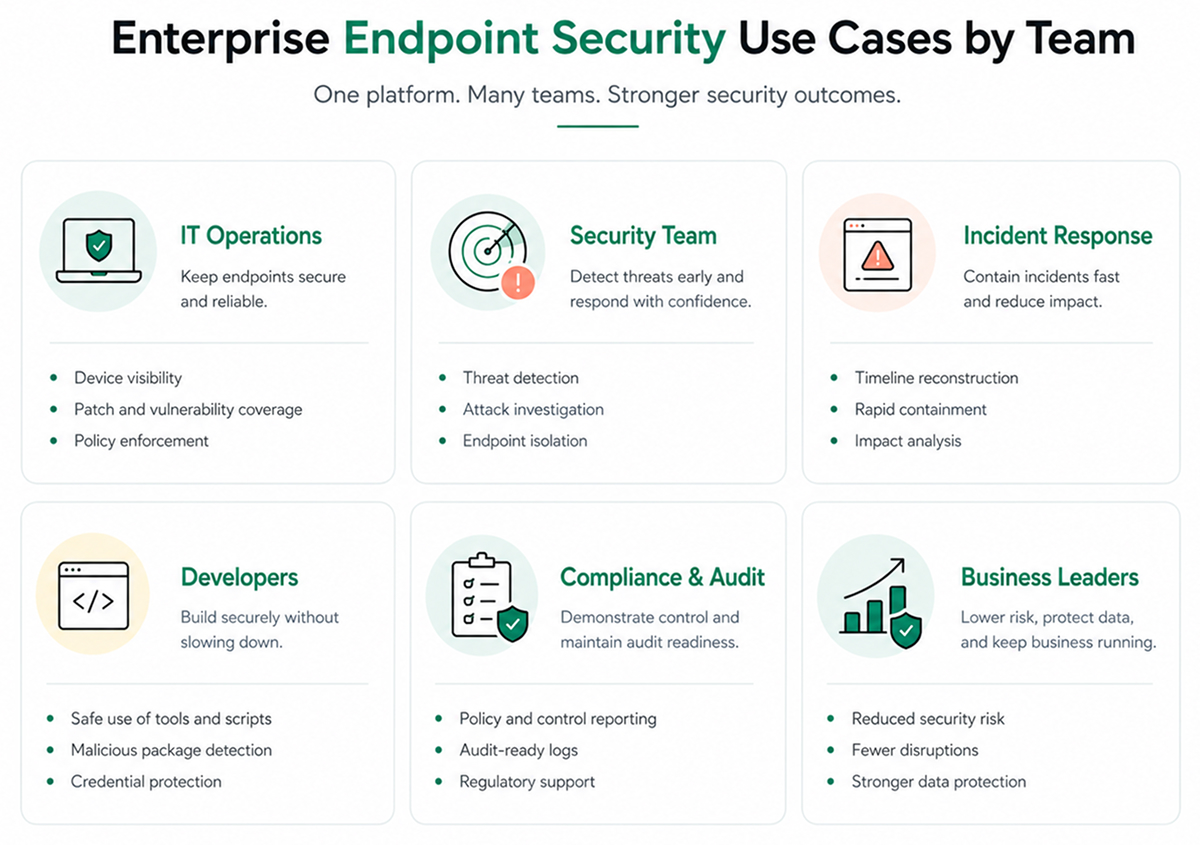
The obvious use case is malware protection, but that is too narrow. Endpoint security now touches incident response, remote work, developer workflows, compliance, and operational risk.
For ransomware defense, endpoint controls can detect suspicious encryption behavior, stop processes, isolate affected machines, and help teams identify the first host to be affected. Rollback may help in some cases, but it should never replace tested backups.
For remote work, endpoint security enables teams to enforce policies beyond the office network. A laptop on home Wi-Fi still needs monitoring, patch visibility, device posture checks, and response controls. VPN-only thinking leaves too much uncovered.
For developer environments, endpoint telemetry can help catch malicious package scripts, unexpected credential access, unusual outbound connections, or abuse of local build tools. The goal is not to block every script. The goal is to detect behavior that does not align with the normal developmental path.
For compliance, endpoint logs can support audit trails around device posture, incident response, and security control coverage. This only works if logs are complete, searchable, and retained long enough to answer real questions.
For incident response, next-generation endpoint security gives responders a starting point. It also helps them avoid treating every alert as an isolated incident. They can inspect timelines, search for indicators, isolate hosts, confirm containment, and check whether the same behavior exists elsewhere.
Final Thoughts
Next-generation endpoint security is not about replacing every legacy control. It is about closing the gap between prevention and response.
The endpoint is where much of the real attack activity becomes visible. A useful stack should detect suspicious behavior, provide sufficient context, and enable teams to act without guessing.
FAQs
1. What makes endpoint security considered next-gen?
Behavioral detection, richer telemetry, automation, and active response controls.
2. How does next-gen EPP differ from EDR?
EPP prevents threats. EDR investigates and responds after detection.
3. Is antivirus part of next-gen endpoint protection?
Yes. Antivirus remains one layer, not the full strategy.