
Policy enforcement is the process by which a written security rule becomes part of how systems, tools, and workflows actually behave. A company may prohibit employees from using unapproved tools to share customer records or require developers to use multi-factor authentication before accessing production systems. On paper, both rules look simple. In daily work, they only matter if the system can apply them at the right moment. That is why policy enforcement matters across access control, data movement, cloud systems, AI tools, and policy violation response.
What Is Policy Enforcement in Cybersecurity?
Cybersecurity policy enforcement means implementing security policies across an organization’s workflows, users, systems, and devices. It is the working layer between a written rule and the action a user is allowed to take. In most organizations, this includes access control, user authentication, data protection, device security, application permissions, cloud configuration, and compliance requirements.
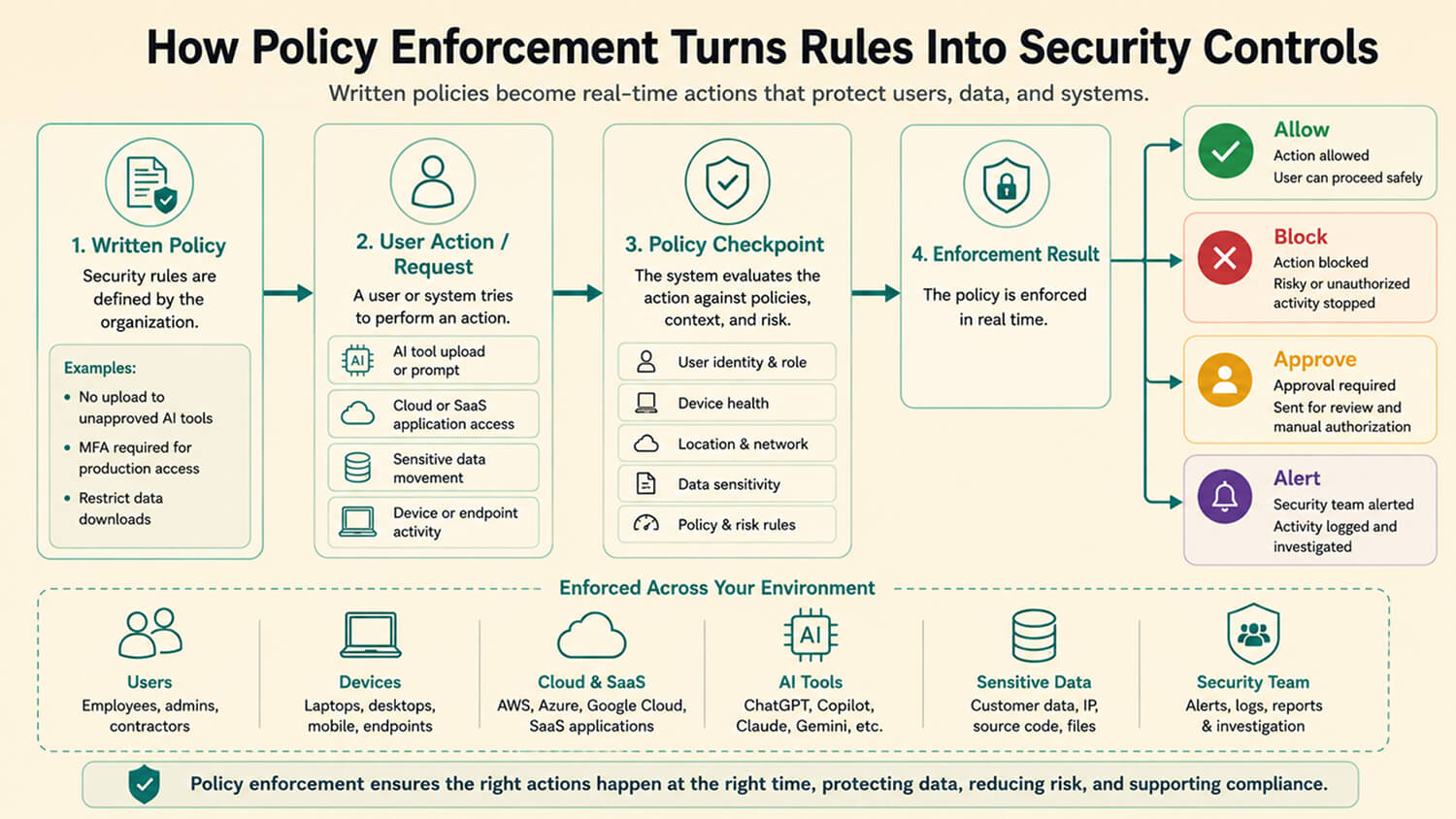
For example, a company may have a policy stating that customer data cannot be copied into public AI tools. Security policy enforcement makes that rule practical. It may detect the upload, block it, warn the user, or create an alert for the security team. In some cases, it may allow the action only after approval.
Without enforcement, a policy is mostly documentation. It may help during audits, but it does not reduce risk unless it changes system behavior.
Types of Security Policies Organizations Must Enforce
Most organizations need to enforce several types of security policies at the same time. The most common ones include:
- Access policies: who can access systems, files, dashboards, and admin tools.
- Authentication policies: when MFA, SSO, or stronger verification is required.
- Data protection policies: how sensitive data can be stored, shared, copied, or exported.
- Device policies: which laptops, browsers, extensions, and endpoints are allowed.
- Cloud policies: how storage, permissions, workloads, and configurations should be managed.
- AI usage policies: which employees can submit to AI tools and which AI applications are approved.
These policies often overlap. A developer using an AI coding assistant may trigger access, data, application, and AI governance rules at the same time. That is why policy enforcement needs context, not just a simple allow-or-block decision.
Manual vs. Automated Policy Enforcement
Manual policy enforcement requires reviews, audits, approvals, and employee reporting. It still has value. Certain decisions require context, particularly when a high-risk action may affect production systems, customer information, or legal requirements.
The problem is scale. Manual review cannot keep up with hundreds of SaaS tools, cloud services, developer workflows, and AI applications. By the time a policy violation is identified in an audit, the data may already have been exposed.
Automated policy enforcement is used when waiting for a manual review would be too slow. The control sits close to the action and applies the rule while the user is doing the work. It might stop a risky upload, revoke an unsafe permission, request another approval step, notify security, or record the event in an audit log.
Consider a developer trying to paste source code into an AI tool that the company has not approved. A basic policy document cannot stop that. An enforcement control can block the upload, explain why it was blocked, and still allow the same developer to use an approved AI tool for lower-risk work. That keeps the rule practical instead of turning it into a blanket ban.
In AI-heavy environments, tools like Pluto Security can help teams see where AI tools are being used and where sensitive data may be involved. That’s because not every AI workflow is something that security teams want to block. They need a way to guide employees toward approved tools without pushing them into shadow AI usage.
Common Challenges in Enforcing Security Policies at Scale
Policy enforcement becomes harder as organizations grow. Employees use more SaaS tools, cloud services, browser extensions, AI assistants, personal devices, and third-party integrations. It’s not always possible for security teams to know where data is going or which tools are being used.
Another challenge is policy drift. A rule may be correct when written, but it may become outdated after a new product launch, a cloud migration, or a change in department workflow. Over time, exceptions also pile up. What starts as a single temporary access request can become a permanent risk.
False positives create another problem. If enforcement blocks too much normal work, users look for workarounds. Good policy enforcement should reduce risk without making daily work unnecessarily difficult.
More rules will not fix weak enforcement. Security teams need clear rules that can be applied consistently where employees actually work.
Final Thoughts
Policy enforcement is what keeps security policies from becoming passive documents. The strongest approach is not to block everything or add more rules. It is to apply clear controls where real work happens, especially across cloud tools, SaaS apps, AI systems, and sensitive data workflows.
FAQ
How often should organizations review and update their security policies?
Most organizations should review security policies at least once or twice a year. That schedule is insufficient when the environment changes quickly. A new cloud platform, AI tool, compliance requirement, merger, or security incident should trigger an earlier review, even if the normal review cycle has not yet arrived.
What is the difference between policy enforcement and policy monitoring?
Policy monitoring tracks activity and reports violations of a rule by users or systems. As soon as the policy is important, there is policy enforcement. For instance, it could be observed that a user posted sensitive data on an unauthorized tool. Uploading may be denied, approved, or it could alert the security team.
How does policy enforcement work across hybrid and multi-cloud environments?
Across hybrid and multi-cloud environments, policy enforcement usually depends on shared identity controls, cloud security rules, logging, and automation. The hard part is maintaining consistency. A storage rule on AWS, an access rule on Azure, and a SaaS permission rule should all support the same security policy rather than function as separate controls.