
A customer support agent passes functional tests and rejects obvious jailbreak attempts. During a security exercise, a tester embeds malicious instructions in a document the agent can retrieve. The model follows the hidden instruction and attempts to call an internal tool with broader access than the task requires. That is the kind of failure AI red teaming is designed to uncover.
What Is AI Red Teaming?
AI red teaming is controlled adversarial testing of AI models, applications, and agents to identify security and safety weaknesses before they are exploited. Rather than checking only whether an application works, an AI red team deliberately tries to make the system cross its intended boundaries.
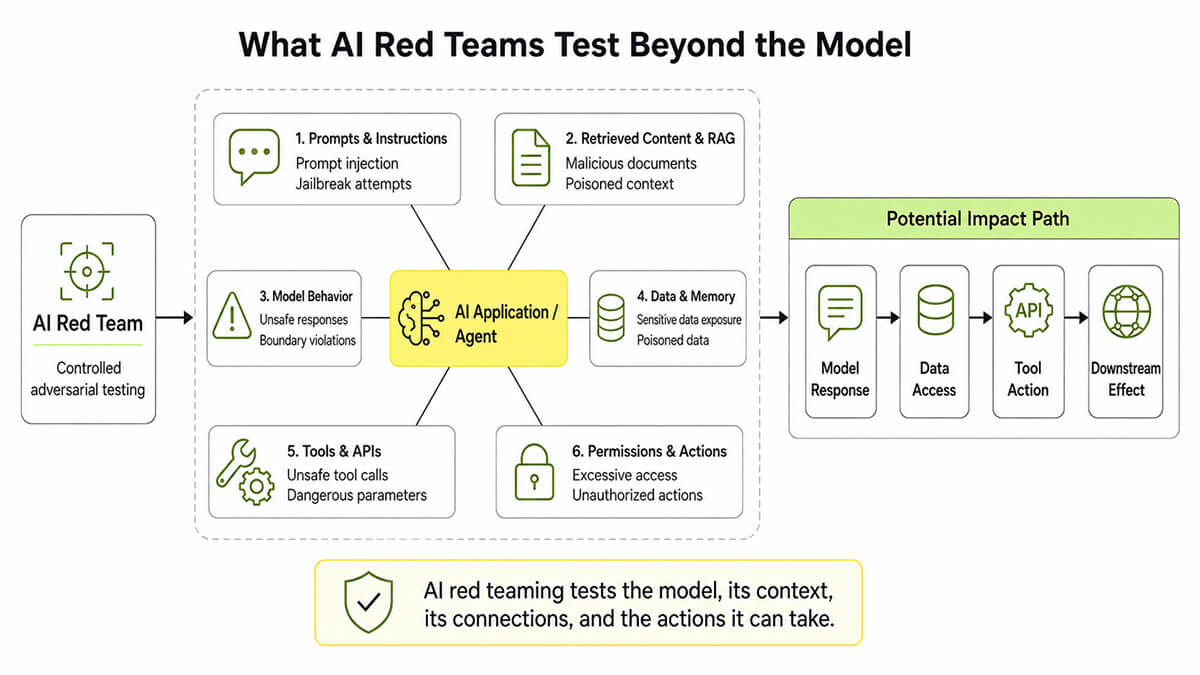
The scope can include the model, prompts, retrieval pipelines, training or embedding data, tool integrations, APIs, permissions, and output handling. Hack The Box describes AI red teaming as attacking your own AI models and systems to identify weaknesses and strengthen defenses. LLM red teaming applies this approach specifically to large language model applications.
What AI Red Teams Actually Test For Beyond Traditional Penetration Testing
Traditional penetration testing still matters because AI applications run on standard infrastructure, APIs, identities, and cloud services. AI systems add another behavioral layer. Model outputs can vary, external content can influence context, and agents may dynamically select tools or actions.
Testing therefore needs to cover abuse paths such as prompt injection, disclosure of sensitive information, poisoned data, unsafe output handling, and excessive agency. OWASP’s current guidance for securing LLM and GenAI applications addresses these attack paths. MITRE ATLAS provides a knowledge base of adversarial techniques against AI-enabled systems.
For an agent, the question is not only, “Can the model be jailbroken?” Testers also need to ask:
- Can untrusted retrieved content change the agent’s behavior?
- Can the agent access data outside the intended scope?
- Can it be called a legitimate tool with dangerous parameters?
- Can output trigger an unsafe downstream action?
This is why red teaming AI models should include the surrounding application and its trust boundaries, not just a chat interface.
How AI Red Teaming Fits Into a Broader AI Security Program
A red team engagement demonstrates how a system behaves under selected adversarial scenarios. It does not replace secure development, access control, policy enforcement, logging, or production monitoring. Those controls must operate before and after the assessment.
Findings should inform engineering work. A successful prompt injection may lead to stronger trust boundaries, better handling of untrusted content, and tighter tool permissions. Unexpected data access may expose a weakness in AI agent access control. Unsafe behavior may also underscore the need for AI agent monitoring that records retrieval steps, tool calls, policy events, and outcomes.
The cycle is straightforward: map the attack surface, test realistic abuse cases, fix weaknesses, retest, and monitor as the system evolves.
Common Findings From AI Red Teaming Engagements
Many findings stem from interactions among components rather than from a single dramatic model flaw. A model may behave reasonably on its own but become risky once it can access private data or high-impact tools.
Common findings include prompt injection altering intended application behavior, sensitive data appearing in responses, weak separation between trusted and untrusted contexts, excessive tool permissions, missing approval gates, or generated output reaching another system without sufficient validation. OWASP groups several of these risks under prompt injection, sensitive information disclosure, improper output handling, and excessive agency.
Severity depends on what the application can access. A manipulated chatbot that produces an incorrect answer is different from an agent that can modify billing records, send messages, or execute code.
How to Build or Outsource an AI Red Teaming Function
An internal AI red team usually needs expertise beyond conventional offensive security. Useful skills include application security, cloud and identity security, machine learning fundamentals, prompt and agent behavior, data pipelines, and threat modeling. Testers also need sufficient product context to recognize a genuine security boundary violation.
Organizations lacking those skills may use specialized AI red teaming services. Before testing begins, the engagement should define the scope, permitted techniques, sensitive systems, success criteria, reporting requirements, and expectations for retesting. Outsourcing does not eliminate internal ownership, as engineers still need to understand and remediate the findings.
Start with the highest-impact workflows. An internal summarization assistant and an autonomous agent with production write access should not undergo the same level of testing.
Final Thoughts
AI red teaming is most useful when it tests the full AI workflow rather than treating the model as an isolated target. Models, retrieval systems, data, tools, permissions, and downstream actions can all affect the outcome.
The goal is not to prove that an AI system is “secure.” Instead, it is to identify realistic failure paths, reduce them, and continue testing as the application evolves.
FAQs
How often should organizations run AI red teaming exercises?
Run them after major changes and regularly for higher-risk AI systems.
Does AI red teaming require different skills than standard red teaming?
Yes. It adds security knowledge for models, prompts, data, and agents.
Can AI red teaming be automated, or must it be done manually?
Both. Automation scales testing; humans uncover novel abuse paths.