
An AI agent may start with a simple task: summarizing support tickets, checking a cloud environment, or updating records after approval. Trouble arises when the agent is granted access to more systems and actions than the task requires. Broad permissions make development easier, but they also increase the risk of harm if the agent makes a bad decision, is manipulated, or uses a tool outside its intended scope.
An overprivileged agent is therefore more than an identity-management problem. It is an AI agent security issue shaped by autonomy, tool use, and the speed at which agents can act across systems.
What Is an Overprivileged Agent?
An overprivileged agent is an AI agent with more access rights than it needs to complete its assigned work. A support agent that only reads customer cases, for example, should not also be able to delete records, modify billing data, or query unrelated HR systems.
The risk stems from capability, not necessarily intent. Agents may choose tools dynamically, combine information from several sources, or act on instructions inside external content. Pluto’s guidance on AI agent access control notes that agents often work from goals rather than fixed execution paths, making broad static permissions harder to justify.
How AI Agents End Up With More Access Than They Need
Most excessive access stems from routine engineering decisions. A team wants an agent to run quickly, so it reuses a service account, assigns an existing IAM role, or grants broad API scopes to avoid permission failures. The prototype reaches production, and those permissions persist.
Access can also grow as the workflow changes. New tools are added, temporary access becomes permanent, and old capabilities persist even after the agent stops using them. Sonrai describes this widening gap between assigned permissions and actual usage as privilege drift.
Shared identities make cleanup harder. If several agents use the same role or credential, teams may not know which workload requires each permission. Removing access then feels risky because nobody wants to risk breaking production.
The Business Risk of Overprivileged Agents in Production Environments
Excess permissions increase the blast radius. If prompt injection, a compromised tool, faulty reasoning, or a configuration mistake changes the agent’s behavior, the impact is largely limited by what its identity is authorized to do.
An agent with unnecessary privileges could expose sensitive data, modify cloud resources, trigger downstream workflows, or perform destructive actions beyond its intended task. QWEY highlights similar scenarios, including data exfiltration, tool misuse, and prompt injection.
There is an operational cost as well. Broad AI agent permissions make investigations harder because security teams must determine what the agent did and which available actions were legitimate. Audit work also becomes more difficult when a single identity reaches unrelated systems.
How Least Privilege Principles Apply Differently to AI Agents Than Human Users
The basic idea of least-privilege AI agents is familiar: grant only the access needed for the job. What changes is how the job is performed.
Human access is often tied to stable responsibilities. An agent may receive a goal and decide at runtime which tools, data sources, and intermediate steps it needs. Recent research on privilege-aware tool selection suggests that agents do not reliably choose the lowest-privilege option on their own, especially when tools fail and the agent retries via another path.
That means agent access control should consider more than a fixed role. Permissions can be scoped by task, tool, resource, action, and time. High-risk capabilities may require approval, and temporary elevation can be granted only for a specific operation.
How to Identify and Remediate Overprivileged Agents in Your Environment
Start by comparing what an agent can access with what it actually uses. Permission reviews are stronger when identity configuration is paired with runtime activity rather than policy documents alone.
A practical review should include:
- Give each agent or workload an identifiable security principal where possible.
- Inventory its APIs, tools, data stores, cloud roles, and write capabilities.
- Compare granted permissions with observed usage over a representative period.
- Remove unused access and separate unrelated workloads sharing credentials.
- Replace standing elevated permissions with short-lived or just-in-time access.
- Require approval before destructive, sensitive, or high-impact actions.
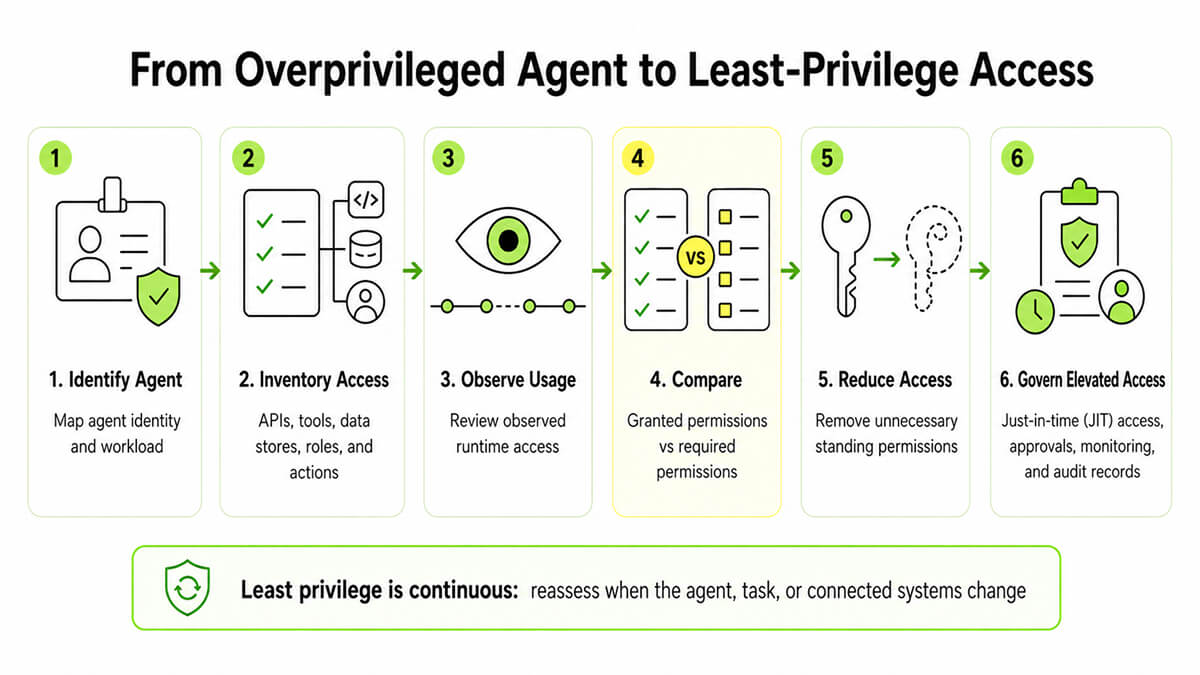
These controls reflect the same themes as Pluto Security’s existing guidance on identifiable agent identities, scoped credentials, runtime monitoring, and approval events.
Pluto Security can support this process by providing visibility and guardrails across AI workflows and integrations. This does not replace IAM controls. It helps teams see how agent permissions are applied during execution.
Final Thoughts
An agent does not need malicious intent to be dangerous. If it can access systems and perform actions beyond its intended role, even a normal mistake or a manipulated instruction can have a much larger impact than expected.
Least privilege keeps that boundary smaller. The goal is not to remove useful capabilities but to ensure each permission is defensible, observable, and limited to the work the agent should perform.
FAQ
Why do AI agents accumulate excess permissions over time?
New capabilities are added, while old permissions are rarely removed.
How can teams audit which permissions an agent actually uses?
Compare assigned permissions with observed runtime access and tool activity.
Does least privilege slow down AI agent performance?
Not normally, provided the required permissions are available when tasks need them.