
AI applications can fail without a server crashing or an attacker stealing anything. Sometimes the system simply keeps performing expensive work until the cost becomes unacceptable.
That is the problem behind denial of wallet in AI. One request may trigger inference, retrieval, tool calls, retries, and other paid services, so the real cost is higher than the prompt itself.
What Is a Denial of Wallet Attack?
A denial-of-wallet attack forces an application to consume billable resources at the owner’s expense. The target is the system’s economic limit rather than a software flaw.
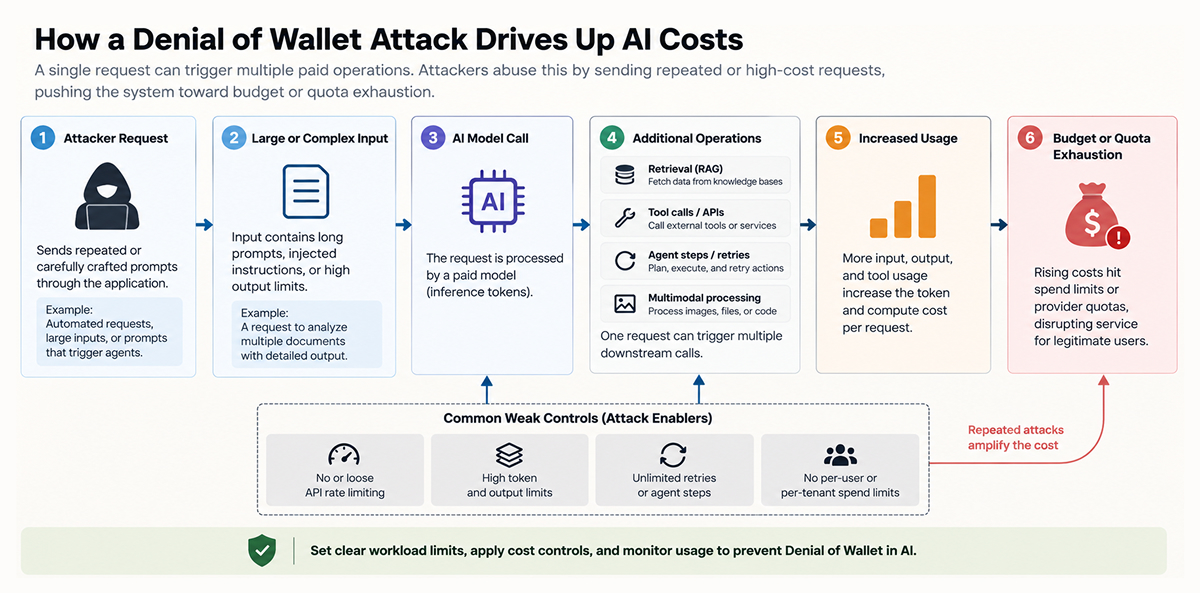
An attacker might send repeated prompts, submit large inputs, or craft requests that trigger expensive model behavior. OWASP describes this as unbounded consumption, in which uncontrolled inference can lead to financial loss and service degradation. A single request can also fan out into retrieval, model calls, image generation, or background jobs.
How Denial of Wallet Differs From Denial of Service
A denial-of-service attack primarily aims to make a system unavailable. Denial-of-wallet attacks focus on making legitimate-looking work financially burdensome.
The two can overlap. Burning through a project budget or a provider quota can eventually block legitimate users. The difference is mostly the pressure point: service capacity in one case, consumption cost in the other.
This is why API rate limiting helps but is not enough. Ten requests that each trigger a long agent workflow may cost far more than hundreds of small inference calls.
The Attack Vectors That Trigger AI API Cost Exhaustion
Cost exhaustion often comes from amplification behind the public endpoint:
- Repeated requests with large prompts or high output limits
- Agent loops that retry failed actions without a stopping condition
- Requests that repeatedly trigger retrieval, code execution, or paid APIs
- High concurrency from one account, tenant, or automated client
- Routing routine requests to unnecessarily expensive models
Poor retry logic, recursion, or tool chaining can turn a single prompt into many downstream operations. With agents, that work may continue after the user-facing request has completed.
The Real-World Impact of a Denial-of-Wallet Attack
The obvious impact is a larger model or cloud bill. The operational effects can be just as disruptive. A team may hit quotas, disable expensive features, throttle traffic, or reject legitimate requests to stop further spending. Cost spikes can hide within normal growth when usage is not attributed to user, tenant, workflow, or model.
For organizations running several AI systems, this falls under broader enterprise AI security. A cost anomaly may stem from a shared credential, an agent workflow, or a downstream service rather than the visible endpoint.
How to Protect AI Infrastructure Against Denial of Wallet
The first control is to limit the work being paid for, not just incoming requests. Set per-user or per-tenant limits on tokens, requests, concurrency, and spend. Add ceilings on output size, retries, agent steps, tool calls, execution time, and recursion depth.
Rate limits should be enforced at multiple layers. Enforce them at the application edge, then add model- or workflow-specific limits deeper in the execution path. Provider-side limits are a final boundary, not the only one.
Good LLM cost optimization also reduces exposure. Smaller contexts, sensible model routing, prompt caching, and avoiding repeated retrieval can lower request costs. These measures do not replace security controls, but they reduce the damage abusive traffic can cause.
Agentic systems need additional boundaries because costs can compound across autonomous actions. Agentic AI security should include scoped permissions, execution limits, logging, and clear stopping conditions.
Conclusion
Denial of wallet is mostly a problem of unbounded work. If a single prompt, user, or agent can trigger unlimited paid operations, the application has a financial failure mode even when the code is behaving as designed.
Protection requires both abuse controls and engineering limits on how much work the system may perform.
FAQ
1. Can denial-of-wallet attacks succeed without exploiting a vulnerability?
Yes. A legitimate feature may already enable expensive or repeated operations. Weak quotas, generous output settings, retry behavior, or unrestricted tool use can create sufficient cost amplification without requiring a traditional software exploit.
2. Does prompt caching reduce denial-of-wallet exposure?
It can reduce the cost of repeated input tokens when cached content is reused. It does not stop high request volume, expensive outputs, downstream tool calls, or uncached workloads, so the exposure only decreases partially.
3. Can AI agents trigger denial-of-wallet attacks accidentally?
Yes. Retry loops, unclear completion criteria, repeated delegation, or failing tools can produce the same cost pattern without an attacker. The cause differs, but the result is still uncontrolled paid work.
4. Which AI API providers have built-in denial of wallet protections?
Major providers such as OpenAI, Anthropic, and Google offer controls including request and token rate limits, usage tiers, and in some cases spend limits. These controls help, but application-level budgets and workflow limits are still needed.