
A service can have legitimate permissions and still become a security problem. The issue arises when a less-privileged caller convinces the service to use its authority for the wrong purpose.
This can lead to the confused deputy problem. AI agents make the pattern easier to reproduce because they sit between users, tools, credentials, APIs, and other agents.
What Is the Confused Deputy Problem?
A confused deputy is a trusted component with privileges that acts on behalf of a requester without properly verifying whether the requester should trigger the action. The attacker does not need the deputy’s credentials. They only need a way to make the deputy use them.
The classic example involved a compiler that could write to a protected accounting file. Users could choose where debugging output was written. By naming the accounting file as the destination, a user without direct access could make the compiler overwrite it. The compiler had legitimate authority, but the user controlled how that authority was applied.
Least privilege limits what a deputy can misuse, but smaller permissions alone do not secure the boundary. Authorization also needs to bind the requester, target, operation, and context before the privileged action runs.
How the Confused Deputy Problem Applies to AI Agents
AI agents often act as software deputies. A coding agent may read repositories, execute shell commands, query cloud APIs, or update tickets. The user requests an outcome, while the agent selects the actions.
Trouble starts when untrusted input influences that choice. A poisoned document, tool response, web page, or prompt may push the agent to call a tool the attacker could never invoke directly. If that tool runs under a user’s cloud session or a broad service account, the agent can turn input manipulation into privilege escalation.
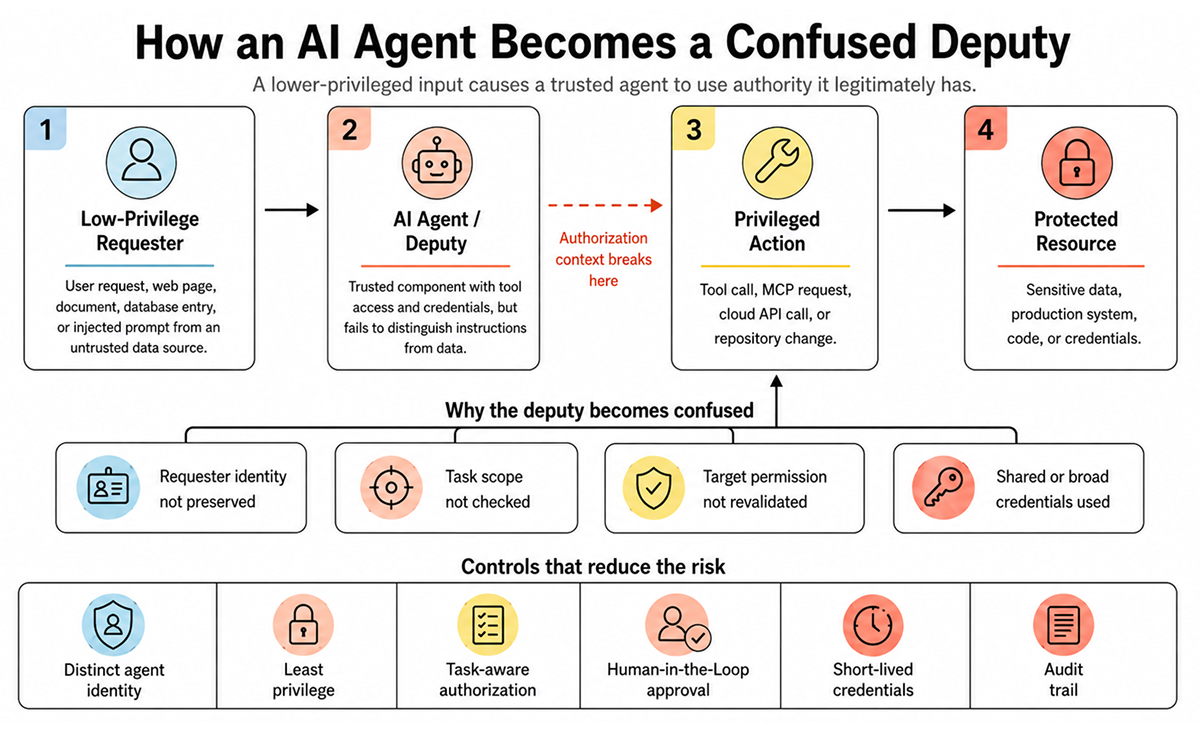
This is why AI agent authorization cannot stop at login. Sensitive tool calls may require separate authorization based on the agent identity, originating user, operation, target, and current task. Agents that inherit a user’s security context make this harder because their activity can look like normal user activity.
MCP presents a similar case. An MCP server or proxy may sit between a client and third-party APIs. The MCP specification warns of the confused deputy risk when authorization codes, token audiences, or downstream credentials are mishandled. It also forbids passing the client’s token to upstream services.
Why AI Agents Are Structurally Prone to Confused Deputy Attacks
The problem is not simply that an agent has privileges. The agent combines authority with inputs whose trustworthiness may change while the task is running.
Common risk patterns include:
- Shared authority: The agent uses a human session, shared service account, or long-lived API key instead of a constrained identity.
- Mixed-trust context: Instructions, retrieved documents, tool output, and external content feed the same decision loop.
- Chained execution: One call can trigger another service or agent, making it easy to lose track of the original requester.
- Broad tool access: The agent can modify more resources than the current task requires.
These risks also overlap with AI agent supply chain attacks. A compromised tool or dependency can provide misleading input, while the agent provides the trusted execution path.
Good non-human identity security requires more than protected credentials. Give agents distinct identities where possible, use short-lived credentials, limit permissions, and re-check authorization for high-risk actions. Logs should record who initiated the task and which identity performed each action.
Conclusion
The confused deputy problem is a mismatch between who has authority and who controls how it is used. AI agents create more of these boundaries, so least privilege requires task-aware authorization and clear identity separation.
FAQs
1. Is the confused deputy problem unique to AI agents?
No. It predates modern AI and appears across operating systems, cloud services, APIs, and automation. AI agents increase exposure because untrusted inputs can influence software that already has useful privileges.
2. How does an MCP proxy become a confused deputy?
An MCP proxy can become a deputy when it uses stored downstream authority for a client request without preserving the correct user, consent, token audience, or resource context. Token passthrough can also create a similar boundary failure.
3. Does object capability security solve the confused deputy problem?
Capability systems address the classic issue by binding authority to the designated object rather than relying on ambient privilege and attacker-controlled names. They reduce the risk, though leaked or overbroad capabilities can still cause security failures.
4. Does the confused deputy problem apply differently in multi-agent systems?
The core issue remains the same, but delegation chains grow longer. One agent may ask another to use different credentials, so each hop must preserve the initiating identity, the intended task, and constrained authority.
5. How does a confused deputy differ from prompt injection?
Prompt injection manipulates an AI system’s instructions or decision process. A confused deputy failure occurs when a trusted component misuses legitimate authority for a manipulated request. Prompt injection can trigger it, but the two are not the same.