
Retrieval-augmented generation lets a model answer questions using current, private, or domain-specific information without retraining. The weak point is easy to miss. The model may be protected, while the documents it retrieves are not.
RAG poisoning targets the retrieval layer. An attacker changes what the system is likely to retrieve, then lets the normal RAG pipeline carry manipulated content into the model context.
What RAG Poisoning Changes
A typical RAG request converts a user query into an embedding, searches a document or vector store, selects relevant chunks, and supplies them to the model. Those chunks can influence the final answer even though the underlying model weights never change.
A RAG poisoning attack exploits this dependency by inserting or modifying content in the retrieval corpus. OWASP defines document poisoning as malicious content entering the corpus and affecting model behavior when that content is later retrieved. The poisoned material might include false facts, altered procedures, misleading links, or instructions intended to override expected behavior.
This is why retrieval-augmented generation security cannot stop at prompt filtering. Retrieved documents are another input boundary.
How Poisoned Content Gets In
The attack does not always require direct access to a vector database. Production systems often build knowledge stores from shared drives, support tickets, wikis, uploaded PDFs, synced websites, and internal document repositories.
A realistic path is an employee uploading a document that appears routine. An ingestion job extracts the text, splits it into chunks, creates embeddings, and adds them to the index. If the pipeline trusts the source because it is internal, malicious instructions or manipulated facts can become retrievable without another security check.
Common entry points include:
- Compromised or attacker-controlled source documents
- Employee uploads with weak validation or review
- Connectors that automatically ingest external content
- Modified pages that are periodically re-indexed
- Unauthorized writes to document stores or ingestion pipelines
This form of knowledge base poisoning can be quiet. Nothing necessarily crashes, and normal queries may still work.
Why Retrieval Makes the Attack Effective
RAG systems are designed to give retrieved context substantial influence. That is the point of grounding. A model that ignored retrieved information would be far less useful for internal documentation, policy lookup, or current product data.
Attackers can exploit the same mechanism. They may craft content to rank highly for specific query patterns, place misleading text near expected keywords, or embed indirect prompt injection instructions within a plausible document. OWASP notes that modified repository content can alter model output when a matching query retrieves it.
The effect is not automatically global. One poisoned chunk may affect only queries that retrieve it, whereas a broadly relevant document can influence a larger set. Research has also shown that even a single poisoned document can sometimes dominate retrieval for targeted queries, so document count alone is a poor measure of exposure.
Controls That Matter
Treat the ingestion pipeline as a security-sensitive data path, not a background indexing task. Most of the useful controls are familiar engineering controls applied at a different boundary.
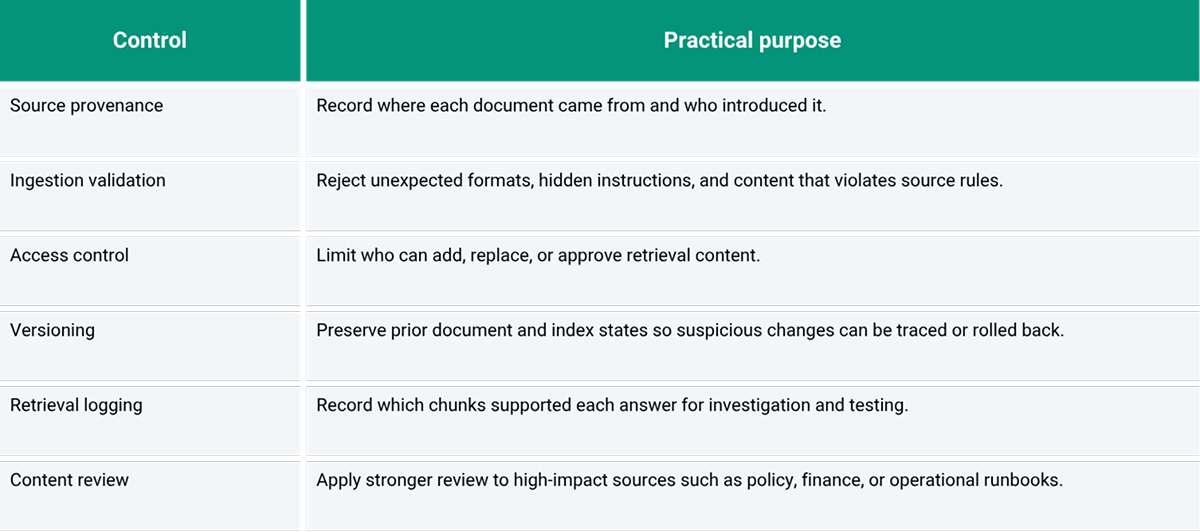
No single filter solves AI data poisoning. Teams need tests that query sensitive topics, inspect retrieved documents, and flag unusual source changes. For organizations managing RAG alongside other AI workflows, Pluto Security can provide visibility, risk understanding, and real-time guardrails across AI-driven activity.
Monitoring should cover ingestion and retrieval. A sudden increase in a document’s retrieval frequency, unexpected source changes, or answers grounded in newly added content may warrant investigation.
Conclusion
RAG adds a data path that must be secured like any other production dependency. The model may remain unchanged, and the application may appear healthy while retrieved content quietly steers answers in the wrong direction.
Good defenses start with control over what enters the corpus, traceability of what is retrieved, and enough testing to notice when either changes.
FAQ
1. How is RAG poisoning different from training data poisoning?
Training data poisoning manipulates data used in pre-training or fine-tuning, potentially altering the model’s learned behavior. RAG poisoning targets external knowledge retrieved at inference time. The model weights may remain unchanged, so remediation may involve removing or correcting poisoned documents rather than retraining the model.
2. Can RAG poisoning occur through employee-uploaded documents?
Yes. If employee uploads are automatically parsed and indexed, a malicious or compromised document can enter via a legitimate workflow. Risk increases when uploads are trusted by default and the ingestion pipeline lacks provenance tracking, content validation, approval rules, or restricted write access.
3. Does RAG poisoning affect one answer or the whole knowledge base?
It depends on retrieval behavior. A narrowly targeted poisoned chunk may affect only a small set of queries, whereas a document designed to match common queries can have a broader impact. The entire knowledge base need not be corrupted for the attack to matter.