
Almost every language model your team uses today, from the chat assistant in the browser to the coding agent in the terminal, runs on the same design. The transformer architecture was introduced in 2017, and understanding how it works helps you judge what these models can do and what they expose.
What Is Transformer Architecture?
Transformer architecture is a neural network design that processes a whole sequence of tokens at once. It was described in the Google paper “Attention Is All You Need.” Older models read text one word at a time. A transformer looks at every token together and figures out how each relates to the others, making GPU training much faster and letting models grow from millions of parameters to hundreds of billions.
How Transformer Architecture Works
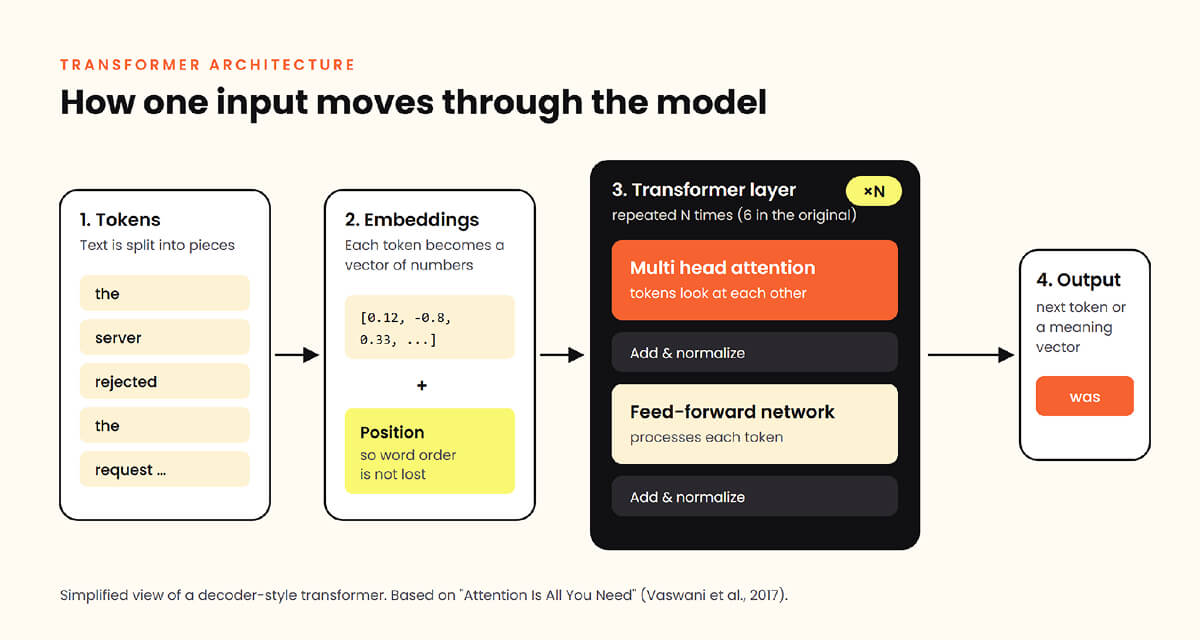
The model first splits text into tokens, and each token becomes a vector called an embedding. Because the model sees all tokens at once, it adds positional information so “dog bites man” differs from “man bites dog.”
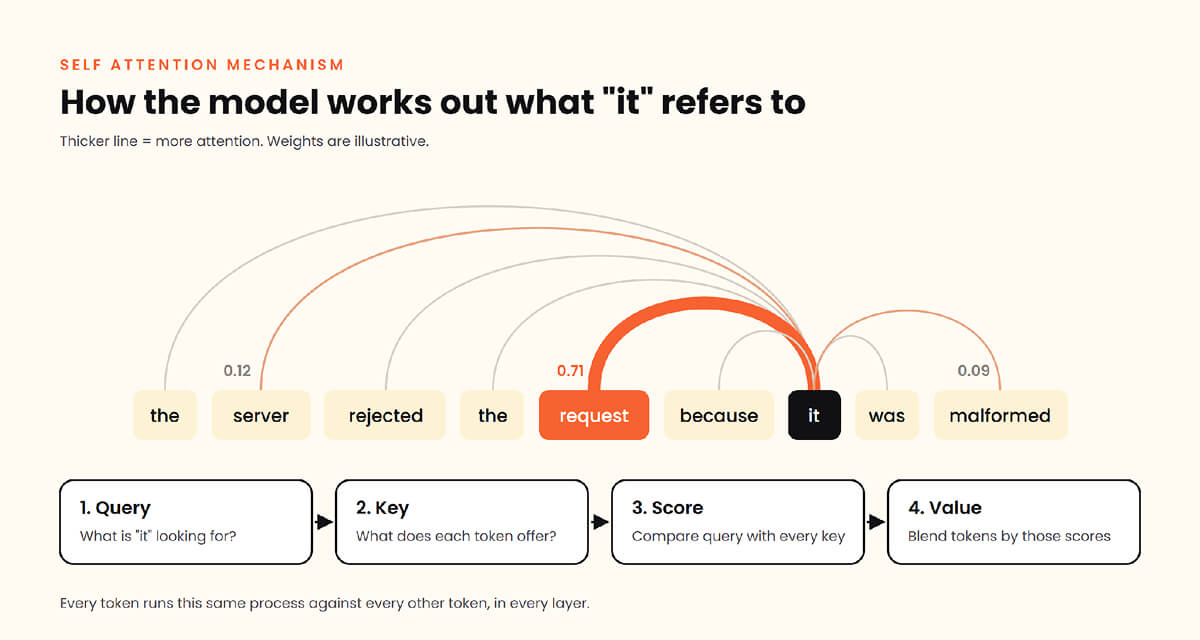
Then the self-attention mechanism does the heavy lifting. For each token, the model creates a query, key, and value vector. It scores one token’s query against every other token’s key and uses those scores to blend the values. In the sentence “the server rejected the request because it was malformed,” attention links “it” to “request,” not “server.” Stack dozens of these layers and the model gets a detailed picture of the input.
Components of a Transformer Model
A standard transformer layer has a few repeating parts:
- An embedding layer and positional encoding that turn tokens into vectors
- Multi-head attention, which runs several attention operations side by side
- A feed-forward network that processes each token after attention
- Residual connections and layer normalization that keep training stable
Multi-head attention splits the self-attention mechanism into parallel heads, and the original model used eight. One head might follow grammar while another tracks which variable a line of code refers to. Their outputs are then joined. The original paper paired an encoder stack, which reads input, with a decoder stack that generates output token by token.
Types of Transformer Models
Most models keep one or both halves of that design. Encoder-only models such as BERT are good at understanding text and show up in search and classification. Decoder-only models such as GPT generate text and power most chat assistants and coding tools. Encoder-decoder models like T5 suit translation and summarization.
Transformer Architecture Security Risks
The design that makes transformers flexible also makes them easy to manipulate. A model cannot reliably distinguish instructions from data because both arrive as tokens in the same context. That is why prompt injection sits at the top of the OWASP Top 10 for LLM Applications. Hidden instructions in a README can steer a coding agent, as seen in this Claude Code prompt injection case.
The model files are another risk. Teams pull pre-trained weights from public hubs, and some formats can run code when loaded. Poisoned training data and unverified fine-tunes make it worse, as this piece covers AI supply chain security for reused models and prompts. Pluto Security helps teams see which AI tools and models the organization uses.
Final Thoughts
Transformer architecture is simple to describe but hard to secure. Attention lets a model weigh every token against every other, and that same property lets one hidden instruction change its behavior. Treat the models, their weights, and their inputs as part of your attack surface.
FAQ
Why did transformers replace RNNs and LSTMs?
RNNs and LSTMs process tokens one after another, so they train slowly and lose context across long passages. Transformers process tokens in parallel and use attention to connect distant words directly. That made training on large GPU clusters practical and gave much better results on long text.
How many parameters does a typical transformer have?
There is no single typical size. The original 2017 base transformer had about 65 million parameters. BERT-base has around 110 million, GPT-3 has 175 billion, and current open-weight models range from about 1 billion to over 400 billion. Size depends mostly on layer count and hidden dimension.
Do vision models also use transformer architecture?
Yes. The Vision Transformer (ViT), published by Google in 2020, splits an image into patches, often 16 by 16 pixels, and treats each patch as a token. The same attention layers work out how patches relate. Transformers are now common in image classification, object detection, and multimodal models.
What limits a transformer’s context window length?
Attention compares every token with every other token, so its cost grows with the square of the sequence length. Doubling the input roughly quadruples the attention workload. The model also stores keys and values for every token during generation. GPU memory, training data, and positional encoding choices all cap the practical window.
Can transformer models run on local devices?
Smaller models can. Models in the 1 to 8 billion parameter range run on modern laptops and some phones, especially after quantization reduces weights to 4 or 8 bits. Tools such as llama.cpp make this simple. Very large models still need data center GPUs, so local use trades some quality for privacy and cost.