
AI agents no longer just answer questions. They run shell commands, install packages, edit files, and call APIs on their own. Each of those actions needs a safe place to run. An agent sandbox is that place, and how it is set up decides how much damage a confused or manipulated agent can do.
What Is an Agent Sandbox?
An agent sandbox is an isolated environment where an AI agent executes code and tool calls without affecting the host machine or production systems. It provides the agent with its own filesystem, processes, and network rules. If the agent runs rm -rf on the wrong directory or pulls a malicious package, the blast radius remains contained within the box. Most sandboxes are disposable: they are created for a task and discarded when the task ends.
How an Agent Sandbox Works
The model itself never runs code. It decides on an action, such as “run the test suite,” and the orchestration layer sends the command to the sandboxed environment. The command executes there, and only the output is returned to the model.
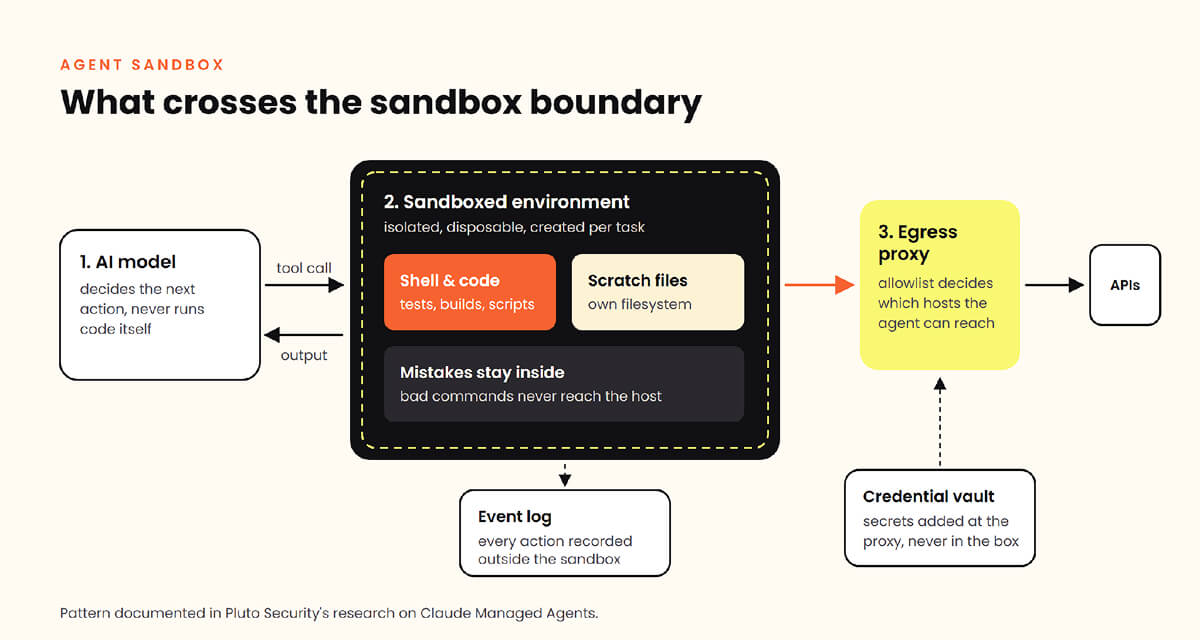
Good setups control what crosses the boundary. Outbound traffic passes through an egress proxy that enforces an allowlist, and a proxy outside the sandbox injects credentials so the agent never holds the raw secret. Anthropic’s hosted runtime follows this pattern, using a gVisor container and a durable event log stored outside it, as Pluto’s research into the internals of Claude Managed Agents shows.
Types of Agent Sandbox Isolation
Isolation strength is the primary trade-off, and it comes down to how much of the kernel the agent shares with the host:
- Containers use Linux namespaces and cgroups. They start quickly but share the host kernel, so a kernel exploit can escape.
- gVisor places a user-space kernel between the agent and the host, intercepting system calls before they reach the real kernel.
- MicroVMs such as Firecracker give each sandbox its own guest kernel behind hardware virtualization, which is the strongest of the three.
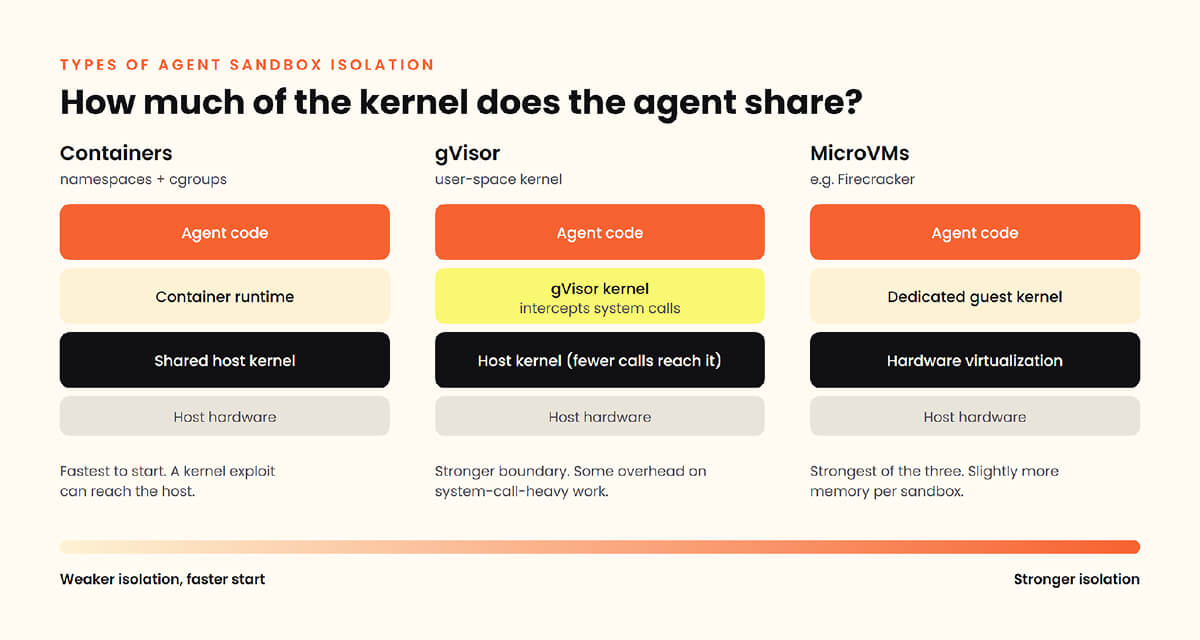
For sandbox security, pick the strongest boundary your latency budget allows. Untrusted code from the internet deserves a microVM or gVisor.
Agent Sandbox Use Cases
Coding agents are the obvious case. They clone a repository, run builds and tests, and propose a diff without touching a developer’s laptop. Data analysis agents execute the generated Python code on uploaded files. Browser agents fill out forms and scrape pages inside a throwaway session. Teams also use sandboxes to safely evaluate agents, replaying risky tasks to see what the agent would do before it gets real access.
Agent Sandbox Limitations
A sandbox limits where damage can land, but it doesn’t stop an agent from misusing what it is allowed to do. If the agent can reach your GitHub API, a prompt injection hidden in a README can still push code or leak a token through that allowed path. Defaults matter for sandbox security too. Pluto found that Claude Managed Agents ship with every built-in tool enabled, automatic execution, and unrestricted internet access unless you change them, as described in this guide to securing Claude Managed Agents.
Environment variables and mounted files are also visible to the agent, so anything placed there can leak. Pluto Security helps teams track which AI agents run in their environment and how they are configured.
Final Thoughts
An agent sandbox determines where an agent’s mistakes land. It does not determine whether the agent makes them. Choose strong isolation, lock down egress and credentials, and review the configuration with the same care you would for any production system the agent can reach.
FAQ
How long does an agent sandbox session last?
It depends on the platform and plan. Many hosted sandboxes cap sessions between under an hour on free tiers and 24 hours on paid plans, while some allow sessions with no fixed limit. Short-lived sessions are safer by default, since any foothold an attacker gains disappears when the sandbox is destroyed.
Do agent sandboxes slow down task performance?
Usually not by much. Modern sandboxes start in milliseconds to a couple of seconds, and the agent’s model calls take far longer. gVisor adds overhead on workloads heavy in system calls, such as large file operations. MicroVMs cost a little more memory per instance, but users rarely notice the delay.
Can an agent sandbox persist data between sessions?
Some sandboxes can. Many are ephemeral and wipe everything when the session ends. Others support snapshots, pause-and-resume, or attached storage that survives restarts. Persistence helps long projects but also retains anything the agent downloaded, including malicious files or leaked secrets, so treat stored state as untrusted on every resume.
Who should own agent sandbox configuration?
The security or platform team should own the baseline, with developers able to request changes. Network rules, enabled tools, and injected credentials are security decisions. Treat agent configurations like infrastructure as code: version them, review every change, and block deployments that use permissive defaults such as unrestricted internet access.
Are cloud-hosted agent sandboxes safer than local ones?
Not automatically. A cloud sandbox keeps agent code off employee laptops and away from local SSH keys and browser sessions. However, your code and data now run on the provider’s infrastructure, and some providers inspect outbound traffic. A local sandbox keeps data in-house but depends on how well each machine is configured. Choose based on your data rules.