Why AI Incident Response Is Different When an AI Agent Is Compromised
Nov 18, 2026・
7 min read

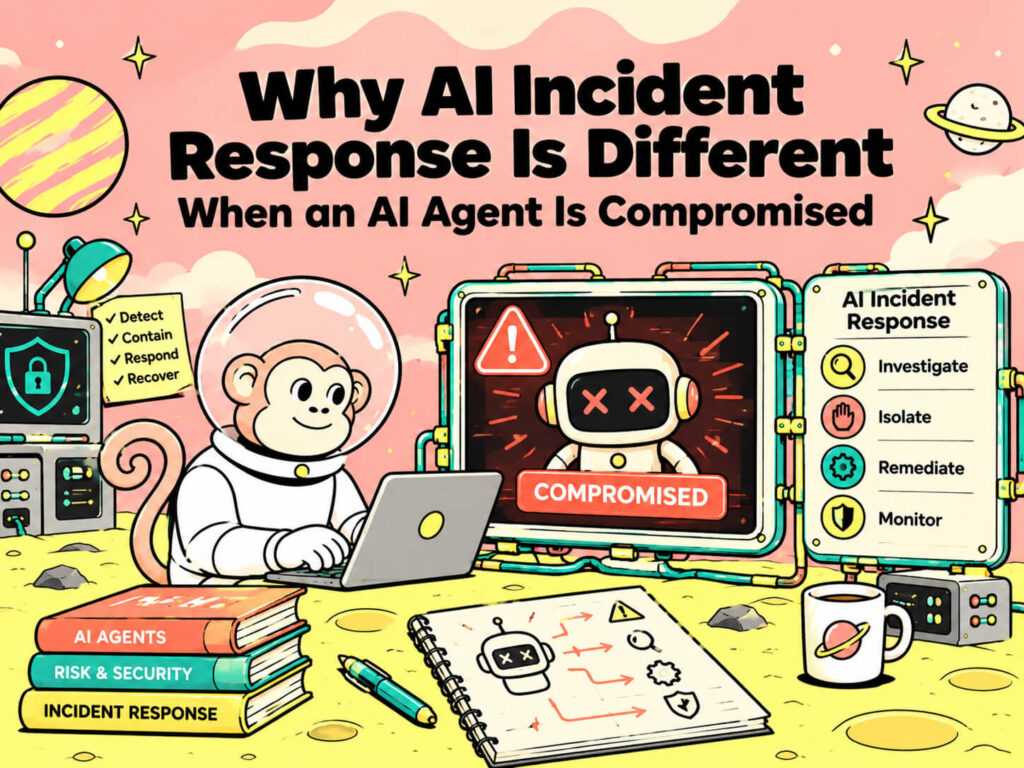
Traditional incident response was built on well-understood security principles: users, endpoints, servers, applications, credentials, and network connections. AI agents introduce another category of principal: non-human software that can interpret context, make decisions, invoke tools, access data, and execute actions autonomously. This changes the incident-response problem: a compromised user account may give an attacker unauthorized access, but a compromised agent may autonomously perform multiple actions, invoke tools, and propagate across interconnected systems within a single workflow. This article examines why incident response differs when an AI agent is compromised.
Traditional incident response generally follows a familiar lifecycle:
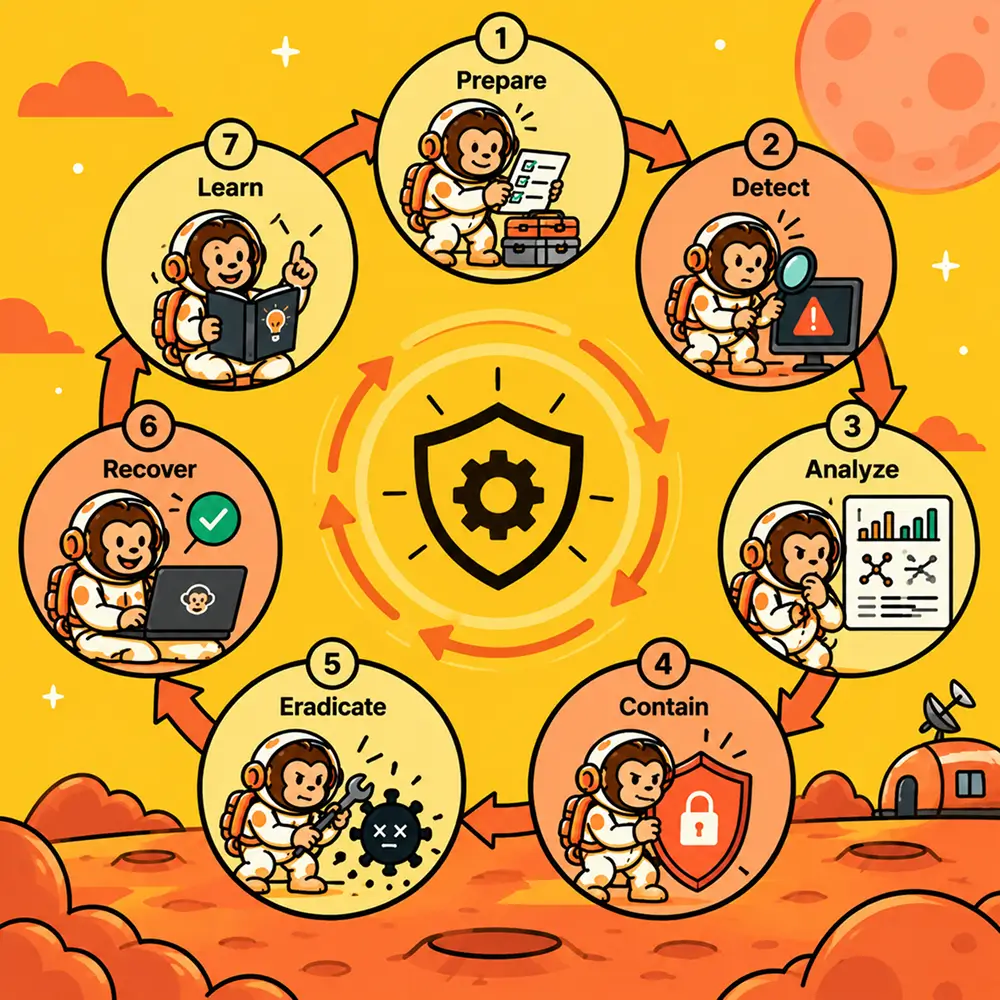
While AI incident response still follows this lifecycle, the evidence model and investigative boundaries become significantly more complex. NIST’s 20261 analysis of responses to AI agent security incidents concluded that traditional cybersecurity principles remain relevant but require adaptation to address the novel threats introduced by AI agents.
The central challenge in modern AI incident response is no longer simply determining which account is compromised, but rather understanding what the agent observed, what influenced its reasoning, what authority it had, what actions it took, which systems it accessed, and which other agents or systems it influenced. For instance, consider a conventional credential compromise: A compromised account can simply pass authentication, gain resource access, and ultimately perform unauthorized activity. An agent compromise is more complex and may resemble a distributed execution chain:
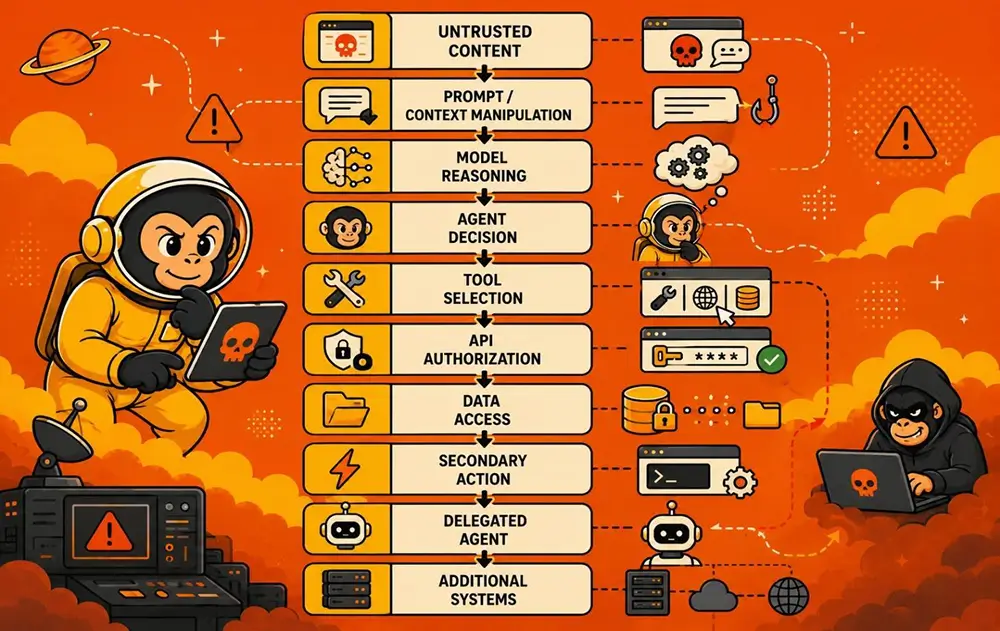
Every arrow can become an investigative boundary. Consequently, an AI investigation must correlate cybersecurity telemetry with AI-specific execution telemetry. That includes prompts, retrieved content, tool calls and tool arguments, authorization decisions, agent identities and delegation chains. Without this context, security teams and investigators may see the final API call but have no idea why the agent made it.
The most significant AI agent security risks arise from agency. An ordinary chatbot may generate an incorrect answer. An agent can act on that answer. OWASP’s 20252 guidance describes excessive agency as a condition in which unexpected, ambiguous, or manipulated model outputs can trigger damaging actions through tools, extensions, or other systems. This creates several possible blast-radius dimensions:
| Blast radius | Potential impact |
| Data blast radius | The agent may have access to:
|
| Transactional blast radius | The agent may be able to:
|
| Identity blast radius | The agent may possess:
|
| Orchestration blast radius | An agent may be able to:
|
Orchestration blast radius: In multi-agent environments, a compromised agent can interact with other agents, invoke additional tools, and traverse the environment to access databases and external APIs. The incident is no longer a single-host compromise but a distributed execution incident.
CSA’s April 20263 research found that nearly all organizations (82%) have unknown AI agents running in their IT infrastructure; 65% of surveyed organizations had experienced AI agent-related incidents in the last 12 months. Detection and response can take hours or days. This means that agent compromise must be treated as a potentially high-velocity identity and application-security incident, not merely an AI quality issue.
This cycle follows NIST SP 800-61 Rev. 3 guidelines:
For AI agents, additional signals are required. Security operations should monitor:
Detection should therefore shift from asking whether an identity is compromised to asking whether the agent is behaving outside its authorized operating envelope.
Suppose a security control detects malicious behavior partway through. Simply terminating the process may prevent payment but leave the system in an inconsistent state. Agent containment therefore needs multiple levels:
| Containment area | Actions |
| Credential containment | Revoke tokens; rotate secrets; invalidate sessions; disable service identities. |
| Tool containment | Disable specific tools; block dangerous functions; remove write capabilities; restrict network destinations. |
| Data containment | Revoke access to sensitive datasets; restrict RAG sources; isolate compromised vector stores; block data exports. |
| Agent containment | Suspend the agent; quarantine its execution environment; disable autonomous execution; prevent delegation to other agents. |
| Workflow containment | Pause transactions; require human approval; roll back where possible; execute compensating actions. |
The containment stage is where AI security policy must become operational. A policy stating ‘AI agents must be monitored’ is insufficient. Security teams need predefined containment actions tied to specific risk levels.
Simply restarting the agent is insufficient: if the malicious instruction persists in its RAG corpus or memory, or the vulnerable tool remains connected, the incident may recur immediately. Before returning the agent to normal operation, security teams should confirm that the underlying vulnerability has been addressed, security controls are functioning as intended, monitoring is active, and the agent is operating within its defined authorization boundaries.
The biggest operational challenge may not be detection but visibility. Traditional infrastructure produces relatively structured telemetry. AI systems produce highly contextual interactions, whose security significance may depend on the sequence of prompts, retrieved content, model decisions, tool calls, and resulting actions. An investigator may need to correlate the following:
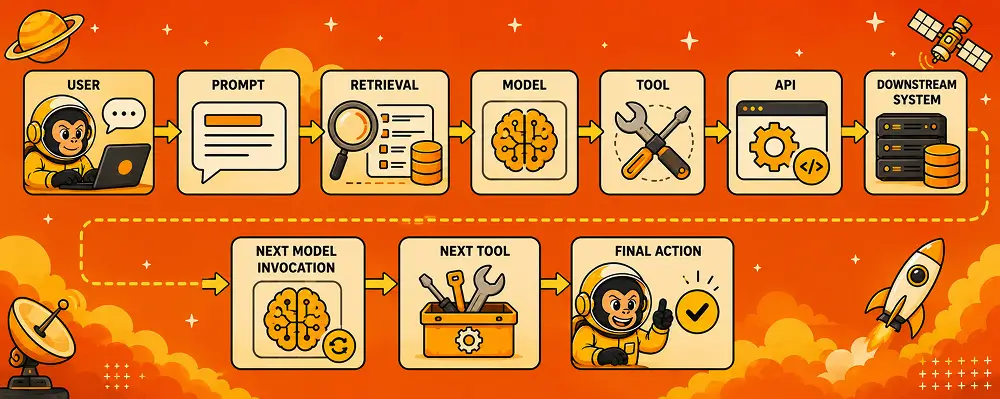
If only the final API call is logged, the most important evidence may be missing. Agent observability therefore needs multiple layers.
| Telemetry area | What to record |
| Identity telemetry | Agent identity; owner; initiating user; credential; session. |
| Model telemetry | Model; model version; system configuration; prompt/context identifiers; safety-policy decisions. |
| Retrieval telemetry | Source; document identifier; trust classification; retrieval timestamp; content provenance. |
| Tool telemetry | Tool; function; caller; authorization decision; execution result. |
| Infrastructure telemetry | DNS; network; process; container; SaaS; endpoint activity. |
| State-change telemetry | Capture what changed, including database records, source code, files, cloud configuration, and financial transactions. |
AI incident response is not a replacement for conventional incident response. It is an extension of it conventional IR into a new execution model. The fundamental IR disciplines remain valid, but AI agents add a new investigative dimension. Security teams must understand not only who authenticated, but also what the agent saw, what influenced its reasoning, what it decided, which tools it invoked, what authority it exercised, what ich other agents it contacted, and what state it changed. This is why agent incidents can be substantially harder to investigate than conventional identity compromises. To understand how organizations can improve visibility into agent activity and reconstruct events during an investigation, explore Pluto’s guide to What Should an AI Agent Audit Trail Capture.
An AI agent can cause damage much faster than a compromised user account because it operates at machine speed and can repeat actions and invoke multiple tools in sequence. The actual impact will depend on the permissions and safeguards in place. For instance, an agent with broad authority can compress reconnaissance, access, execution, and propagation into a single automated workflow.
Security should typically lead incident command, while AI engineering, platform, data, legal, privacy, and business teams provide specialist support. The security team should retain authority and oversight of containment and evidence preservation, while AI teams are essential for understanding model behavior, orchestration logic, tool integrations, model configuration, and remediation.
It is crucial to reconstruct the complete execution graph: the initiating user, agent identity, prompts, retrieved content, model decisions, tool calls, delegated agents, credentials, API activity, data accessed, and resulting state changes. Next, correlate these findings with telemetry from infrastructure, identity, database, cloud, and network. Also, always assume the full permission set was potentially exposed until evidence proves otherwise.
Eradication means removing the underlying cause and the persistence mechanism. It does not mean simply stopping the agent. Depending on the AI incident, eradication can require credential rotation, removal of malicious documents, tool revocation, framework patching, and RAG and memory cleansing. It may also include reducing permissions, replacing models, rebuilding infrastructure, and changing policies to prevent recurrence.
When an AI agent is involved in a breach, external communication should focus on verified facts rather than speculative claims about autonomous behavior. Explain which systems and data were affected, and when the organization detected and contained the incident. Also address customer impact and remediation in place. Legal, privacy, and communications teams should always coordinate disclosures according to applicable requirements.
To best prepare for an AI incident, run scenarios that include indirect prompt injection, compromised agent credentials, and malicious MCP tools. Expand the exercises to cover RAG poisoning, excessive agency, agent-to-agent compromise, unauthorized data exfiltration, and destructive tool execution. These exercises should force teams to reconstruct agent decision chains, revoke agent authority, contain workflows, and determine whether affected systems have changed.
Useful References