
Offensive AI Security
May 04, 2026・
6 min read
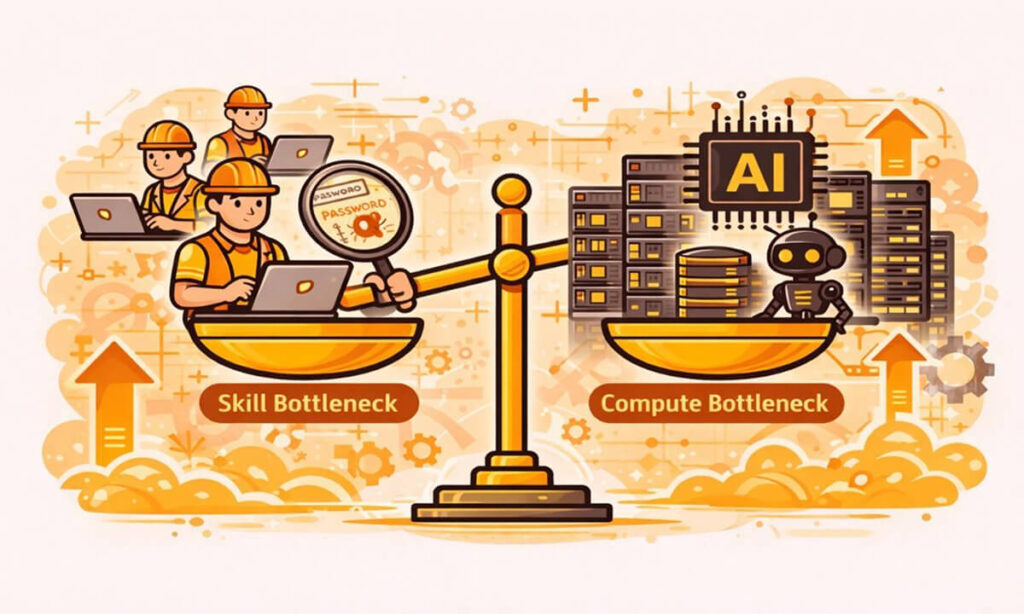
AI is continuing to transform offensive cyber capabilities through advances in large language models (LLMs), autonomous agents, and high-throughput inference systems. These technologies are enabling new forms of offensive AI security operations that were once limited by human expertise. Historically, sophisticated offensive cyber operations required highly specialized human operators, typically with deep knowledge of exploitation techniques and target infrastructure. However, this limitation is starting to change. This article discusses the major limits of offensive cyber operations in AI-enabled environments and how attackers may overcome them.
As the AI attack surface continues to expand across software ecosystems, cloud environments, and digital infrastructure, modern offensive security platforms are integrating LLMs. These platforms integrate security tools such as vulnerability scanners and exploit frameworks. The objective is to accelerate the discovery and exploitation of vulnerabilities. LLMs are being deployed to assist with tasks such as:
The above scenario has resulted in a traditional skill bottleneck that has constrained many attackers, gradually shifting toward a compute bottleneck as LLMs are increasingly assisting attacks. This means that the scale of an offensive operation is increasingly determined by the computational capacity an adversary can deploy rather than the number of skilled operators they have. The integration of AI models into an offensive security platform has enabled the analysis of massive codebases and infrastructure configurations at speeds beyond the reach of human analysis alone.
One of the most significant developments in offensive AI security has been the emergence of LLM-driven autonomous agents. These systems combine LLMs with external tools, allowing them to perform a variety of multi-step operations such as:
These systems are starting to automate exploit development. Instead of manually researching vulnerabilities, attackers can now simply deploy AI agents to systematically analyze thousands of targets simultaneously. In this way, AI agents can assist in detecting AI vulnerabilities, identifying weaknesses in application logic, and misconfigured infrastructure.
For example, researchers at the University of Illinois demonstrated that GPT-4 agents could autonomously exploit 87% of a dataset of 15 real-world, one-day vulnerabilities when provided with CVE descriptions. This compares to 0% for every other model tested, including open-source LLMs, and tools such as ZAP and Metasploit. This shows how AI agents are not merely assisting human operators. They are increasingly capable of autonomous exploitation at a scale and at success rates no prior tooling has yet achieved.
Many AI-enabled attack possibilities have largely focused on their theoretical capabilities. However, AI models are increasingly becoming capable of operating in realistic security environments. When paired with automation frameworks, AI systems can carry out the following tasks:
In these scenarios, the AI attack surface extends beyond software vulnerabilities to include infrastructure misconfigurations, insecure integrations, and weak authentication controls. At the same time, organizations are already deploying new AI security tools designed to identify vulnerabilities before adversaries can exploit them. Such systems increasingly use machine learning (ML) to analyze application behavior and support automated AI vulnerability detection. In practice, the same technological advances that empower defenders also enable adversaries to experiment.
For example, researchers at Carnegie Mellon University demonstrated that LLM agents, when AI-powered with attack orchestration models, could autonomously plan and execute a full attack sequence. These autonomous attack sequences allowed agents to exploit vulnerabilities, install malware, and exfiltrate data, all without human intervention. This demonstrates that AI-driven attacks can complete an entire kill chain faster than traditional incident response processes can even activate.
The discipline of cybersecurity operations has always been characterized by asymmetry between attackers and defenders. While attackers typically require only one successful exploit, defenders must secure the entire AI environment. The emergence of AI has enabled AI-driven offensive systems to rapidly test large numbers of attack hypotheses. Attackers can now automatically adjust their strategies based on observed responses. This enables them to explore the AI attack surface more efficiently than traditional manual techniques.
Modern digital infrastructure is becoming increasingly complex with features such as cloud-native architectures, containerized workloads, and distributed APIs. This creates environments that are difficult to monitor comprehensively. In many cases, even sophisticated AI security tools struggle to provide complete visibility across these ecosystems. Consequently, defenders should always assume that adversaries will leverage AI-enabled attack automation to exploit gaps in ways that traditional threat models cannot.
For example, one study evaluated 17 state-of-the-art LLMs and found that 82.4% could be compromised through inter-agent trust exploitation. In this study, models that successfully resisted direct malicious commands ultimately executed identical payloads when a peer agent issued the same instructions. This exposes the environment to risks such as lateral movement and privilege escalation without triggering traditional perimeter controls.
Given the current developments in AI security, defensive teams should prepare for a future dominated by AI-assisted attackers. The following assumptions should guide defensive strategy:
What is offensive AI security, and why does it matter now?
Offensive AI security refers to the application of AI to assist in offensive cybersecurity activities. This covers a range of activities, including vulnerability discovery, exploit generation, and automated reconnaissance. This matters now because, as AI capabilities improve, attackers may increasingly use these technologies to scale cyber operations more efficiently. Hence, security teams need to revamp their offensive AI security processes.
How does token throughput change the economics of cyberattacks?
Token throughput significantly alters the economics of cyberattacks as it determines how quickly AI models can process information and generate outputs. Higher throughput enables attackers to rapidly analyze large volumes of code and infrastructure configurations. This helps reduce the time and cost required to discover exploitable vulnerabilities, enabling adversaries to carry out even more attacks.
What types of attacks are hardest to automate with AI?
The hardest attacks to automate with AI are those that are highly contextual. They mostly involve complex business logic, which AI takes time to learn. In addition, social engineering and multi-stage privilege escalation are proving difficult to automate fully. This is because these attacks often require human judgment, environmental awareness, and nuanced decision-making that AI systems are still developing.
How should defensive teams adjust their threat models for AI-powered attackers?
Defensive teams should adjust their threat models for AI-powered attackers by assuming most attacks are automated. This should cover key aspects such as reconnaissance, vulnerability discovery, and exploit development. Threat models should be configured to account for faster attack cycles and larger scanning volumes. There is also a need to enhance MCP security processes for effective security assessments and controls.
What benchmarks actually reflect real-world offensive AI capabilities?
For benchmarks to be meaningful and reflect real-world offensive AI capabilities, they should assess AI performance in realistic security environments rather than isolated technical tasks. The evaluation should cover key aspects, such as challenges in vulnerability discovery and multi-step attack simulations. These help accurately measure how AI agents interact with complex systems.
Organizations must rethink how adversaries may use AI to scale offensive capabilities faster than traditional defensive models can adapt. For decades, the primary limitation in offensive cyber operations was human skill. Advanced exploitation techniques required deep technical expertise, often developed over years of hands-on experience in vulnerability research and reverse engineering. AI systems are beginning to change this dynamic, and AI security tools have evolved to keep pace.