

Most authentication systems were designed around people. A user logs in, proves their identity, obtains a session, and performs actions within an application.
AI agents do not behave like that. They may run without a person present, call tools, retrieve context, and act across several systems using delegated access. That changes the identity problem. AI agent authentication is not just another login screen. It is a question of how software proves what it is, what it is allowed to do, and whether its actions still match the task it was given.
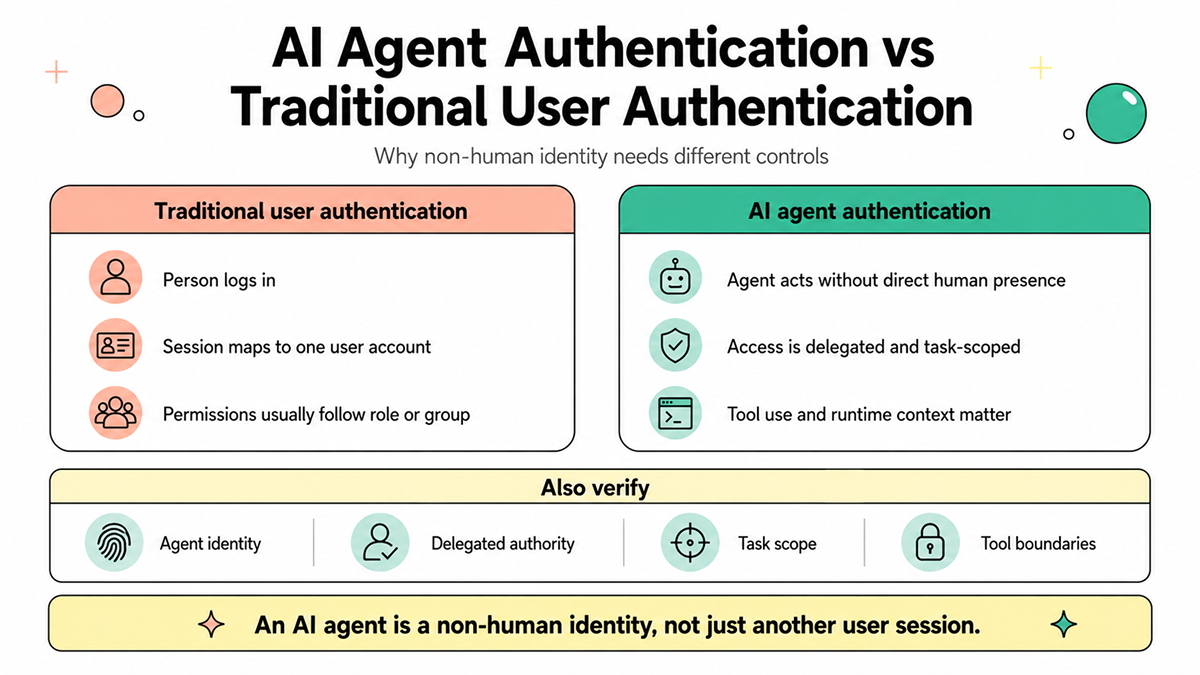
How Traditional Authentication Was Built Around Human Identities
Traditional authentication assumes a human is at the edge of the system. The person has an email address, password, browser session, device, security key, or some other factor that can be tied back to a known account.
Authorization is usually applied after authentication. The user belongs to a group. The group maps to permissions. These permissions define what the user can read, edit, approve, or delete.
This works when the person directly chooses the action. If something goes wrong, the audit log can show which account clicked the button or called the API. It may not explain intent, but it gives engineers a place to start. AI agents weaken that starting point.
What Makes AI Agent Authentication Fundamentally Different
An AI agent is a non-human identity, but it is not the same as a typical service account. A service account usually runs a predictable job. It backs up a database, deploys a build, rotates logs, or syncs records between systems.
An agent can decide which tool to call next. It can read the context, revise a plan, retry a failed step, summarize data, open a ticket, or call another system. Two similar requests can lead to different execution paths.
That is why AI agent authentication requires more than verifying that a token is valid. The system also needs to know which agent is acting, who delegated authority to it, what task it is performing, and which boundaries apply at that time.
Agent authentication has to answer several questions:
- Agent identity: Which agent, workflow, or runtime is making the request?
- Delegated authority: Which user, team, or system gave it permission?
- Task scope: What job is the agent trying to complete?
- Tool boundary: Which API, database, file, or service is it allowed to touch?
- Runtime context: Is the agent running in an expected environment?
These checks cannot sit only at login time. An agent may begin with a narrow task and then discover related context. Some of that context may be useful, but some may be outside the scope.
Why Authorization Has to Be More Dynamic
AI agent authorization is harder because permission depends on intent and context, not only on role. A code review agent may need to read a repository and comment on a pull request. It should not be able to merge code, change branch protection, or read production secrets.
The permission model should be narrower than the user making the request. It should also be shorter-lived.
Traditional user access often stays active for hours, days, or longer. Agent access works better when credentials are issued for a single task, tool, or workflow stage. When the task ends, the token should expire or be revoked.
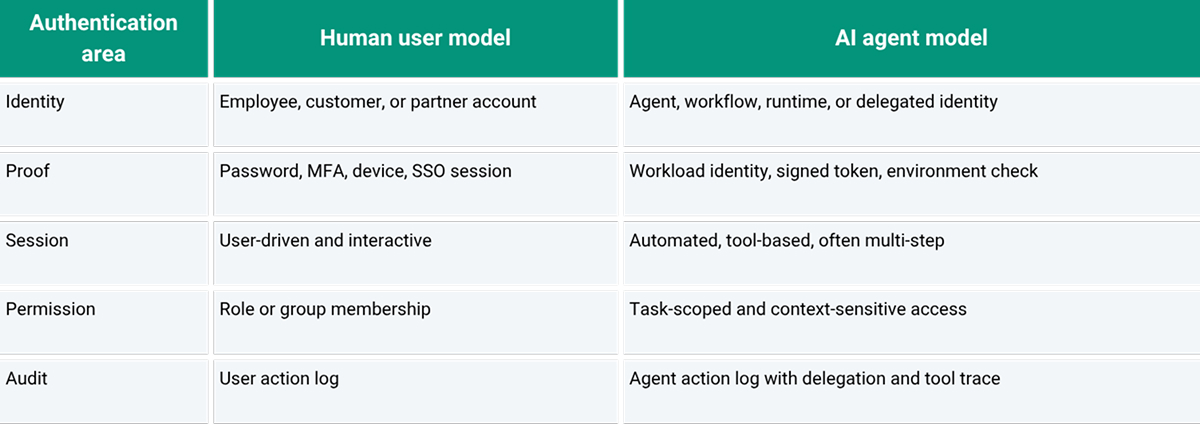
Where Engineering Teams Usually Get It Wrong
Common weak patterns include shared credentials, broad service accounts, and thin audit logs. A team may grant an agent a single API key or admin-level access during a prototype phase because it is faster. Later, several workflows depend on the same access, and the logs only show a generic service account. When something changes, engineers cannot easily tell which agent ran, what task triggered it, who delegated the action, or which policy allowed it.
A better design treats agents as first-class identities. Provide them scoped credentials. Bind access to workload and task context. Use short-lived tokens. Add approval gates for irreversible actions. Log enough detail to reconstruct the path.
In AI-heavy workspaces, Pluto Security can add a useful control layer by giving security teams visibility into AI-driven activity, risk context, and guardrails that govern how employees and workflows use AI tools.
Final Thoughts
AI agent authentication is different because the actor is different. An agent is not a person clicking through a session, nor is it just a static backend job. Traditional authentication still matters, but it cannot carry the full model on its own.