

Endpoint detection and response, or EDR, is effective at monitoring machines for suspicious behavior. It can flag malware, unusual process activity, script abuse, and risky commands on laptops, servers, and workstations.
AI agents present a more complex case. Their risky actions may not look like an attack at all. They may use approved tools, valid access, and normal workflows while still doing something outside the scope of the task they were trusted to complete.
What EDR Solutions Were Designed to Detect
EDR tools were built around activity on laptops, servers, and workstations. They watch processes, files, memory behavior, registry changes, command execution, and network connections from managed endpoints.
That makes EDR useful when a threat leaves a host-level signal. It can detect suspicious PowerShell chains, unexpected executables, credential-dumping attempts, or risky commands triggered from a developer workstation, including cases where an AI agent initiates such activity.
But EDR assumes that the endpoint is the primary place where the threat manifests. That assumption gets weaker when agents work through APIs, SaaS tools, cloud consoles, CI systems, ticketing systems, and code repositories. Some of that activity never appears to be a malicious process on a machine.
Where EDR Falls Short Against AI Agent Behavior
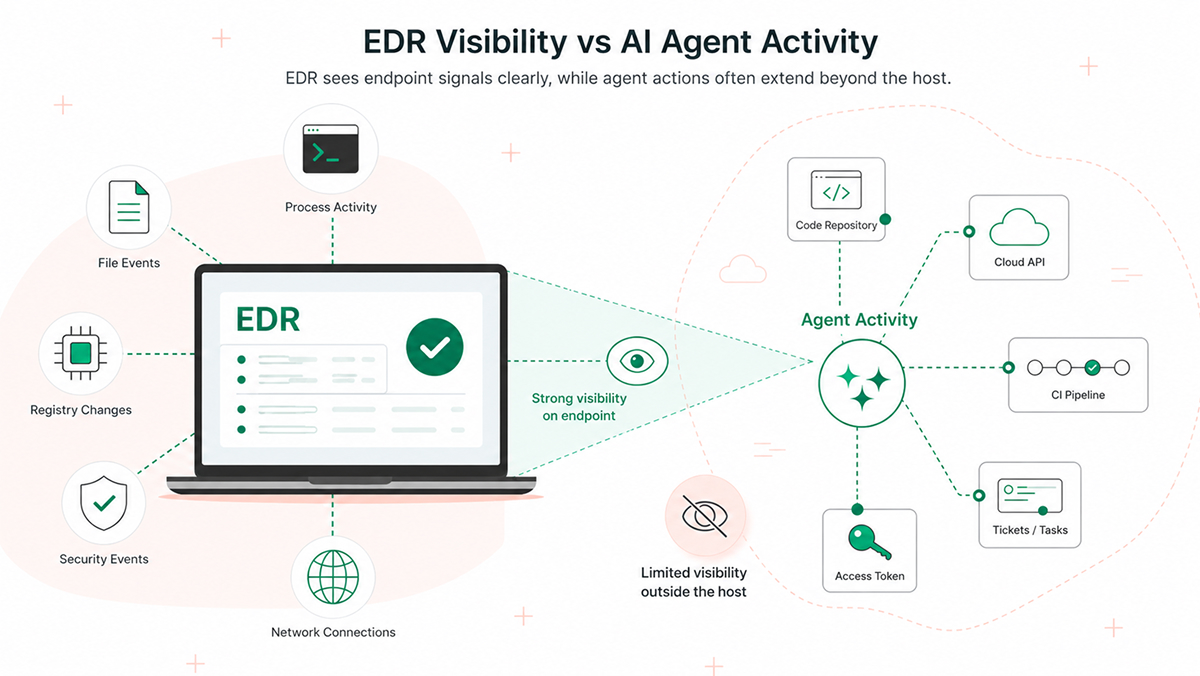
The problem is not that EDR is obsolete. The problem is scope. An AI agent may use a valid token, call an approved API, read a repository, trigger a workflow, or summarize customer data. From the endpoint view, this can look like normal browser or CLI activity. The dangerous part may be the decision, not the executable.
EDR limitations usually appear in a few areas:
- Identity context: EDR can see what runs on a host, but it may not know whether an AI agent identity should have used a token for that task.
- Tool intent: A command can be technically normal yet still be wrong for the approved workflow.
- Cross-system behavior: Agent activity may span Git, Slack, CI, cloud APIs, and internal apps, with no single endpoint showing the full path.
- Delegated access: A human account may approve an agent, but subsequent actions may occur without the person being actively present.
- Data misuse: Reading, copying, or sending sensitive context through allowed tools may not create a malware-like signal.
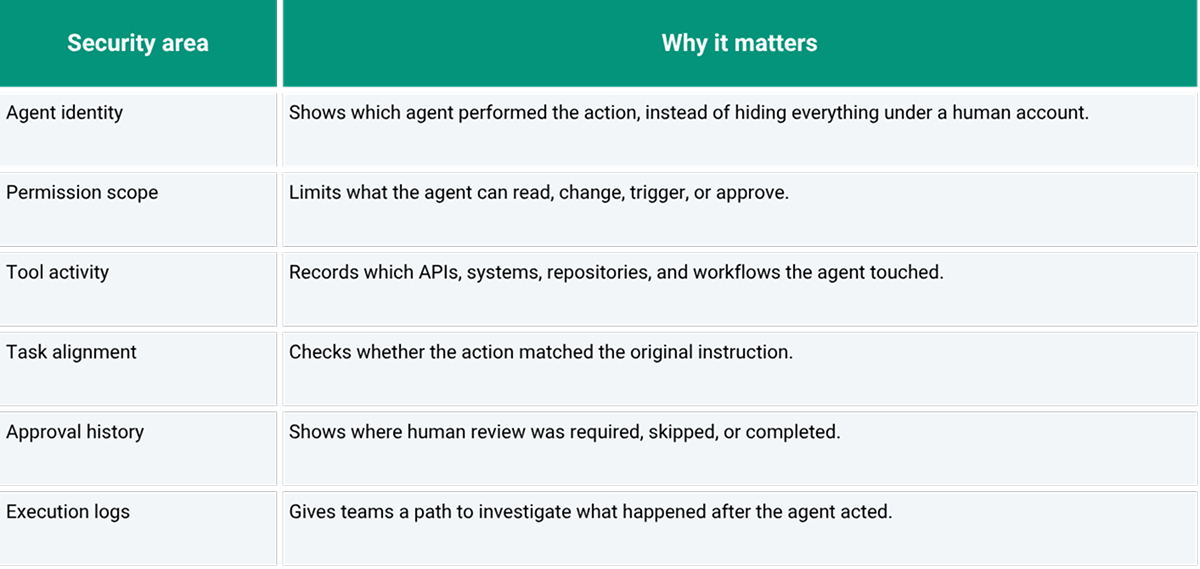
This is where AI agent security needs more than endpoint telemetry. Teams need to know which agent acted, what instruction it followed, which tools it touched, what data it accessed, and whether the action matched policy.
AI agent identity is especially important. Treating every agent action as the human owner’s activity creates weak audit trails. If a developer authorizes an agent to inspect a failing build, that authorization should not silently expand into broad repository access, production log access, or cloud permission reuse.
A CI remediation agent may fix a failed test, open a pull request, and add a summary without triggering EDR, since the work occurs within normal development tools. The real risk is whether it stayed within the assigned repo, changed only expected files, used the right access, and avoided secrets.
That is where agentic security needs stronger controls around task scope, permissions, approval state, and execution history.
What Security Teams Should Track
Modern EDR products have improved with behavioral analytics and automated response features. That helps with malware, fileless attacks, and suspicious endpoint activity. It does not fully solve the AI agent security problem. Many agent failures are valid actions performed within a weak scope, with poor identity separation, or in the absence of governance.
Final Thoughts
Existing EDR solutions can detect some AI agent threats, especially when the agent causes suspicious endpoint behavior.
They are weaker when the risk lives in identity, delegation, tool use, workflow scope, or cross-system action. That is the gap engineering and security teams need to close.