

Endpoint visibility used to mean knowing what was running on employee devices, which files were accessed, and whether network or system activity deviated from policy.
AI coding tools make code harder to read. A developer can now ask an assistant to inspect code, rewrite a function, generate tests, or run commands. The endpoint is no longer just where code is edited. It is where prompts, source code, credentials, local tools, and automated actions begin to overlap.
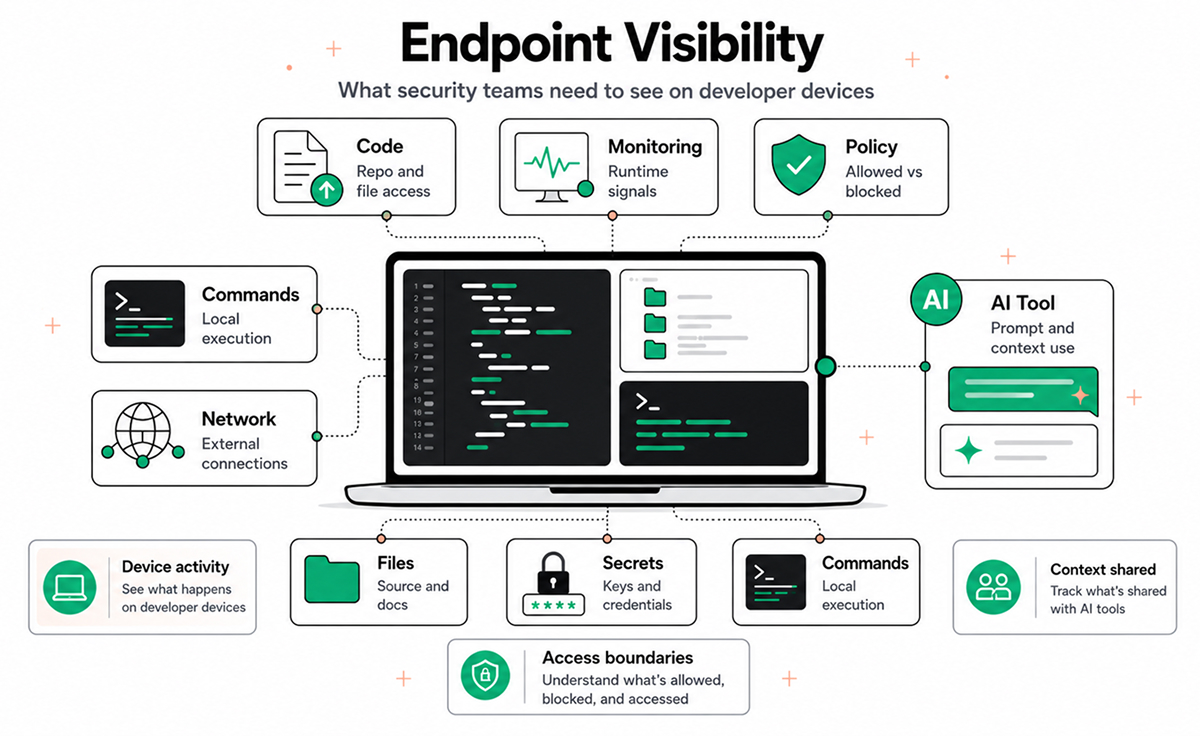
What Endpoint Visibility Covers in Traditional Security Contexts
Traditional endpoint visibility focuses primarily on device activity. Security teams want to understand what happens on employee machines before it becomes a larger incident.
That typically includes installed applications, running processes, file changes, command execution, browser activity, network traffic, USB activity, and signs of malware or policy violations. In engineering teams, it may also include developer tools such as terminals, package managers, IDEs, containers, SSH clients, and Git operations.
The goal is not to monitor every keystroke. That creates noise and privacy problems. Good endpoint visibility gives security and IT teams enough context to investigate risk without treating normal development work as suspicious by default.
Why AI Coding Tools Change the Endpoint Visibility Equation
AI coding tools shift the question from “what is running on this device?” to “what is this tool doing in the engineering context?”
A normal IDE opens files because the developer opens them. A coding agent may scan the repository, inspect dependencies, search logs, summarize code, and prepare changes across multiple files. The exact risk depends on how much local access the tool has. Some tools stay within the editor. Others may run through desktop apps, browser sessions, terminal commands, local model runtimes, API calls, or plugins.
That makes AI endpoint security more complex than blocking a single application or approving a single browser extension.
An organization may allow AI assistance for boilerplate code but not for proprietary algorithms. It may allow code explanation but not upload of customer data. It may allow reading from local repos but not command execution. Those rules are hard to enforce if security teams can only see that an AI tool was opened.
A useful visibility model needs to distinguish normal developer assistance from risky behavior.
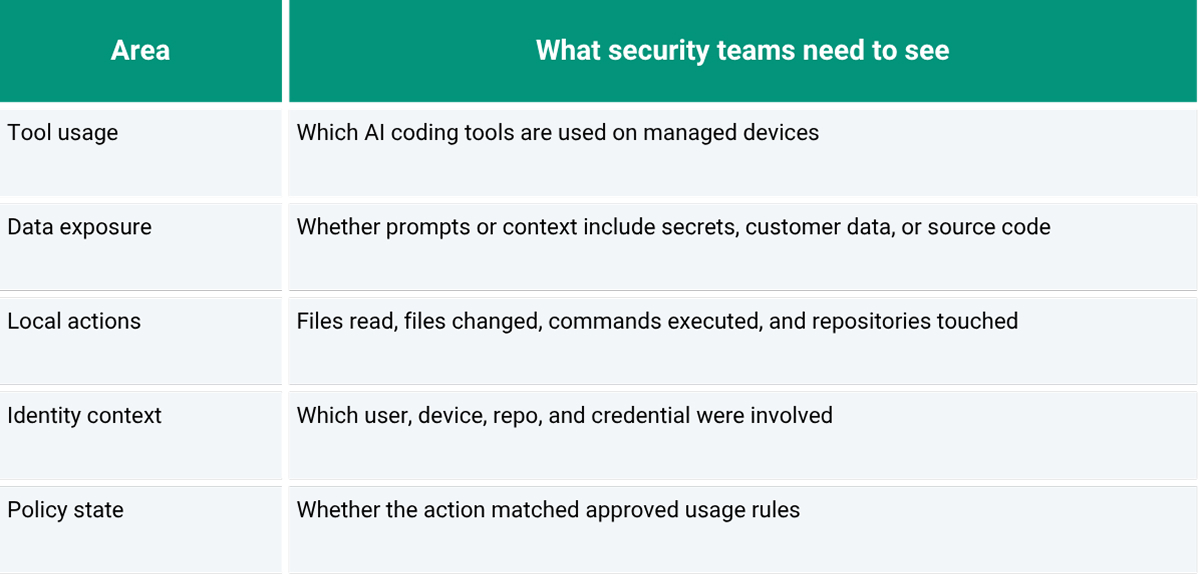
This is where endpoint visibility and control become harder to separate. Visibility alone tells teams what happened. Control helps determine what should be allowed, blocked, warned, or routed for approval.
A developer asking for a unit test suggestion is low risk most of the time. A local agent that reads several repositories, encounters an API key, and then sends context to an external service is different. Both may look like “AI tool usage” in a shallow inventory. They are not the same security event.
The hard part is that AI coding work often looks productive. It may occur during normal business hours, under a real employee account, and within an approved repo. Traditional alerts may stay quiet because nothing appears malicious.
Security teams need more specific signals:
- Prompt and context category: Sufficient classification to determine whether sensitive code, secrets, credentials, or customer data may have been shared.
- Agent action history: A record of files read, files edited, commands requested, and tools used during the coding session.
- Repo and permission boundary: Whether the AI tool stayed within the expected project and used the appropriate level of access.
- Approval state: Whether risky actions require review before execution.
This should not become blanket blocking. Developers use AI coding tools to handle repetitive work, unfamiliar code, test generation, refactoring, and debugging. A heavy-handed policy will push usage into unmanaged paths.
The better approach is more focused. Allow approved tools. Define what data they can access. Limit agent permissions. Log meaningful activity. Block obvious violations. Require review for actions that modify code, access secrets, or cross project boundaries.
That is the practical meaning of endpoint visibility in AI-assisted development. It is not just asset inventory. It is knowing how AI tools interact with code, credentials, files, and developer workflows on real machines.
Final Thoughts
Endpoint visibility is still about understanding device activity, but AI coding tools add another layer. Teams now need to see tool behavior, data movement, and agent actions within engineering work.
The goal is not to slow developers down. It is to keep AI-assisted coding within clear boundaries and provide enough evidence to investigate when something goes wrong.