Why AI Agent Security Risks Multiply When Agents Orchestrate Each Other

Nov 25, 2026・
6 min read

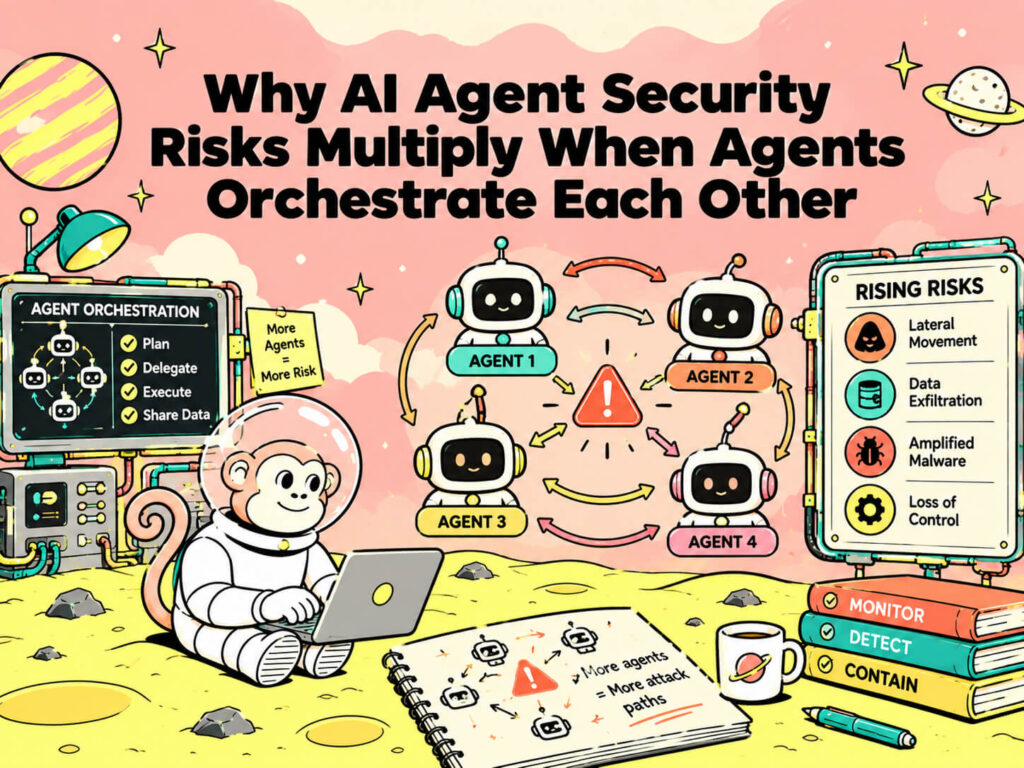
AI agents become much harder to secure when they stop operating as isolated systems and start working together. A single agent may already have access to enterprise resources. In a multi-agent architecture, one agent can delegate tasks to another, which can invoke additional tools or agents, initiating further actions. The resulting system is no longer simply an AI application but a distributed, dynamic execution graph. This article explores why AI agent orchestration security is becoming a critical enterprise security concern as agents delegate tasks, share context, invoke tools, and propagate capabilities across interconnected systems.
A multi-agent system consists of multiple AI agents cooperating to accomplish a larger objective. A simplified multi-agent architecture might look like this.
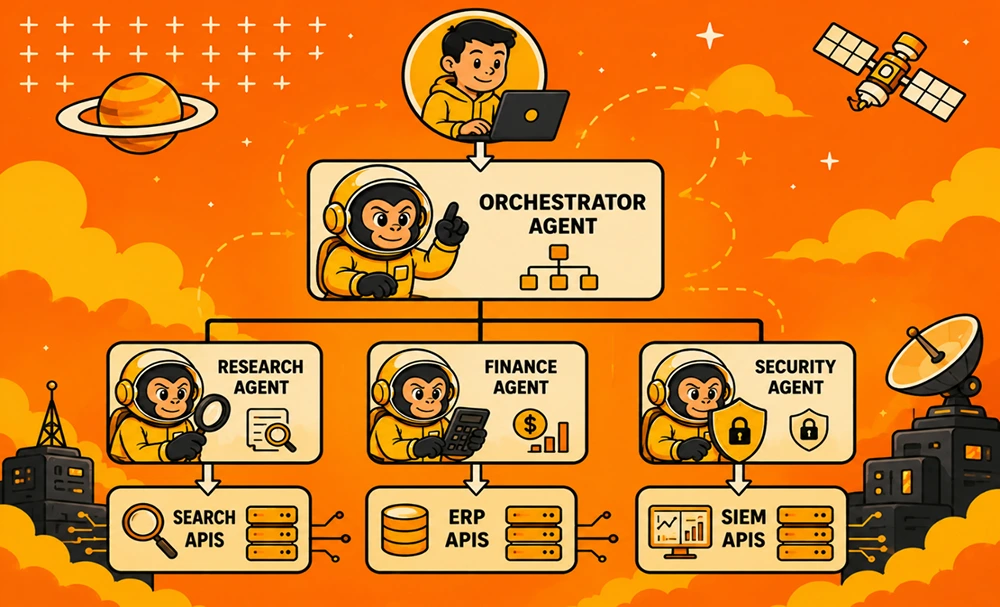
The orchestrator decomposes a task and delegates portions of it to specialized agents. This architecture provides significant advantages, including:
But every delegation creates another trust relationship. For security leaders, the key question is no longer only how to secure an AI agent but also how to secure the relationships among agents. That is the foundation of multi-agent security: the security boundary now extends across agent identity, delegated authority, task context, and downstream execution.
NIST’s 2026 AI Agent Standards Initiative1 recognizes that agents increasingly interact autonomously with external systems and highlights the need for standards that enable secure interoperability, since interoperability also expands the attack surface. The more agents can communicate with each other, the more opportunities exist for:
The security risk of a multi-agent system is not simply the sum of the risks of individual agents. Interactions create additional attack paths. Consider three agents: A, B, and C. Agent A has access to customer data, Agent B has access to internal analytics, and Agent C is permitted to send external email. Individually, these permissions may seem reasonable, but if Agent A can instruct Agent B and Agent B can instruct Agent C, the combined system may create an unintended data-exfiltration path from customer data, through the agents, to an external email system.
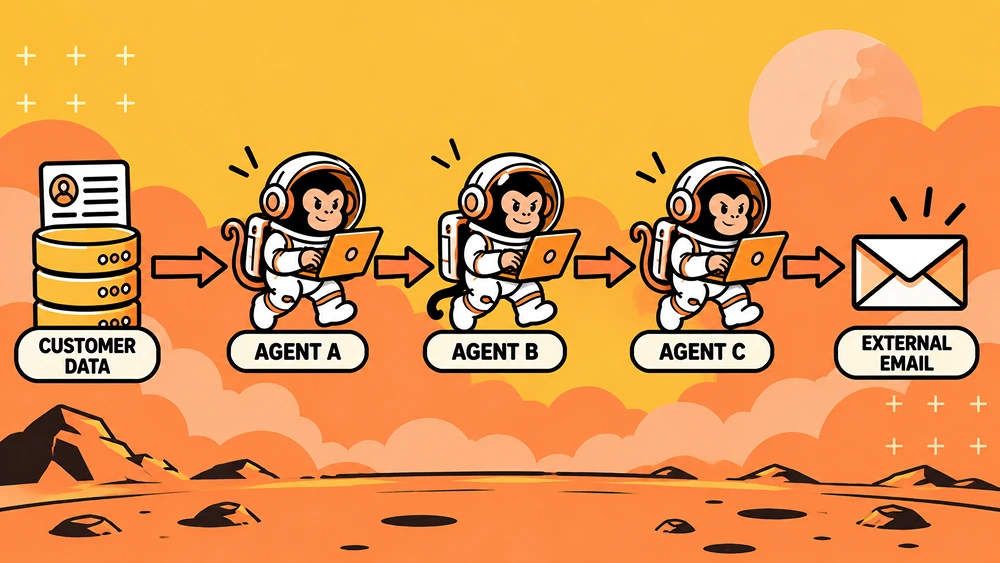
No individual agent necessarily has both access to sensitive data and authority for external communication, but the orchestration graph creates the combined capability. This is one of the most significant AI agent security risks in multi-agent architectures. NIST’s 2026 Insights into AI Agent Security from a Large-Scale Red-Teaming Competition2 further illustrates the security challenges of autonomous agents and the importance of evaluating their behavior under adversarial conditions.
Confused-deputy problem: Traditional security engineering has long recognized confused-deputy attacks (See How Prompt Injection Attacks Work for a detailed discussion on these attacks). The key point is that multi-agent systems introduce a dynamic version.
The attack path begins with an attacker manipulating Agent A, which then uses trusted delegation to instruct Agent B to perform a privileged action. The second agent may never encounter the attacker directly, making attribution and policy enforcement substantially more difficult.
Identity and Privilege Propagation: One of the biggest architectural questions is whether delegated authority should propagate from one agent to another. In most high-risk environments, the answer should be no, not automatically. For instance, when a human asks the orchestrator to analyze a customer account, the orchestrator should issue task-scoped authority to the research agent rather than pass the user’s full privileges downstream. The research agent should receive only the permissions required for its assigned function, such as read-only access to the relevant data.
If the Research Agent needs access to another resource, it should request additional authorization. This is the foundation of zero trust for AI agents, in which every delegation should be evaluated independently. The policy engine should consider factors such as:
The principle is straightforward: delegation should transfer a narrowly defined capability, not unrestricted authority.
Insecure Inter-Agent Communication: Once agents communicate, their messages become a security boundary. A secure architecture needs to distinguish message authenticity from message authorization. Cryptographic authentication can establish that a message came from an agent, but it does not establish whether that agent was authorized to request the action. Therefore, inter-agent communication requires at least:
The OWASP Securing Agentic Applications Guide 1.03 provides additional guidance on assessing security risks in agentic systems, including the trust boundaries and interactions that arise when agents communicate and delegate tasks.
One of the more difficult multi-agent security risks is recursive or uncontrolled feedback, in which Agent A interacts with Agent B, which interacts with Agent C, ultimately feeding back into Agent A.
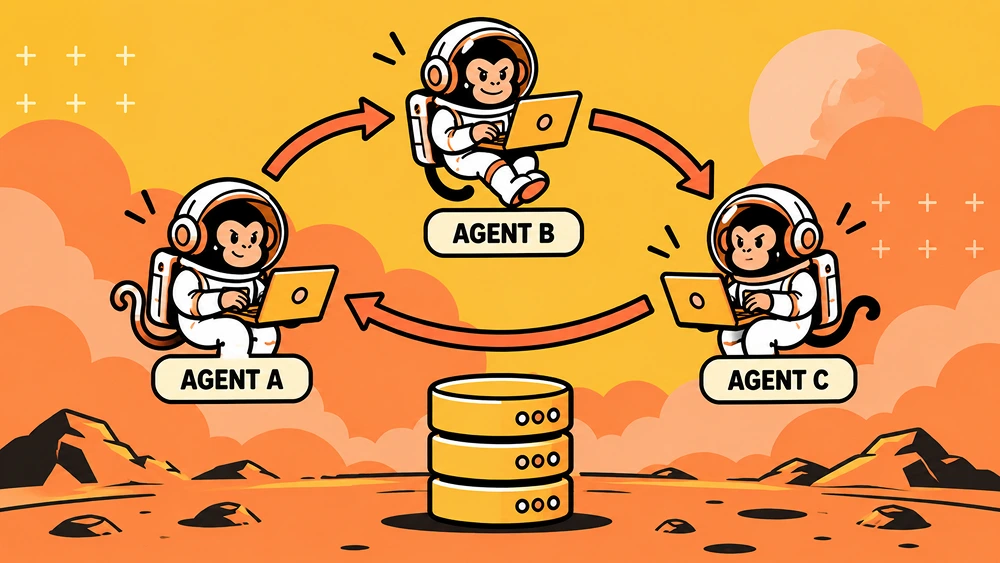
Each agent evaluates the previous agent’s output and produces another action. If the system lacks any of the following, the workflow can continue indefinitely.
The cause need not be malicious: loops can arise from locally rational decisions that lead to globally unsafe behavior. For example, Agent A determines that it needs more information. Agent B determines that it needs data from Agent C. Agent C then determines that it should ask Agent A for additional context. The result is a feedback loop. In a production environment, such loops can create:
Shared memory creates another major attack surface. For example, Agent A stores the information that Customer ABC has approved unrestricted data access. Agent B later retrieves this information and treats it as authoritative. If the original information was malicious or incorrect, the compromise can persist beyond the original interaction, creating a chain in which poisoned memory influences Agent A, enters the shared context, reaches Agent B, and ultimately triggers a privileged action:
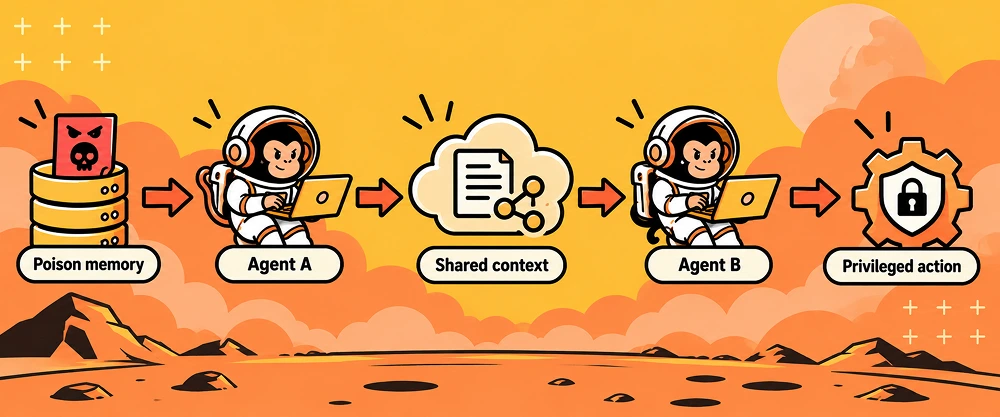
This is fundamentally different from a transient prompt injection. The malicious state can survive the original attack. Security controls should therefore include:
An agent should not be able to write arbitrary information into shared memory merely because the information was generated by another agent.
Consider:
If the Research Agent can instruct the Finance Agent to execute a payment, it has effectively gained indirect payment capability. This is a privilege-escalation path created by orchestration. The solution is not simply to restrict the Finance Agent. The delegation interface itself must enforce policy.
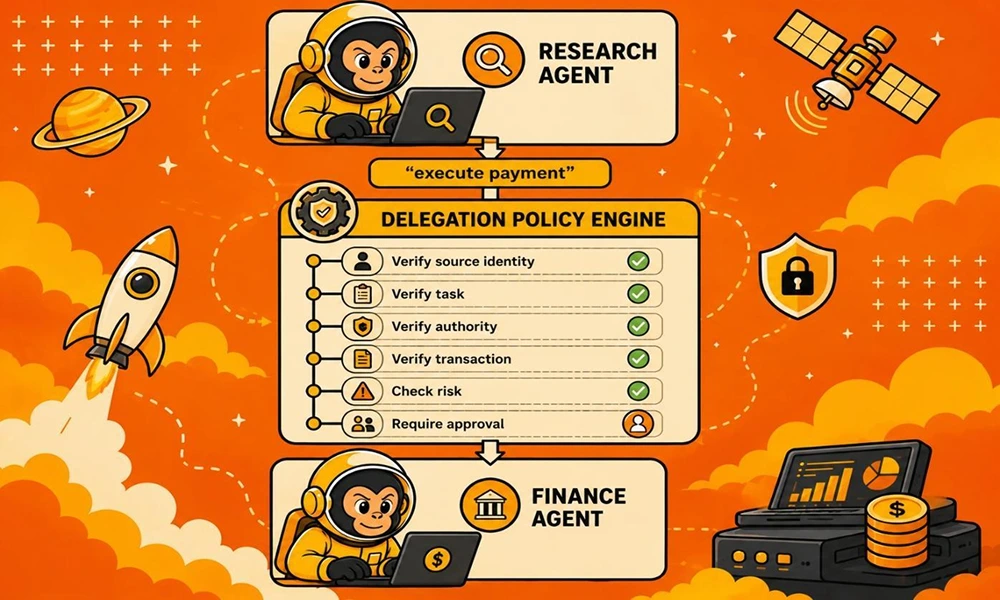
This is where AI agent orchestration security intersects directly with Zero Trust: no agent, delegation, or action should be trusted implicitly.
Security teams should monitor the graph, not just individual agents. A conventional dashboard might show all agents as normal, yet the combined workflow could be malicious. Graph-level analytics should ideally identify:
Multi-agent AI changes the security problem because capabilities can propagate through relationships. A single agent may be manageable, but in a network of agents, everyach new connection creates another potential attack path. This means the security architecture must evolveshift from protecting individual agents to protecting the agentic system as a graph. The ultimate objective is simple: An agent should never become more powerful merely because another agent asked it to. For a closer look at the security challenges arising from agent-to-agent interactions, read Pluto’s article on A2A Security: Why Agent-to-Agent is a Growing Blind Sport.
Organizations should regularly test whether AI agents can be manipulated to misuse delegated privileges, bypass authorization controls, or trigger unauthorized actions through other agents. In a controlled environment, simulate compromised agents, malicious messages, and unexpected task handoffs, and always verify that access controls, isolation mechanisms, and audit logs detect or prevent such scenarios before deployment.
Every task should include a unique correlation identifier that links the initiating principal, orchestrator, delegated agents, and tool calls. Extend monitoring to authorization decisions, data sources, external destinations, and resulting state changes. This creates an execution trace that lets auditors and investigators reconstruct the full workflow instead of reviewing isolated agent logs.
The difference is that an orchestrator generally coordinates tasks and therefore has broader visibility and delegation capabilities, whereas a sub-agent should have narrowly scoped permissions only for its assigned function. The orchestrator should therefore not be able to automatically transfer its own authority to sub-agents. Each delegation should be independently authenticated, authorized, scoped, monitored, and audited.
Yes, with some qualifications: conventional SIEM telemetry is often insufficient on its own, so organizations need agent-specific events, including task identifiers, parent agents, delegation relationships, tool calls, authorization decisions, model versions, and resource access. SIEM platforms can then be configured to correlate these events with identity, cloud, network, application, and endpoint telemetry.
Protocols such as the Model Context Protocol (MCP) and Agent2Agent (A2A) enable AI agents to interact with tools and other agents, expanding and restricting delegated permissions. They should also verify that receiving agents independently authorize requested actions and avoid automatically extending trust across agents simply because they communicate through an approved protocol.
Organizations should require production deployments to record agent identity, the initiating principal, task ID, parent-child relationships, delegated authority, and model and version metadata. Tool calls, authorization decisions, resource access, data transfers, security events, and consequential state changes should also be logged. Logs should be tamper-resistant, time-synchronized, retained based on risk, and preserved and accessible for forensic investigation when required.
Useful References