The Manipulated Agent: When Apify’s MCP Turns Against You
Apify's official MCP connector let a scraped web page trigger a second, authenticated Apify action nobody asked for. Chapter 3 of Operation: MCP breaks down the demo, the lethal trifecta behind it, and Apify's response.
A page should not get a vote in what your agent does next. With Apify’s official MCP server, it can. We found a serious prompt-injection vulnerability that lets a malicious page make the assistant contact attacker-controlled infrastructure through the victim’s account. From there, the same assistant can waste API calls and paid compute, expose data in its context, or interfere with live automations – while the user thinks it is simply reading a page.
TL;DR
What it is. With over 100,000 monthly users and more than 5.2K GitHub stars, Apify’s official MCP server connects AI agents to web extraction, account storage, and thousands of cloud-hosted scraping and automation tools.
Who it reaches. The server is designed for clients such as Claude Desktop, Cursor, VS Code, and custom agents used by developers, analysts, researchers, sales teams, and operations staff.
What we found. Content returned by apify--rag-web-browser could manipulate the agent into making a second fetch to an attacker-chosen URL that the user never requested.
The impact. A malicious page can waste the victim’s API calls and paid compute, send the assistant to attacker-controlled infrastructure, or interfere with real automations. If sensitive data is already in the conversation, the same outbound request can become a path for stealing it.
The pattern. This is the lethal trifecta: untrusted content, access to private data, and a way to communicate externally inside one agent session.
Apify’s response. Apify treated the finding as a broader, “probably unsolvable” prompt-injection problem for autonomous agents, recommending constrained environments, per-action approval, or explicit acceptance of the risk.
What helps. Keep open-web retrieval separate from authenticated actions, preserve the provenance of tool arguments, and require confirmation when content introduces a new destination or state-changing action.
Why Apify’s MCP Reaches So Far
Since MCP was introduced, it has spread well beyond software development. Analysts use agents for research, sales teams use them for enrichment, and operations teams use them to connect data collection with recurring workflows. Apify’s MCP server makes that easy: one authenticated connection lets an agent search the web, extract content, and run thousands of cloud-based scraping and automation jobs. Apify advertises access to more than 7,000 of these tools, while its connectors can link compatible automations to business applications such as Notion, GitHub, and Slack.
Inspecting remote pages is not an edge case here; it is one of the server’s core workflows. Many users can therefore connect Apify to their work, ask an assistant to read an ordinary page, and never realize that the returned markdown enters the same decision loop as tools authorized against their account. For non-technical users in particular, “read this page” does not sound like granting that page influence over the agent’s next authenticated action.
So We Tested It
We asked an agent to inspect a page using the default apify--rag-web-browser tool. The first tool call was exactly what the user requested. Apify then returned the scraped page as markdown through the job’s stored results, placing attacker-controlled text into the agent’s context.
That text instructed the agent to call apify--rag-web-browser again, this time with a different URL chosen by the attacker. The agent complied. The attacker did not need the victim’s Apify token, JavaScript execution, or access to the victim’s machine; they only needed control over content the agent was asked to read.
In the recorded demo, we used content in a GitHub issue because it is a normal page someone might ask an assistant to inspect. The delivery layer could just as easily be documentation, a support ticket, a README, a product page, a comment, or any other external content returned to the model.
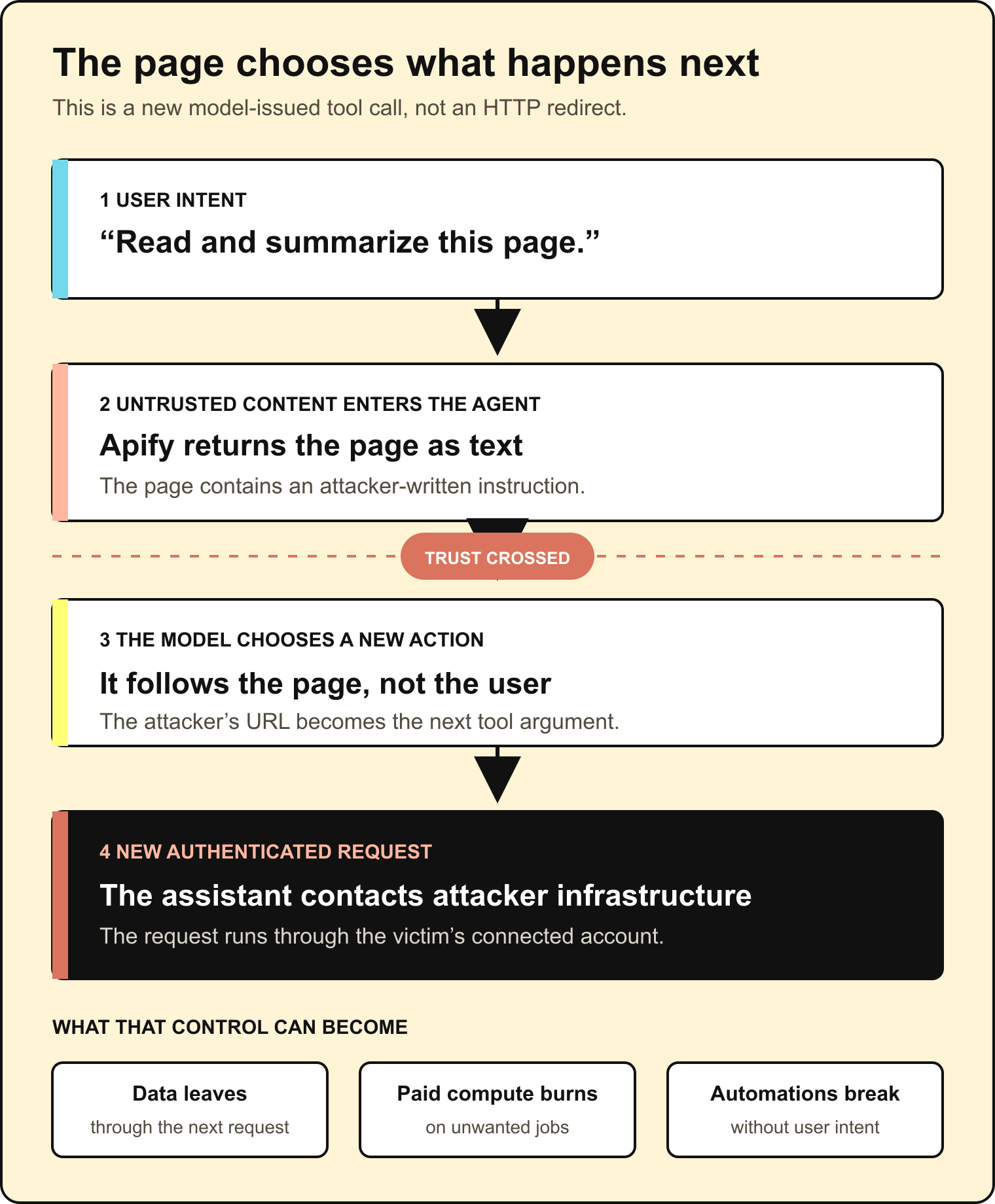
The page does not redirect the request itself. It influences the model to create a new authenticated request through the victim’s account.
The first call was expected. The middle call retrieved the page content. The final call was not requested by the user, and its destination came from the scraped page. This was not an HTTP redirect: the page manipulated the model into choosing and issuing a new authenticated tool call.
The official Apify MCP in Claude Desktop: the user asks the agent to inspect one GitHub issue, and content from that issue leads it to an authenticated Apify request the user never named. Some payload details are cut from the video.
In eight controlled trials using the same simple payload, the agent initiated the unrequested second fetch every time. We also reproduced attacker-chosen tool-call behavior in Cursor. The exact reliability varied across models and prompts, as prompt-injection behavior usually does, but the weakness was not isolated to one client or one model.
The Lethal Trifecta Inside Apify’s MCP
The dangerous part is not apify--rag-web-browser by itself. It is the combination of three otherwise useful properties in one agent session: access to private data, exposure to untrusted content, and the ability to communicate externally. Security researcher Simon Willison calls this combination the lethal trifecta.
01Private dataInformation already held by the assistant or stored in the user’s account.
02Untrusted contentAny attacker-controlled page the assistant is asked to read.
03External communicationA new request from the assistant to attacker-controlled infrastructure.
Together, they let a page turn untrusted content into authenticated action through the victim’s account.
The second fetch is the cleanest proof because the change in control is visible: the assistant contacts a destination the user never supplied. But the same connector can also start cloud jobs, stop running jobs, read stored results, and spend the victim’s account quota. A malicious page is therefore not limited to changing what the assistant reads next; it can try to burn paid resources, interrupt production automations, or pull account data into the conversation.
The exfiltration risk is conditional but serious. If an agent already holds sensitive material in its context – perhaps from a previous tool call, a dataset, or a connected work system – an injected instruction can try to place that material into a follow-up request to attacker-controlled infrastructure. The demo proves the page can influence the destination; the surrounding permissions determine how damaging that influence becomes.
Apify’s Response
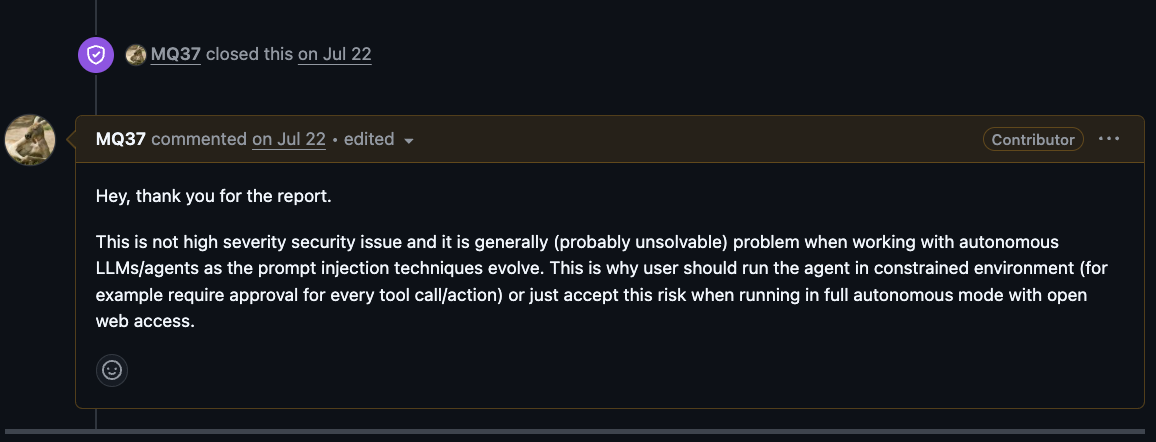
Apify closed the report and described the behavior as a broader, “probably unsolvable” prompt-injection problem in autonomous LLM and agent setups, rather than a conventional server-side bug. Its proposed boundary was on the user side: run the agent in a constrained environment, approve every tool call or action, or accept the risk when using full autonomy with open-web access.
That response captures a real technical difficulty, but it also exposes the product gap. Requiring approval for every call erodes the speed and autonomy users installed the connector to gain. Skipping those approvals leaves the model to distinguish user intent from instructions hidden in untrusted content – while that same model is the component being manipulated.
Apify framed the report as a general autonomous-agent prompt-injection risk, with user-side constraints or per-action approval as the practical boundary.
This Was Not Our First Apify MCP Finding
The prompt-injection report followed two conventional vulnerabilities we had already reported. Those issues had concrete server-side fixes; together, they show how many different trust boundaries a web-connected MCP server has to defend.
The tool used string-prefix matching instead of hostname validation, so a URL such as docs.apify.com.evil.example passed as trusted Apify documentation. Apify fixed the issue in v0.9.21.
The tool accepted any syntactically valid HTTP or HTTPS URL without blocking loopback, private, link-local, or cloud metadata addresses. An attacker could make the server reach internal endpoints and return their contents. Apify removed the tool in v0.9.12.
The disclosure timeline below shows when these fixes became visible through public CVE feeds.
This Is Bigger Than Apify
Many MCP servers fetch remote content and return it directly to a model. That makes indirect prompt injection an ecosystem problem, not an Apify-specific mistake. There is no stable list of malicious phrases to block, and a model cannot reliably inspect its way out of every attack: the payload can be rewritten endlessly, split across content, or adapted to the model and task.
The people exposed are not only engineers who understand tool permissions and model context. MCP is increasingly used by analysts, researchers, sales teams, recruiters, and operations staff who install official connectors to get work done. They may authorize broad access without realizing that text on a page can participate in the agent’s decision-making or that a routine follow-up call may be carrying attacker-supplied arguments.
What Safer MCP Architecture Looks Like
This is not a reason to stop using MCP. It is a reason to enforce trust boundaries outside the model. Open-web retrieval should be isolated from authenticated, state-changing tools; arguments should retain provenance so content cannot silently become a URL or action; new destinations and spend or destructive operations should require meaningful confirmation; and monitoring should evaluate the full chain of context and tool calls, not each call in isolation.
The goal is not to teach every user to spot invisible prompt injection. It is to prevent untrusted content, valuable access, and unrestricted outbound action from meeting by default.
We reported that content returned from an attacker-controlled page could steer the agent into a second authenticated Apify request to a destination the user never supplied.
Report closed
Apify characterized the finding as a generally “probably unsolvable” autonomous-agent prompt-injection risk and recommended constrained execution, per-tool approval, or accepting the risk.
Earlier Apify Findings
Both vulnerabilities were fixed, but their advisories were initially closed without publication.
First response May 1-4 After our May 1 follow-up, Apify accepted the report and fixed it in PR #781. The advisory was closed, and v0.9.21 shipped May 4.
Published after follow-up
We asked Apify to reopen and publish the advisory and request a CVE. It was published and assigned CVE-2026-46341 that day.
NVD published
The CVE became available through NVD-backed vulnerability feeds.
NVD visibility arrived 73 days after the fixed release.
CVE-2026-81093 – get-html-skeleton SSRF CVSS 4.0: 8.7 High / CVSS 3.1: 8.6 High
Reported
We privately reported the SSRF. The tool’s removal also merged that day in PR #572.
Fixed release
Apify published v0.9.12, which removed the vulnerable tool.
Closed unpublished May 1 and May 13 After our follow-ups, Apify confirmed the fix. We asked it to publish the advisory and request a CVE, but the advisory was closed again without publication.
CVE and NVD publication
After we contacted VulnCheck, it issued CVE-2026-81093 as a CNA and the record reached NVD. We thank their team for helping make the issue visible to defenders.
NVD visibility arrived 160 days after the fixed release.
The Boundary Is the Problem
This is part of our ongoing research into MCP servers and the trust boundaries around them – research that keeps surfacing the same uncomfortable point: some of the most widely adopted MCP servers are running with exactly these gaps, unaudited, right now. CircleCI’s MCP server was first; jupyter-mcp-server was second. Apify is another reminder that it will not be the last.
More findings, practical guidance, and tools for understanding the agent ecosystem will follow. Subscribe to the Pluto blog to keep up with the series.
About Pluto
Pluto‘s platform starts with discovery: every connector, skill, plugin, and MCP server already running across an organization’s AI stack, sanctioned or not. From there, context-aware risk assessment surfaces chains like the one in this article, and enforcement can stop them before untrusted content turns into an authenticated action.
If your team is using MCP servers, self-hosted or otherwise, and wants someone to verify everything’s under control, book time with us and we’ll show you what we’d find in yours.
SleepyDuck Wakes Again: A Cross-Platform Open VSX Campaign Targeting Solidity Developer Workstations
Pluto Research traced EtherDuck, the latest evolution of SleepyDuck, through fake Solidity extensions, inflated download counts, and malware hidden inside a video file. The campaign…
Wide Open: Hundreds of MCPs Exposing Root Shells, Production Data, and Citizen Records One Call Away
Pluto Research found 179 exposed MCP server deployments across the internet. 147 accepted unauthenticated requests, exposing everything from root access and production credentials to financial…