Introduction
Artificial intelligence (AI) systems are rapidly becoming foundational infrastructure across many modern enterprise environments. Unlike traditional applications, these systems introduce dynamic execution paths, probabilistic outputs, opaque dependencies, and constantly evolving attack surfaces, which make static security reviews and periodic assessments no longer sufficient for such environments. This article focuses on security visibility and continuous monitoring capabilities that observe not only infrastructure and application behavior but also model interactions, AI-generated outputs, pipeline integrity, and autonomous system actions in real time.
Key Takeaways
- AI systems often introduce dynamic attack surfaces that traditional monitoring platforms were not designed to detect effectively.
- Effective AI monitoring must cover models, prompts, agents, pipelines, APIs, dependencies, and runtime behavior.
- AI-assisted development significantly expands exposure within software supply chains and CI/CD workflows.
- Real-time behavioral analysis is critical for detecting threats such as prompt injection, model abuse, and anomalous AI activity.
- Security teams should integrate telemetry across cloud infrastructure, developer tooling, orchestration platforms, and AI execution environments.
Why Traditional Monitoring Falls Short for AI Systems and Pipelines
Traditional monitoring is often insufficient for effectively managing modern AI systems and pipelines due to the following reasons:
- Differing security architectures: Traditional monitoring architectures were built around deterministic systems such as servers, databases, applications, and authentication events. AI systems, on the other hand, behave fundamentally differently. Outputs are probabilistic, contextual, and adaptive. Two identical prompts may produce different behaviors depending on the retrieval context, embedded memory, fine-tuning variations, and the agent’s decision pathways. This ultimately creates major visibility gaps for conventional security tooling.
- Static detection logic: Legacy monitoring systems typically rely heavily on static processes such as signature matching, known indicators of compromise, and fixed baselines and rule sets. AI environments often invalidate many of these assumptions, as shown in the examples below:
| Traditional Application |
AI-Driven Application |
| Predictable execution flow |
Dynamic execution flow |
| Deterministic outputs |
Probabilistic outputs |
| Static business logic |
Adaptive reasoning |
| Limited external interaction |
Autonomous tool usage |
| Controlled API paths |
Agentic decision-making |
- Contextual understanding: Modern LLM-powered applications are typically designed to be context-aware and can autonomously perform a variety of functions, such as querying external APIs, generating code, invoking plugins, executing tools, and modifying downstream operations. Traditional SIEM rules often lack the contextual awareness needed to distinguish legitimate AI behavior from malicious manipulation. In addition, monitoring AI systems is often insufficient because their intent and reasoning process (aka “chain of thought”) carry important operational and security-related signals. This is where advanced AI security monitoring becomes essential.
What Continuous Monitoring Actually Covers in a Modern AI Environment
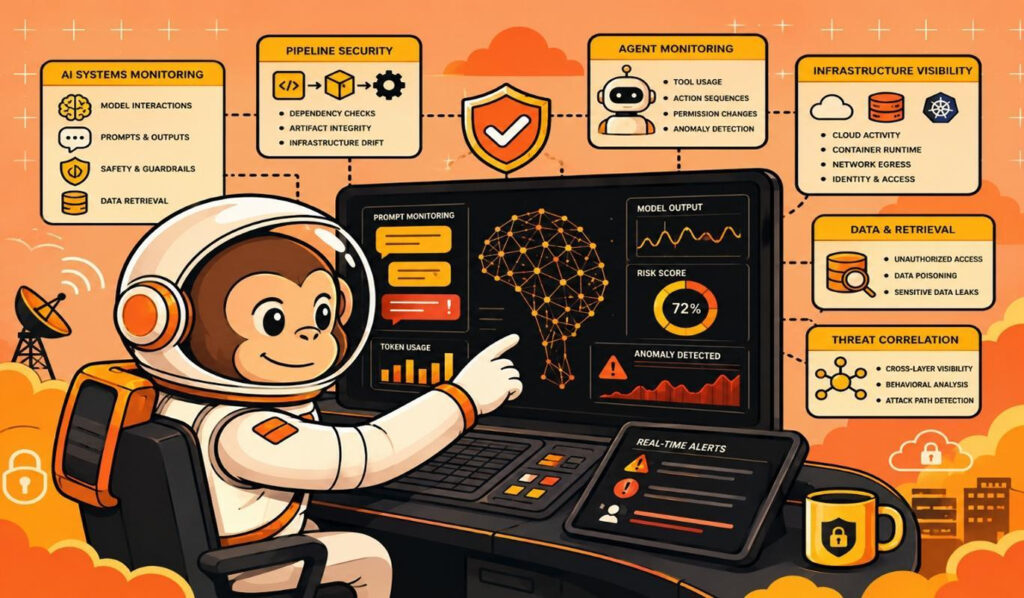
Security leaders often underestimate the breadth of visibility required in AI ecosystems. Monitoring no longer applies only to servers and endpoints. Effective AI security visibility spans multiple interconnected layers.
- Model Interaction Monitoring: Enterprise security teams operating in an AI environment must observe the following on a continual basis:
-
- Prompt inputs
- Model outputs
- Token usage anomalies
- Unsafe response patterns
- Prompt injection attempts
- Jailbreak behaviors
- Sensitive data leakage
AI monitoring systems should also be able to identify suspicious prompt engineering patterns in real time before malicious outputs propagate downstream.
- Pipeline and Build Integrity AI-assisted development significantly increases software supply chain complexity. Therefore, monitoring should include:
-
- Dependency changes
- Generated code anomalies
- Pipeline permission changes
- Artifact integrity validation
- Unauthorized model updates
- Infrastructure drift detection
Modern CI/CD pipeline security strategies increasingly depend on runtime telemetry rather than relying solely on pre-deployment scanning.
- Agentic Workflow Monitoring: Autonomous AI agents often introduce an entirely new risk category. Security teams should therefore monitor the following in agentic workflows:
-
- Tool invocation sequences
- Escalating permission requests
- Cross-system actions
- Lateral movement attempts
- Excessive API chaining
- Unusual decision pathways
Unlike traditional applications, autonomous AI agents may independently initiate actions without direct human intervention, hence the need for effective AI monitoring tools.
- Infrastructure and Runtime Telemetry: Foundational visibility remains critical, including:
-
- Container runtime activity
- Kubernetes behavior
- GPU workload anomalies
- Network egress patterns
- Authentication telemetry
- Cloud API access
- Identity misuse
However, infrastructure telemetry alone is insufficient without context for the activities occurring at the AI layer, so additional AI monitoring tools and mechanisms are needed.
- Data Governance and Retrieval Monitoring Retrieval-Augmented Generation (RAG) systems often create additional exposure. Monitoring should therefore identify the following aspects:
-
- Unauthorized document retrieval
- Sensitive context exposure
- Vector database abuse
- Data poisoning attempts
- Embedding manipulation
Persistent visibility across these layers is what generally transforms monitoring from reactive logging to operational defense and should always be a key priority for security teams.
Where Vulnerabilities Enter Before Deployment
Many enterprises tend to focus heavily on securing production AI systems while underestimating pre-deployment exposure. In reality, some of the highest-risk attack surfaces emerge earlier in the lifecycle.
- AI-Generated Code: AI coding assistants frequently generate insecure authentication logic, hardcoded secrets, and unsafe deserialization routines. This also extends to vulnerable dependencies and sometimes to broken authorization patterns. Because AI-generated code appears syntactically correct, insecure implementations may bypass traditional peer review and security validation processes. Proactive security teams should continuously inspect:
-
- Generated pull requests
- Dependency insertion
- Permission changes
- Infrastructure-as-code modifications
- Secrets exposure
Enterprises evaluating secure development practices should also review this Pluto article for further details: Pluto Security’s analysis of AI application security risks in fast-paced development environments.
- Third-Party AI Dependencies: Modern AI stacks rely heavily on open-source models, Python packages, vector databases, and inference frameworks. This can also extend to plugin ecosystems and model hubs. It is crucial for security teams to note that each dependency introduces additional supply chain exposures, with attackers increasingly targeting:
-
- Model repositories
- Package registries
- AI plugins
- Extension ecosystems
- Prompt templates
- MCP servers and tool integrations
- AI skills and agent capabilities
The growing intersection between AI tooling and software supply chains is explored further in Pluto Security’s article on AI agent supply chain attacks.
- CI/CD Pipeline Weaknesses: AI systems require frequent retraining, continuous deployment, dynamic configuration updates, and automated model promotion. This often creates highly active pipelines with broad automation privileges. Without effective visibility, attackers may carry out a variety of attacks, including:
-
- Inserting malicious artifacts
- Poisoning training data
- Modifying deployment logic
- Replacing approved models
- Manipulating inference configurations
This makes monitoring an enterprise’s CD/CI pipelines just as important as monitoring production systems themselves, and a key aspect that security teams should undertake.
Choosing the Right AI System Monitoring Tools for Your Stack
No single platform currently provides complete visibility across AI environments. Security leaders should instead always evaluate monitoring capabilities across multiple functional categories.
- AI Runtime Visibility Platforms: These platforms focus on:
-
- Prompt inspection
- Output validation
- Behavioral anomaly detection
- Model interaction telemetry
- Agent monitoring
- Key capabilities should include:
-
- Real-time policy enforcement
- Context-aware alerting
- Model risk scoring
- Prompt attack detection
Security leaders and their teams should understand that effective real-time AI monitoring relies heavily on behavioral context rather than on static signatures alone.
- Pipeline Security Platforms: As a minimum, modern pipeline monitoring should include the following:
-
- Artifact attestation
- Dependency integrity checks
- Secret scanning
- Infrastructure drift analysis
- Runtime deployment telemetry
Security leaders should always prioritize solutions that can correlate pipeline events with runtime behavior for more effective results.
- Cloud-Native Monitoring: AI workloads increasingly span multiple resources, including Kubernetes clusters, serverless infrastructure, GPU orchestration layers, and hybrid cloud environments. Best-of-breed AI monitoring tools should be designed to support:
-
- Runtime container analysis
- GPU telemetry
- Identity-aware analytics
- Identity-Centric Monitoring: Identity has become a fundamental component of AI security. Effective AI monitoring should cover the following identity security components:
-
- API token usage
- Service account anomalies
- Privilege escalation
- Federated identity misuse
- Agent impersonation
Many AI systems operate through chained identities across APIs, orchestration platforms, and cloud services. Visibility into these relationships is critical for every security professional.
- Integrated Threat Correlation: The most effective AI monitoring architectures correlate telemetry extensively across the following systems and resources:
-
- Developer activity
- AI model interactions
- CI/CD pipelines
- Cloud infrastructure
- Identity systems
- Runtime environments
This enables security teams to identify multi-stage attack paths that would otherwise appear benign when viewed in isolation. Enterprises evaluating AI system monitoring tools should therefore prioritize platforms capable of contextual correlation rather than isolated logging capabilities.
Frequently Asked Questions (FAQ)
1. How is continuous monitoring different from traditional log management?
Traditional log management primarily focuses on identifying, searching, and storing historical events on an after-the-fact basis. Continuous monitoring, on the other hand, emphasizes real-time visibility, behavioral analysis, and anomaly detection. It prioritizes active risk correlation across an enterprise’s entire infrastructure, pipelines, AI systems, identities, and runtime environments to identify emerging threats before they have a diverse impact on operations.
2. Can real-time AI monitoring detect prompt injection attacks in production?
Yes. Advanced monitoring systems can effectively detect suspicious prompt-injection attacks in production. This encompasses attempts to manipulate context, abnormal tool invocation patterns, and unsafe output generation behaviors. Effective detection typically relies on behavioral analysis, contextual understanding, and runtime policy enforcement. The process does not rely on static signature-based detection models alone.
3. How do AI system monitoring tools handle encrypted or obfuscated model outputs?
This largely depends on the design of each particulate AI system monitoring tool. For instance, most platforms rely on metadata analysis, behavioral telemetry, contextual correlation, and policy validation rather than directly inspecting encrypted content. Some solutions are also designed to perform secure runtime analysis within trusted execution environments to evaluate outputs before external transmission or downstream workflow execution.
4. How often should continuous monitoring policies be reviewed and updated?
Continuous monitoring policies should ideally be reviewed continuously alongside infrastructure, model, pipeline, and application changes. However, this can be less frequent depending on the enterprise. In most modern, rapidly evolving AI environments, less-than-continuous reviews are often insufficient. High-maturity enterprises frequently update monitoring logic dynamically in response to threat intelligence, architectural changes, and newly observed attack behaviors.
Conclusion
With AI systems fundamentally changing enterprise attack surfaces and enterprises accelerating the adoption of LLMs and autonomous agents, visibility gaps are expanding faster than most security programs can adapt to. This has led to static assessments and periodic reviews no longer being sufficient for dynamic AI ecosystems that operate continuously across cloud infrastructure, developer environments, and automated workflows. For CISOs and senior technical leaders, the challenge is whether security operations can evolve quickly enough to maintain visibility across systems that increasingly think, act, and adapt autonomously, hence the need for continuous AI monitoring systems.
Useful References
- Mobb. (2025). The hidden security crisis in AI-generated apps: 40% are leaking sensitive data.
https://www.mobb.ai/blog/the-hidden-security-crisis-in-ai-generated-apps
- OX Security. (2025). CI/CD pipeline security best practices to protect the software supply chain.
https://www.ox.security/blog/ci-cd-pipeline-security/
- Pluto Security. (2025). AI application security: Managing risks of rapid development.
https://pluto.security/blog/ai-application-security-risk-fast-development/
- Pluto Security. (2025). Software supply chain attack: AI agent ecosystem as battleground.
https://pluto.security/blog/ai-agent-supply-chain-attacks/
- ReversingLabs. (2025). MCP server credential weaknesses and AI security risks.
https://www.reversinglabs.com/blog/mcp-server-credential-weakness