
Endpoint Visibility in the Agentic Era: What Your EDR Isn’t Logging

Eitan Chassid
Aug 17, 2026・
6 min read
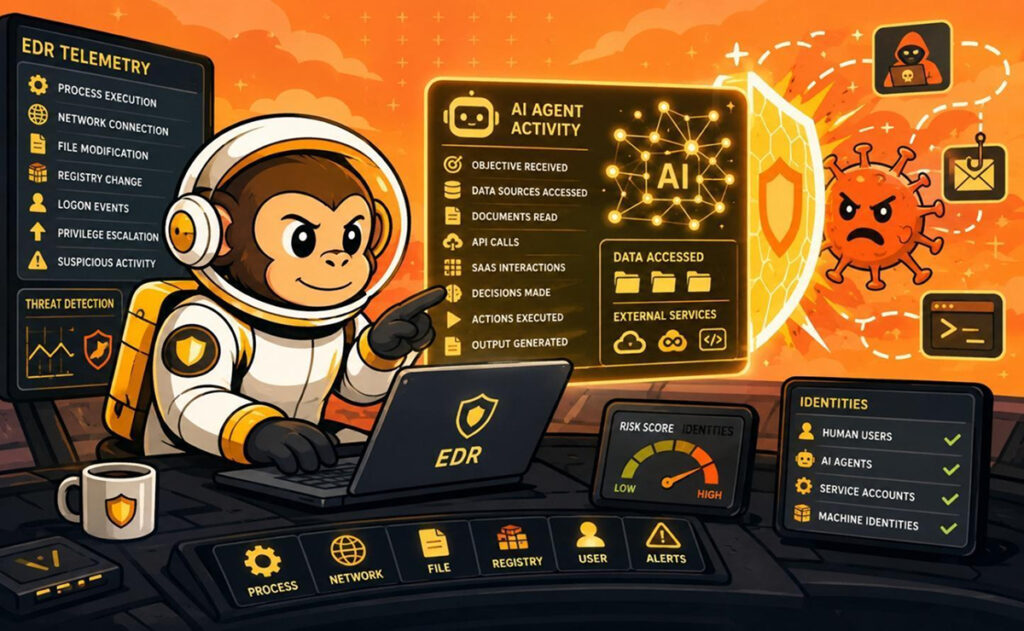
The rise of autonomous AI agents capable of performing complex tasks and making decisions without continuous human interaction introduces an entirely new category of endpoint activity. While traditional Endpoint Detection and Response (EDR) platforms remain essential for detecting conventional attacks, they were not designed to understand or monitor autonomous AI behavior. As organizations accelerate AI adoption, security leaders face a growing challenge in securing actions that are technically legitimate yet operationally invisible. This article explores endpoint visibility as a strategic capability rather than simply an operational security function.
Traditionally, endpoint visibility referred to an organization’s ability to monitor, inventory, and understand activity across its endpoint environment. This included laptops, servers, virtual desktops, and mobile devices. Accordingly, traditional endpoint visibility focused on monitoring activities such as:
For more than a decade, these capabilities have consistently powered and formed the foundation of Security Operations Center (SOC) operations. The assumption behind most endpoint security products in the past was relatively simple: a human user acts, malware attempts to compromise an endpoint, and an EDR records the evidence for SOC operatives to act upon. However, that assumption no longer holds due to recent developments in AI. Instead, endpoints increasingly host AI assistants capable of independently performing a variety of functions, including:
The major challenge facing security leaders and their teams is that the above activities often occur without generating the telemetry that traditional EDR products were designed to collect. This lack of telemetry increases the likelihood of successful attacks.
Modern EDR platforms excel at detecting indicators of compromise across enterprise environments. They are highly effective at identifying security issues, including:
The primary limitation of this detection model is that many AI-initiated activities fall outside the telemetry traditionally collected by EDR solutions. As a result, many enterprises face growing security visibility gaps because AI agents frequently operate entirely within legitimate application contexts and approved business workflows. Attackers can exploit these gaps because legitimate AI activity is largely unmonitored. For example, an autonomous AI assistant may:
None of the above activities necessarily appear malicious to operating systems and traditional endpoint monitoring tools. Instead, they closely resemble normal application usage and work patterns in a secure environment, using trusted applications. This creates significant EDR visibility gaps, leaving business-critical activity largely invisible to traditional endpoint security tools. Adversaries can therefore exploit these blind spots while operating within approved workflows. This does not mean that current EDR platforms are ineffective. Rather, the enterprise computing model has rapidly evolved beyond what EDR solutions were originally designed to observe, and they are struggling to keep up.
For instance, unlike generative AI chat interfaces that simply respond to user prompts, agentic AI systems perform multi-step tasks with progressively greater autonomy. An AI agent, acting autonomously, can:
This creates a new category of identity: a machine identity that operates alongside human identities in the same workplace. From a governance and security perspective, every autonomous action an AI agent takes raises the following critical questions:
The bottom line is that traditional endpoint telemetry rarely provides security practitioners with the context needed to answer these questions. Consequently, enterprises require new approaches to AI agent monitoring that go beyond existing operating system events to keep attackers at bay.
The inability to comprehensively monitor AI-driven endpoint activity poses several strategic risks for many enterprises. These include:
Without this level of context visibility, security teams increasingly face incomplete evidence. This unnecessarily extends investigation times and reduces stakeholder confidence in forensic conclusions.
Security leaders and their teams should begin redefining endpoint visibility as a strategic business intelligence capability rather than solely an endpoint telemetry function to achieve effective results. Modern endpoint visibility and control must extend beyond processes and devices to include AI-driven interactions, in line with current developments. Key capabilities include:
Such context transforms raw telemetry into actionable intelligence, which is crucial for enforcing policy and making risk-informed security decisions.
Endpoint visibility is the ability to continuously monitor an organization’s entire infrastructure, including devices, users, applications, and system activity. The objective is to understand what is happening across enterprise endpoints. As AI-driven workloads become increasingly common, comprehensive endpoint visibility enables an enterprise to achieve faster threat detection, stronger incident response, regulatory compliance, and informed security decision-making.
Many AI agent actions fall outside traditional EDR logging processes. These include prompt execution, application-level decision-making, and SaaS interactions. It is also difficult to log API orchestration and autonomous workflow execution that occur within legitimate software processes. Because traditional EDR primarily monitors operating system events, these activities may not be fully recorded or correlated, as they involve business-context activities.
Organizations should combine traditional EDR solutions with identity-centric monitoring, application telemetry, and AI activity logging. Browser visibility, governance controls, and continuous auditing of AI permissions and actions should also be incorporated. This layered defense approach improves threat detection and supports security investigations. It also helps ensure AI operates within an enterprise’s approved security and compliance boundaries.
Many enterprise endpoints are no longer operated exclusively by humans, as autonomous software agents increasingly perform tasks across business environments. This evolution fundamentally changes what visibility means, and security leaders continue to rely solely on operating system telemetry, risking the oversight of a growing share of enterprise activity.
Future-ready organizations will therefore complement EDR with identity-aware monitoring, application telemetry, AI governance, and comprehensive logging of autonomous agent behavior to achieve effective outcomes.
Useful References